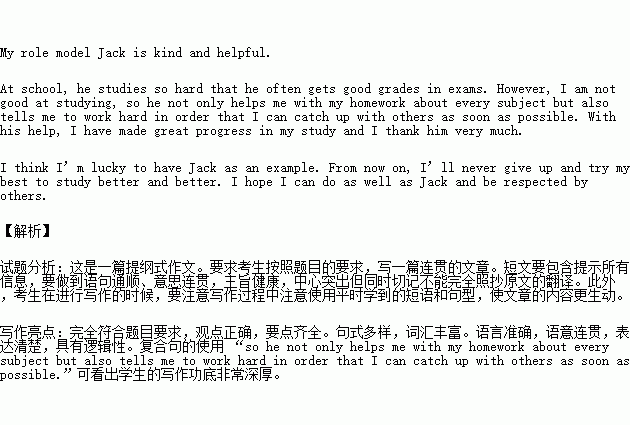
文段表达
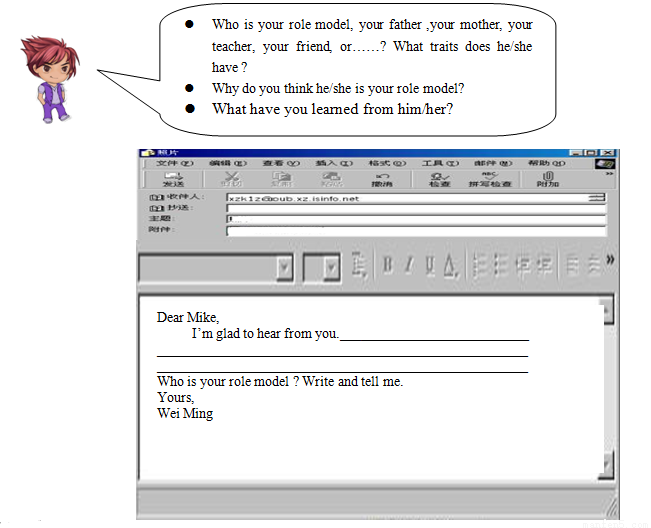
根据中文和英文提示,用英文写一封意思连贯、符合逻辑、不少于50词的邮件。邮件的开头和结尾已给出,不计入总词数。 所给提示词语仅供选用。请不要写出你的校名和姓名。
66.假如你叫魏明,你的美国笔友Mike通过邮件,想知道在生活中谁是你的榜样?请你向Mike介绍:你的榜样是谁?你的家人朋友、老师或同学…….他/她的性格如何?为什么你认为他(她)是你的榜样,你从他/她身上学到了什么?
提示词语:role model, kind, helpful, help, work hard, hope
科目:初中英语 来源:2015-2016学年江苏淮泗片教育联盟八年级下学期一次月考英语试卷(解析版) 题型:单项填空
---What age did you leave home?
--- I left home at 18,Neil.I _____your city for five years.
A. have gone to B. have been
C. have been in D. have come to
查看答案和解析>>
科目:初中英语 来源:2015-2016学年江苏建湖县近湖中学八年级下学期开学考试英语试卷(解析版) 题型:单项填空
If we do nothing, soon there __________ be none left.
A.must B.can C.should D.may
查看答案和解析>>
科目:初中英语 来源:2016届北大附中河南分校九年级3月月考英语试卷(解析版) 题型:单项填空
---What do you think of receiving and giving gifts?
--- I think the art of receiving a gift is ______ than the art of giving.
A. much more difficult
B. very more difficult
C. much difficult
D. as difficult as
查看答案和解析>>
科目:初中英语 来源:2016届北大附中河南分校九年级3月月考英语试卷(解析版) 题型:单项填空
To protect trees, we shouldn’t use paper towels ______napkins.
A. or B. and C. but D. with
查看答案和解析>>
科目:初中英语 来源:2016届北京市怀柔区九年级上学期期末考试英语试卷 (解析版) 题型:阅读理解
Liang Huili is the leader of Huana International Volunteer Service Group,with hundreds of students, young professionals and business leaders. They held a basketball match to help 150 poor students in western China with school supplies(用品) and winter clothes. She also worked with an organization in the US to raise money for children with heart disease.
Born in Guangdong Province in 1942, Liang moved with her family to Taiwan at the age of seven. Liang taught at a primary school for seven years until her boyfriend went to America in 1969, one year after they got married.
“We didn’t have much money,” she says, “ so I started babysitting for other Chinese families and taking care of my own daughter at the same time.” She also taught children Chinese at Chinese schools. What’s more, she would help newly arrived Chinese families find apartments and work, and sometimes lend them money.
“I remember those students from China who first came in 1986. They didn’t have much money, and idea of what to do,” Liang told us. “ I then asked people in my neighborhood and my Chinese friends for donations(捐赠)-not only some money but also small electronic appliances needed for daily living.”
One of her experiences in Dayton, Ohio made her want to make volunteering a vocation(职业). She remembers how she once collected(接走) two Chinese professors who had missed their flight and had no one there to pick them up. A friend told Liang about it, and she went to meet them herself around midnight. She found the men feeling lost in that strange country, where no one spoke their language. They didn’t want to go to an American hotel, and didn’t know how they would get to Columbus the next day. “ So I talk to them and took them home with me,” she says, “ and today, I am still in touch with those two professors. We are good friends.”
1.Liang helped poor students in western China by______.
A. holding a basketball match
B. working with an American organization
C. asking her Chinese friends for donations
D. taking the poor students to her home
2.Liang moved with her family to Taiwan when she was_____ years old.
A. six B. seven C. eight D. nine
3.Her experience of_______ made her decided to make volunteering her vocation.
A. moving from place to place
B. helping students in 1986
C. being a primary school teacher
D. helping the two professors in Dayton
4.What can we learn about Liang from the passage? ______
A. She didn’t have to worry about money.
B. She likes helping others when they are in trouble.
C. Many Chinese families lent her money.
D. She asked people to take care of her daughter.
查看答案和解析>>
科目:初中英语 来源:2016届北京市怀柔区九年级上学期期末考试英语试卷 (解析版) 题型:单项填空
— Class begins now. Stop ________, please!
—OK.
A. talk B. talking C. to talk D. talked
查看答案和解析>>
科目:初中英语 来源:2015-2016学年江苏盐城盐都区西片八年级下学期一次月考英语卷(解析版) 题型:单项填空
When they walked along the river,they suddenly heard somebody ________ for help.
A. called B. call C. to call D. calling
查看答案和解析>>
科目:初中英语 来源:2015-2016学年北大附中学河南分校八年级3月月考英语卷(解析版) 题型:单项填空
Her son _____ Coke, but now he _____ milk.
A. used to drink; is used to drinking
B. used to drinking ; drinks
C. is used to drinking; used to drink
D. is used to drink; is drinking
查看答案和解析>>
湖北省互联网违法和不良信息举报平台 | 网上有害信息举报专区 | 电信诈骗举报专区 | 涉历史虚无主义有害信息举报专区 | 涉企侵权举报专区
违法和不良信息举报电话:027-86699610 举报邮箱:58377363@163.com