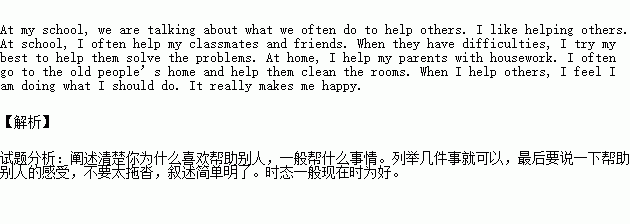
假如你是李华,你们学校正就“帮助别人,快乐自己”这一话题开展大讨论。请你用英语写一篇短文给某英文网站投稿,谈谈你是否喜欢帮助别人, 你常常帮助别人做什么事情,以及你这样做的感受。
提示词语:like, classmates, friends, parents, solve problems, housework, happy
提示问题: ● Do you like helping others?
● What do you often do to help others?
● How do you feel?
At my school, we are talking about what we often do to help others. ___________
_______________________________________________________________________________
_______________________________________________________________________________
_______________________________________________________________________________
_______________________________________________________________________________
_______________________________________________________________________________
_______________________________________________________________________________
_______________________________________________________________________________
科目:初中英语 来源:2015-2016学年江苏邗江区七年级下期中考试英语试卷(解析版) 题型:单项填空
Some social workers_____ different skills often meet at the centre.
A. with B. has C. have D. are
查看答案和解析>>
科目:初中英语 来源:2015-2016学年八年级上册单元课时训练英语试卷(1)(解析版) 题型:单项填空
The students in this school are made school uniforms on Monday.
A. to wear B. wearing C. wear D. worn
查看答案和解析>>
科目:初中英语 来源:2016届北京市西城区初三一模英语试卷(解析版) 题型:阅读理解
阅读理解.
Drinking tea is an important part of Chinese culture. It is seen as the national drink in China. The most common types of Chinese tea are as follows.

Green Tea is the oldest and most popular. It has a pale color and a sharp flavor (口味). It is produced mainly in Anhui and Zhejiang. The most popular is Longjing Tea, which is produced near West Lake, Hangzhou.
Red Tea (Black Tea) is the second most popular type of Chinese tea. It can help treat stomachaches. Dianhong and Yixing are popular sorts of red tea.
Wulong Tea, also known as blue tea, has the advantages of green and red teas. It has a gentle flavor and can help people lose weight. Tie Kuanyin Tea in Anhui and Dongding Wulong Tea in Taiwan are two well-known types of it.
Scented Tea (花茶) is created by mixing tea leaves with fiowers. It is known by its strong fragrance(芳香) , and it can help people feel comfortable after drinking. Iasmine (荣莉) tea is the most popular of this kind.
Tips of Tea Drinking
Do you know how to drink tea in a right way? Here are some tips:
Drink it hot.
Don’t drink too much strong tea.
The best time to drink tea is between meals.
Drink tea a couple of hours after taking medicine.
Green tea is the best choice for office workers.
1.___________is the oldest and most popular tea in China.
A.Wulong Tea B.Scented Tea
C.Red Tea D.Green Tea
2.Red Tea can__________.
A.help people lose weight
B.help people feel lucky
C.help treat stomachaches
D.help people sleep well
3.Dongding Wulong Tea is produced in
A.Taiwan B.Yixing
C.Anhui D.Hangzhou
4.The right way to drink tea is___________.
A.to drink it cold
B.to drink between meals
C.to drink much strong tea
D.to drink with medicine
查看答案和解析>>
科目:初中英语 来源:2016届北京市西城区初三一模英语试卷(解析版) 题型:单项填空
— Do you know Mr. Smith?— Yes. I ___________ him since 2008.
A.know B.knew
C.have known D.will know
查看答案和解析>>
科目:初中英语 来源:2016届北京市通州区初三一模英语试卷(解析版) 题型:阅读理解
阅读下列短文,根据短文内容,从短文后各题所给的A、B、C、D四个选项中,选择最佳选项。
Have you ever walked down a city street and suddenly seen a bright garden full of vegetables and flowers?
It may be a community garden. The community gardens are planted by the people in the community. They are not just pretty places. They improve the neighbourhoods.
People first started planting these gardens during the 1970s. At that time, the price of vegetables and fruits was rising. In many city neighbourhoods, crime(犯罪) was increasing. There were also many other problems. People decided to get together to plant gardens to fight against these problems. The gardeners thought they might make the area more beautiful and improve people’s life.
These gardeners were right! Community gardens have many benefits. They improve their neighbourhoods. They also make people feel they belong to the community. When people work together in a garden, they feel they are connected with each other. People work on a small area within the garden. They grow vegetables or fruits. Each person decides what he or she is going to grow. However, they also work together to help each other. Some members have gardening experience. They can help those who are just learning how to grow vegetables and fruits.
Sometimes, garden members pay for supplies. The supplies usually include small plants and tools. Many community gardens have sponsors(赞助者). They pay for the supplies for the gardens. It helps to keep the gardens going every year. Sponsors may be parks, schools and local companies. Some groups want to be a part of the community. They help clean up and beautify a neighbourhood. They also pay for the supplies.
Community gardens give people a chance to work together. They can make the community stable(安定的). There are many programs of community gardens. Some gardens provide programs for children and elder people. They may provide classes. They may give the vegetables and fruits to poor people. Community gardens also improve air.
Today there are about 10,000 community gardens in cities in the US. They have become popular because of their benefits. People enjoy having vegetables and flowers in their neighbourhoods.
【小题】1.Who plant the community gardens?
A.Gardeners of the companies.
B.People in the community.
C.Sponsors in the community.
D.People from the government.
【小题】People started to plant community gardens because _______.
A.it was a good way to learn gardening
B.they liked fresh vegetables and flowers
C.it helped them get more experience
D.they wanted to solve the problems
【小题】What do sponsors do for community gardens?
A.They pay for the supplies.
B.They clean community gardens.
C. They provide classes.
D.They give poor people vegetables.
【小题】What is the passage mainly about?
A.The relationship of neighbours.
B.The future of community gardens.
C.The introduction of community gardens.
D.The experiments in community gardens.
查看答案和解析>>
科目:初中英语 来源:2016届北京市通州区初三一模英语试卷(解析版) 题型:单项填空
—What are they doing?
—They a movie now.
A.watch B.watched
C.are watching D.will watch
查看答案和解析>>
科目:初中英语 来源:2016届北京市顺义区初三一模英语试卷(解析版) 题型:单项填空
— Is Jim in the classroom?
— No, he _______ to the dining hall.
A.goes B.will go
C.has gone D.went
查看答案和解析>>
科目:初中英语 来源:2014-2015学年北京市石景山区中考一模英语试卷(解析版) 题型:单项填空
It was dark, ______ I couldn’t see what was happening.
A.orB.thoughC.butD.so
查看答案和解析>>
湖北省互联网违法和不良信息举报平台 | 网上有害信息举报专区 | 电信诈骗举报专区 | 涉历史虚无主义有害信息举报专区 | 涉企侵权举报专区
违法和不良信息举报电话:027-86699610 举报邮箱:58377363@163.com