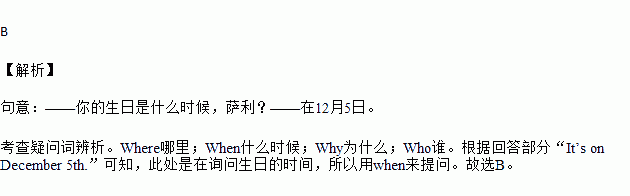
—________ is your birthday, Sally?
—It’s on December 5th.
A.Where B.When C.Why D.Who
科目:初中英语 来源:天津市和平区2018-2019学年七年级下学期期末英语试卷 题型:完成句子
根据汉语意思和中文提示,完成下列各句。每空一词。
1.上周我去了三次体育馆。
I went to the sports hall ________ ________ last week.
2.别打扰他,他正在度假。
Don’t bother him. He is ________ ________.
3.迈克,你觉得这架钢琴怎么样?
Mike, what do you ________ ________ this piano?
4.儿童节是我最喜欢的节日。
________ ________ is my favourite festival.
5.凯文什么也没说,他只是点点头。
Kevin didn’t say anything. He only ________ his ________.
查看答案和解析>>
科目:初中英语 来源:天津市河北区2019-2020学年九年级上学期期中英语试卷 题型:单选题
The students about the journey to the Grand Canyon when the teacher came into the classroom.
A.are talking B.have talked C.will talk D.were talking
查看答案和解析>>
科目:初中英语 来源:重庆市江津区2019-2020学年七年级上学期期末英语试卷 题型:补全对话7选5
阅读下面对话,从方框内7个选项中选择5个恰当的句子完成此对话,并把答题卡上对应题目的答案标号涂黑。
A. What about this one?
B. How much is it?
C. What colour do you want?
D. Can I help you?
E. You are welcome.
F. Oh, I like this one.
G. What size do you want?
A: 1.
B: Yes, please. I want a hat for my son.
A: For your son? 2.
B: I like the blue one.
A: 3.
B: It looks nice. 4.
A: Fifty yuan.
B: OK. I’ll take it. Thank you.
A: 5.
查看答案和解析>>
科目:初中英语 来源:重庆市江津区2019-2020学年七年级上学期期末英语试卷 题型:单选题
—What’s her name?
—________ .
A.I’m Kate B.No, I’m not C.She is my friend D.Linda
查看答案和解析>>
科目:初中英语 来源:重庆市江津区2019-2020学年七年级上学期期末英语试卷 题型:单选题
__________comes before October and it’s the __________ month of the year.
A.September, ninth B.September, nineth
C.November, eleventh D.November, eleven
查看答案和解析>>
科目:初中英语 来源:北京市海淀区2019-2020学年九年级上学期期末英语试卷 题型:阅读单选
Our brains believe information automatically(自动地)-even if it's false-because we can learn efficiently this way. "We're learning false information not because we're poor learners or not working hard, " says David Rapp, a psychology and education professor at Northwestern University. "In many cases, it's a useful skill for us to accept what people tell us, because often what people tell us is true."
When we hear new information, those fresh facts don't cover what we knew before. We'll draw on old or new information when the situation comes up. ___________ . Short-term memories are easier for our brains to access than facts we heard longer ago, because they're fresher in our minds-even if they're wrong. Since we have to think back further to remember old information, we will often ignore it in favour of new inaccurate(不准确的)information. New information is what we're currently thinking about or has been recently presented to us, while the old one isn't as readily available.
We also buy into the facts that seem more reasonable. Often, this means they fit better with what we want to believe, which can explain why people quote different facts in political debates. Both candidates said something that was objectively true or not, but people would go with what they hope to be true.
Things get even trickier when truth and falsehood coexist in the information. For instance, our brains aren't sure whether to believe the descriptions of London in Harry Potter. "Don't look for that train station to Hogwarts, but there might be streets mentioned that are real, " says Dr. Rapp. In fact, our brains can keep track of what's true or false by mentally tagging(标记)facts as either true or false, but sorting all that information takes time. In many cases, we are unlikely to think critically to get information, especially when we are reading for pleasure.
However, it's worth putting in the extra effort to have a second thought about the information that seems doubtful. "With the ease that we can look things up on the Internet, " says Dr. Rapp, "there's no reason not to." "Seek out reliable sources, " he adds.
1.The missing sentence in Paragraph 2 might be "___________ ".
A.We always find the information updating fast nowadays
B.Oftentimes, we use the information we heard most recently
C.From time to time, we fail to remember unimportant things
D.We hardly see old information that is different from the truth
2.The underlined phrase "buy into" in Paragraph 3 can be replaced by ___________ .
A.believe in B.learn from C.come up with D.care about
3.Why does the writer mention Harry Potter in Paragraph 4?
A.To prove people are unable to think critically when reading.
B.To show the information we get can be a mix of true and false.
C.To warn readers of the negative influence, of false information.
D.To explain how individual facts are mentally tagged as true or false.
4.What can we learn from the passage?
A.Our brains can do very little with false information.
B.Short-term memories can cover long-term memories.
C.Dr. Rapp calls on people not to depend on the Internet.
D.People need to double-check the information they question.
查看答案和解析>>
科目:初中英语 来源:2019年山东省德州市齐河县中考一模英语试卷 题型:话题作文
为增强安全意识,学校英语俱乐部将开展“如何提升自我保护能力”的讨论。请以“How to protect ourselves”为题,写一篇英语短文,内容必须包括以下要点:
1. 尊重他人,与同学友好相处;
2. 公共场所,举止文明,不追逐打闹;
3. 不乱交网友,不泄露个人信息;
4. ……(自助发挥,至少两点)
注意事项:
1.语言通顺,要点齐全,意思连贯,条理清楚,书写规范;
2.文中不得出现真实的地名、校名、人名等信息;
3.词数80-100,标题与结尾已给出,不计入总词数;
How to protect ourselves
____________________________________________________________________________________________________________________________________________________________________________________________________________________________________________
Danger is never as far away as we think. Take good care of ourselves at all times!
查看答案和解析>>
科目:初中英语 来源:黑龙江省哈尔滨市2019-2020学年六年级(五四制)上学期九月月考英语试卷 题型:单选题
Is this your father?—Yes _______ is.
A.she B.this C.it
查看答案和解析>>
湖北省互联网违法和不良信息举报平台 | 网上有害信息举报专区 | 电信诈骗举报专区 | 涉历史虚无主义有害信息举报专区 | 涉企侵权举报专区
违法和不良信息举报电话:027-86699610 举报邮箱:58377363@163.com