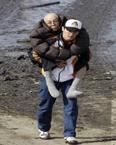
---Was Ling ling born in Xuzhou?
---______.She was born in Qingdao.
科目:初中英语 来源:2011届河北省廊坊市安次区初中毕业生升学文化课第一次模拟考试英语试卷 题型:阅读理解
Tokyo, March 11, 2011
|
| A.闹钟 | B.警报 | C.短信 | D.铃声 |
| A.2 | B.3 | C.4 | D.5 |
| A.Lin Jia has never met with an earthquake in Japan. |
| B.There have been five earthquakes in Japan since 1900. |
| C.The earthquake is the most powerful on record ever to hit Japan. |
| D.The local government warned people of the coming earthquake in some ways. |
| A.Keep away from the nuclear power plants. |
| B.Running out of the building. |
| C.Keep calm and organized. |
| D.Get the cell phone alerts |
| A.a newspaper | B.an advertisement | C.a diary | D.a novel |
查看答案和解析>>
科目:初中英语 来源:2010-2011学年江苏省泰州市海陵区初三中考适应性训练英语试卷 题型:阅读理解
Tokyo, March 11, 2011
|
Could it have been worse?
More than a minute before the earth under their feet began to shake, many millions of Japanese people got cell phone alerts; TV networks interrupted (打断,中断) their broadcasts and turned to the latest announcement of Japanese government; loud speakers started suddenly to warn people of the coming tsunami; bullet trains came to a stop. The earthquake on March 11 was the first test of the nation’s earthquake early-warning technology (地震预警技术). However, in the fight of Man vs Nature, Nature won again. Hundreds, if not thousands of people, lost their lives in Japan. Scientists believe it is the fifth-strongest quake in the world since 1900 and the most powerful on record ever to hit Japan.
Lin tells of calm survivors
When the office began to shake, his friends were calm and still working. But the shaking became stronger. People shouted at him: “Run out of the building, now!” This was Lin Jia’s first experience of an earthquake. Lin, 26, has been in Japan for three months, working as a software engineer in Shinagawa, Tokyo. Lin stayed with others in a bus station all afternoon. Buildings were shaken by a series(系列) of aftershocks. He was nervous, but the people around him were so calm and organized that he gradually (逐渐) calmed down.
1. What does the underlined word “alert” mean?
A. 闹钟 B. 警报 C. 短信 D. 铃声
2. How many ways of earthquake early-warning are mentioned in the passage?
A. 2 B. 3 C. 4 D. 5
3. Which of the following is NOT true?
A. Lin Jia has never met with an earthquake in Japan.
B. There have been five earthquakes in Japan since 1900.
C. The earthquake is the most powerful on record ever to hit Japan.
D. The local government warned people of the coming earthquake in some ways.
4. What is the most important after an earthquake according to the article?
A. Keep away from the nuclear power plants.
B. Running out of the building.
C. Keep calm and organized.
D. Get the cell phone alerts
5. Where does this article probably come from?
A. a newspaper B. an advertisement C. a diary D. a novel
查看答案和解析>>
科目:初中英语 来源: 题型:阅读理解
阅读下文并回答问题。
In 2005, Chen Yixun first sang the song Exaggerated (《浮夸》). But this song had new lyrics(歌词) in 2010 by Terry Lin Zhixuan, a 47-year-old Taiwanese singer. He is famous for his nice voice. In 1996 he was invited to London and became the first Chinese to work together with the famous international band(乐队)there. Terry Lin’s Exaggerated was in his album(专辑)One Take, which is a live album made in Taiwan.
Exaggerated became famous again when Terry Lin sang it again in the popular Hunan TV show I’m a Singer. Lin Zhixuan was No.1 in the fifth week and No. 2 in the seventh week. He said he would sing Exaggerated if he could stay until the final competition of the first season show.
66. Was Lin Zhixuan the first person to sing Exaggerated?
_________________________________________________________
67. What is Lin Zhixuan famous for?
_________________________________________________________
68. When did Exaggerated become famous again?
_________________________________________________________
查看答案和解析>>
科目:初中英语 来源:福建省期末题 题型:阅读理解
| 任务型阅读,根据对话内容完成表格。 | ||||||||||
| W: Hi, Li Min. You don't look well today. M: Yes, I have a headache. I went to bed very late last night. W: Staying up is bad for your health. When did you go to bed last night? M: I didn't go to bed until twelve o'clock. W: What were you doing then? M: I was repairing my computer. W: Is that OK now? M: No, it still doesn't work now. Can you help me, Kate? W: I'm sorry. I know nothing about computer. You'd better ask Peter for help. I'm sure he can help you repair it. M: Oh! That's a good idea. Let's go. | ||||||||||
|
查看答案和解析>>
科目:初中英语 来源: 题型:阅读理解
|
| A.闹钟 | B.警报 | C.短信 | D.铃声 |
| A.2 | B.3 | C.4 | D.5 |
| A.Lin Jia has never met with an earthquake in Japan. |
| B.There have been five earthquakes in Japan since 1900. |
| C.The earthquake is the most powerful on record ever to hit Japan. |
| D.The local government warned people of the coming earthquake in some ways. |
| A.Keep away from the nuclear power plants. |
| B.Running out of the building. |
| C.Keep calm and organized. |
| D.Get the cell phone alerts |
| A.a newspaper | B.an advertisement | C.a diary | D.a novel |
查看答案和解析>>
湖北省互联网违法和不良信息举报平台 | 网上有害信息举报专区 | 电信诈骗举报专区 | 涉历史虚无主义有害信息举报专区 | 涉企侵权举报专区
违法和不良信息举报电话:027-86699610 举报邮箱:58377363@163.com