—Do you often play soccer with your friends?
—No,I don’t like sports. I often play piano in my free time.
A. a; the B. /; the C. the; a D. the; /
B 【解析】 句意:-你经常和你的朋友们一起踢足球吗?-不,我不喜欢运动。在空闲时间我经常弹钢琴。a是不定冠词,修饰可数名词单数,表示泛指一个…;the是定冠词,修饰名词表示特指“这个;那个”。第一个空后soccer是足球,在球类运动的前面不需要加冠词;第二个空后的piano是钢琴,在乐器的前面必须加定冠词the。故应选B。 举一反三单元同步过关卷系列答案
科目:初中英语 来源:外研版八年级英语下期末复习常考题专项练习 题型:多任务混合问题
Anne is a newspaper 1. (report). She chose this job so she could travel2. (介词) the world. The work has3. (teach) her many unforgettable lessons. She has 4. (see) wars, earthquakes and death. But she has also seen courage, hope and 5. (happy). Last year, she 6. (win) an award for her reporting in 7. (African). She was very proud 8. (介词) it. At first, she thought she got the award because of her good 9. (work). But then she realized that she should thank many other people for 10. (they) help.
1.reporter 2.around 3.taught 4.seen 5.happiness 6.won 7.Africa 8.of 9.work 10.their 【解析】本篇文章难度适中,主要讲述安妮的人生经历,她从事记者这一行业收获很多,但她也知道要感激很多人。 1.句意“安妮是一个新闻记者”。根据结构可知,空处应填名词,r...查看答案和解析>>
科目:初中英语 来源:2018年上海中考英语试卷 题型:单选题
-Must I do the project on my own?
-No, you____.You can work with your classmates.
A. needn’t B. can’t C. shouldn’t D. mustn’t
A 【解析】句意:——我必须自己做这个项目吗?——不,你不需要。你可以和你的同学一起工作。A. needn’t不必;B. can’t 不能;C. shouldn’t不应该;D. mustn’t禁止,千万别。以must开头的一般疑问句,以must开头的疑问句,肯定回答用must,而否定回答则用needn’t或don’t have to,意为“不需要、不必”,而不能用mustn’t,故选A。查看答案和解析>>
科目:初中英语 来源:2017-2018年山西省晋中市灵石县二中八年级上册期末测试卷 题型:单选题
— ? —I like action movies.
A. Do you like movies? B. Do you like action movies?
C. What kind of movies do you like? D. Where do you want to go?
C 【解析】试题句意:你喜欢什么样的电影?我喜欢动作片。根据答语I like action movies.可知问句应为What kind of movies do you like?故选C。查看答案和解析>>
科目:初中英语 来源:2017-2018年山西省晋中市灵石县二中八年级上册期末测试卷 题型:单选题
— do you surf the internet?
—Three or four times a week.
A. How many B. How often
C. How long D. How far
B 【解析】 句意:-你多久上一次网?-一周三次或四次。How many多少,提问数量,修饰可数名词复数;How often多久一次,提问频率;How long多长时间,对一段时间提问;How far多远,提问距离。根据对话的意思和下面的回答Three or four times a week可知,这里问的是频率,故应选B。查看答案和解析>>
科目:初中英语 来源:仁爱七年级下册英语Unit5单元测试英语 题型:句型转换
句型转换
1.I like English best, how about you?(同义句转换)
I like English best, ______ ______ you?
2.Kangkang often rides a bike to school. (同义句转换)
Kangkang often _________ _________ ________ ________ ________ .
3.I always get up very early, at around six thirty. (同义句转换)
I always get up very early, at _________ ________ ________six.
4.Jane sometimes goes to school on foot. (同义句转换)
Jane sometimes ________ ________ school.
5.Jane sometimes goes to school by bus.(一般疑问句)
_______ Jane sometimes _________ to school by bus?
6.she, plays, often, guitar , Sundays, on, the(连词成句)_____________________________
1. what about 2. goes to school by bike 3. about half past 4. walks to 5. Does go 6. She always plays the piano on Sunday. 【解析】 1.句意:我最喜欢英语,你呢?原句中how about you是反问对方的情况,同义词是what ab...查看答案和解析>>
科目:初中英语 来源:仁爱七年级下册英语Unit5单元测试英语 题型:单选题
What time do you get up _____ weekdays?
A. at B. of C. on D. by
C 【解析】句意:在工作日的时候你几点起床?at在具体时间点、中午、黄昏、黎明等;of…的;on在具体某一天、在星期几、在周末、在工作日;by到…时候。on weekdays在工作日,固定短语,故应选C。查看答案和解析>>
科目:初中英语 来源:山东省德州市2018届九年级第二次练兵考试英语试卷 题型:阅读单选
Have you ever taken photos by using mobile phones with selfie sticks(自拍杆)? This new invention is a small, useful and cleverly-designed tool.
However, a pair of US artists from New Mexico, Arie Snee and Justin Crowe believe they have invented a better one and they call it “selfie arm”. For better or worse, they have taken the world by storm. It makes those people in the pictures seem to be holding hands with a loved one.
The pair say it offers a far better experience than using a straight stick. The selfie arm makes people feel they are not alone when they take photos. It seems that they are together with their friends. They think their invention solves the main problem that the selfie stick has —people look alone while they are taking pictures of themselves with great interests. The product, at present, just an art project and a model, conveniently provides you a welcoming arm. And better yet in the future, it’ll talk in a friendly way and never get angry or upset. The pair say they are fascinated by these new ideas.
The “selfie arm” is made of fiberglass(玻璃纤维). It is lightweight and easy-taking.
The project that they work on shows the growing selfie stick phenomenon(现象) directly and the increasing need for narcissism(自恋) and Internet agreement.
1.The selfie arm is _____________________.
A. the latest mobile phone B. lightweight and easy-taking
C. cleverly-designed but useless D. a useful digital camera
2.“The pair say it offers a far better experience than using a straight stick.” Here “it” refers to _____.
A. a selfie stick B. a selfie arm C. a hand D. a loved one
3.Aric Snee and Justin Crowe come from _______________.
A. Mexico B. New Zealand C. America D. Not mentioned
4.___________ will make people feel they are alone while taking photos.
A. The storm B. The selfie arm C. The pair D. The selfie stick
5.The passage is mainly talking about _________________.
A. a new kind of fiberglass
B. a pair of artists who are interested in taking photos
C. an invention that can reduce loneliness
D. a cleverly-designed tool for taking photos with mobile phones
1.B 2.B 3.A 4.D 5.D 【解析】本篇文章难度适中,主要讲述一种新的发明——自拍杆,以及自拍杆的好处。 1.细节理解题。根据It is lightweight and easy-taking可知,它很轻便,而且容易携带,故选B。 2.代词指代题。根据The pair say it offers a far better experience ...查看答案和解析>>
科目:初中英语 来源:重庆市018届九年级下学期第一次模拟考试英语试卷 题型:阅读单选
Here is an experiment (实验) to see how ants can organize some clever teamwork.
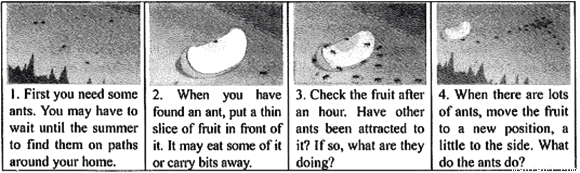
What’s going on?
You can see one of the best examples of insect teamwork by watching ants. If one ant finds food, it leads others there to eat it too. They follow each other by making long trails. The ants go back and forth collecting food, to take back to their nest (穴). When you move the fruit, the ants will still find it. But, instead of making a new direct route (路线) to the food, they will follow each other through their old trail route.
1.What will happen if one ant finds food?
A. The ant will eat all the food. B. The ant will watch other ants.
C. The ant will lead others to the food. D. The ant will wait until others come.
2.If the fruit is moved to a new position, the ants will ________.
A. rail to find it B. give up looking for it
C. make a new direct route to it D. get to it through the old trail route
3.Which is the correct order to do this experiment?
a. Move the fruit to a new position.
b. Find an ant.
c. Check the fruit an hour later.
d. Put a thin slice of fruit in front of the ant.
A. a-b-c-d B. b-d-c-a C. d-b-c-a D. c-a-d-b
4.What can we learn from this experiment?
A. The experiment is done successfully in the lab.
B. Ants do the experiment to show their team spirit.
C. Careful watching does little help in this experiment.
D. We can find out some facts by doing small experiments.
1.C 2.D 3.B 4.D 【解析】本题难度适中,主要通过小实验来说明蚂蚁的团队合作的力量。 1.根据If one ant finds food, it leads others there to eat it too可知,故选C。 2.根据When you move the fruit, the ants will still find it. But, ...查看答案和解析>>
湖北省互联网违法和不良信息举报平台 | 网上有害信息举报专区 | 电信诈骗举报专区 | 涉历史虚无主义有害信息举报专区 | 涉企侵权举报专区
违法和不良信息举报电话:027-86699610 举报邮箱:58377363@163.com