书面表达(本题15分)
根据要求完成短文写作,请将作文写在答题卡指定的位置上。
旅游是一种非常好的活动,许多人对于旅游都怀有浓厚的兴趣。读了上面旅行社推介的几条旅游线路,请写一篇文章,内容包括:
1. 简述外出旅游的好处。(至少两点)
2. 上面的旅游线路哪条你去过?说明你选择这条线路的原因并介绍你该次旅游经历。
如果这些线路你还没去过,请为即将到来的暑假选择一条线路,说明你选择该条线路的原因,并为自己设计一个旅行计划。
要求:1. 不得照抄原文,不得在作文中出现学校的真实名称和学生的真实姓名。
2. 语句通顺,书写规范, 词数80个左右,作文的开头结尾已经给出,不记入总词数。
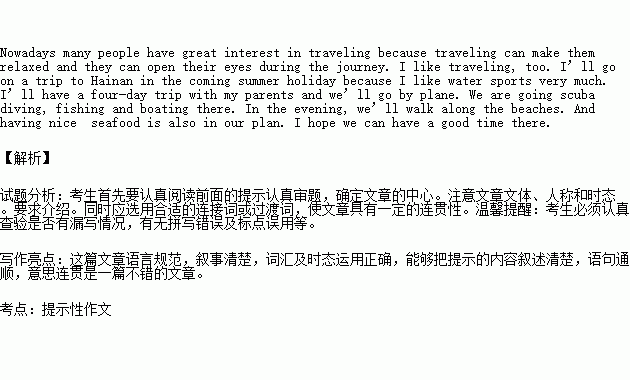
Nowadays many people have great interest in travelling because
_____________________________________________________________________________
_____________________________________________________________________________
_____________________________________________________________________________
 智慧小复习系列答案
科目:初中英语 来源:2015年初中毕业升学考试(山东菏泽卷)英语(解析版) 题型:阅读理解
Parents can be very important teachers in our lives. However, they are not always the best teachers. Parents may be too close to their children emotionally (感情上). Sometimes they can only see their children through the eyes of a protector. For example, a teacher might see a trip to a big city as a valuable experience. However, it might seem too dangerous to a parent.
Another problem is that parents may expect their children’s interests to be similar to their own. If they love science, they may try to force (强迫) their child to love science too. But what if (要是……又怎样) their child’s true love is art, or writing, or car repair?
Parents usually want to pass on their values to their children. But should children always believe what their parents do? When children are young, they believe that their parents are always right. But when they get older, they will have different ways of thinking.
The most important thing to realize is that we all have many teachers in our lives. Our parents teach us, our teachers teach us, and our friends teach us. Books and newspapers and televisions also teach us. All of them are valuable.
1. ________ might see a trip to a big city as a valuable experience, according to the passage.
A. A parent
B. A teacher
C. Either a teacher or a parent
D. Neither a teacher nor a parent
2.Parents may hope that their children have the same ________ as their own, according to the passage.
A. looks B. interests
C. habits D. jobs in the future
3.The underlined phrase “pass on” in the 4th paragraph means “________” .
A. 路过 B. 继承 C. 传递 D. 领悟
4.When children get older, they ________.
A. don’t believe their parents any more
B. should always believe what their parents do
C. believe that their parents are always right
D. begin to have their own ways of thinking
5.What is the best title of the passage?
A. Never grow up!
B. Believe your parents forever.
C. Are parents always the best teachers?
D. How many teachers can we have in our lives?
查看答案和解析>>
科目:初中英语 来源:2014-2015学年山东聊城文轩中学七年级下学期期中考试英语试卷(解析版) 题型:单项填空
There is ____________ cat in the house. Is _____________cat yours?
A. the, a B. the, the C. a, the D. a, a
查看答案和解析>>
科目:初中英语 来源:2014-2015学年广东省汕头市龙湖区中考模拟考试英语试卷(解析版) 题型:单项填空
――_______ you like to go with me to the cinema this evening?
――I’d love to, but I have to look after my little brother.
A. Would B. May C. Must D. Dare
查看答案和解析>>
科目:初中英语 来源:2014-2015学年广东省汕头市龙湖区中考模拟考试英语试卷(解析版) 题型:单项填空
――Can we get home earlier tomorrow?
――Sure, _______ you mind taking the late train.
A. if B. unless C. until D. whether
查看答案和解析>>
科目:初中英语 来源:2014-2015学年广东汕头市业模拟考试英语试卷(解析版) 题型:阅读理解
Questionaire
Read the question and answer YES or NO, then you will find out how good you are.
1. When you don’t understand something, you ask questions.
2. You like listening to older people talk about the past.
3. You think that you can learn something interesting from everyone around you.
4. You are brave enough when you have to talk to people you don’t know. You enjoy reading books about famous people.
5. You always see and talk to different people.
6. You are interested in learning new ways of doing things.
7. You enjoy sharing experiences with friends and learning from people of all ages.
8. You talk a lot about yourself.
9. Even if you are often wrong, you make your own decisions.
10. You hate teaching what you are good at: sports, technology, whatever.
11. Your parents don’ understand you, so you don’t talk to them much.
SCORE NOW: Score 2 points if you answer YES to each of the first 8 questions, and 0 if you choose NO.
Score 2 points if you answer NO to each of the last 4 questions, and 0 if you choose YES.
18-24 You are friendly and open-minded. You make people feel important by listening to what they have to say. You’ll probably succeed in learning all kinds of interesting things. Good for you!
10-16 Remember that every single person you know can teach you something. You will greatly make your life rich and colorful.
0-8 About 400 years ago, a famous writer wrote, “ No man is an island”. This is still true today. Try to be more open and interested in people around you.
1.If you say “YES” to all these questions, you’ll get _____ points.
A. 12 B. 16 C. 20 D. 24
2.When you score 22 points, you are _____.
A. shy and nervous B. silent and serious
C. open and friendly D. brave and strong
3.The writer thinks you should_____.
A. always see and talks to the same people
B. make your own decision whenever you want
C. enjoy teaching what you are good at
D. talk much about yourselves when possible
4.“No man is an island” in the text probably means that______.
A. the famous writer was very clever
B. everything is the same as 400 years ago
C. you will feel lonely if on an island
D. you can not live alone in the world
5.The questions are used to test whether you are willing to _____.
A. learn from others B. help other people
C. do all by yourself D. depend on others
查看答案和解析>>
科目:初中英语 来源:2014-2015学年广东汕头市业模拟考试英语试卷(解析版) 题型:单项填空
I will go on with the experiment unless my mother _____ me to stop.
A. will ask B. asks C. asked D. has asked
查看答案和解析>>
科目:初中英语 来源:2014-2015学年广东汕头市毕业生学业模拟英语试卷(解析版) 题型:其他题
Nowadays, WeChat is 1. more and more popular in China. No matter where we are, we can sign up and sent text or voice messages to our 2. .We can also find a stranger to talk to by shaking the 3. . Another funny function is that WeChat can help to search for people 4. live nearby with the program on. Many people like this function, because it can help them to find more people who they may know.
In my 5. , Wechat is really a useful chatting tool. It can help people communicate with their friends more 6. . However, it is also bad for people, especially students. As you see, some people use Wechat for too long. It is not healthy to them. So I have some 7. to use it in a correct way. First, we should not use it 8. we are studying. We can’t focus on your 9. if we use it. Second, we must be careful. We should neither show too much personal information nor trust strangers so much.
We should learn 10. to use it properly. Remember, Wechat is not everything in your life. Don’t depend too much on it.

查看答案和解析>>
科目:初中英语 来源:2014-2015学年四川开江县永兴中学七年级下期中英语试卷(解析版) 题型:单项填空
Like any other _____ here, he can walk ______ his two hands.
A. boys, with B. boy, on
C. boys, on D. boy, use
查看答案和解析>>
湖北省互联网违法和不良信息举报平台 | 网上有害信息举报专区 | 电信诈骗举报专区 | 涉历史虚无主义有害信息举报专区 | 涉企侵权举报专区
违法和不良信息举报电话:027-86699610 举报邮箱:58377363@163.com