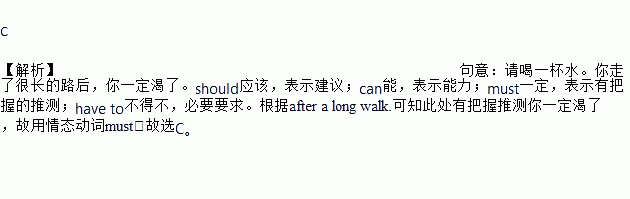
Have a glass of water, please. You ______ be thirsty after a long walk.
A. should B. can C. must D. have to
C 【解析】句意:请喝一杯水。你走了很长的路后,你一定渴了。should应该,表示建议;can能,表示能力;must一定,表示有把握的推测;have to不得不,必要要求。根据after a long walk.可知此处有把握推测你一定渴了,故用情态动词must。故选C。科目:初中英语 来源:2018年四月山东省重点班九年级第一次模拟考试英语试卷 题型:单选题
—_______ does this car belong to?
—Mr Green, I think..
A. Who B. What C. Whose D. How
A 【解析】句意:-这辆汽车是谁的?-我想是Green先生的。Who谁;What什么;Whose谁的;How怎样。根据句意可知,这里问的是汽车是谁的,B和D意思不对。句中belong to后面应该跟人称代词作宾语,不能说“属于谁的”,应该是“属于谁”,故应选A。查看答案和解析>>
科目:初中英语 来源:江苏省盐城市2018届九年级下学期第一次月考英语试卷 题型:单选题
Could you tell me ______?
A. how long he has bought the car
B. how many students were there in your class last year
C. which is the way to the museum
D. how to do with the problem
C 【解析】句意:请你告诉我哪一条是去博物馆的路吗?how long he has bought the car形式错误,bought是瞬间性动词,不能和一段时间连用;how many students were there in your class last year形式错误,在宾语从句中应用陈述语序,而这里是疑问语序;which is the way to the museum哪一条是...查看答案和解析>>
科目:初中英语 来源:江苏省盐城市2018届九年级下学期第一次月考英语试卷 题型:听短对话回答问题
(题文)What does the man want Alice to do?
A.  B.
B.  C.
C. 
查看答案和解析>>
科目:初中英语 来源:牛津译林版九年级下册英语 Unit 3 Robots-Study skills 测试 题型:句子/对话改错
下面各句均有一处错误,请找出并改正。
1.I won’t buy a car unless it is too expensive.
A B C D
2.What can you do if owning a robot is much too trouble?
A B C D
3.My hobby is reading. It can give me knowledge and make me happily.
A B C D
4.Amy doesn’t do homework as carefully than you do.
A B C D
5.He didn’t know how to buy for his mother.
A B C D
1.A, will 2.D, too much 3.D, happy 4.C, as 5.B, what 【解析】 1.根据句意“如果汽车不是太贵,我会买一辆。”故把won’t改为will。故从此为: A, will 。 2.much too“太,很”,修饰形容词或副词,too much“太多”,修饰不可数名词。trouble“麻烦”,是不可数名词,故用t...查看答案和解析>>
科目:初中英语 来源:牛津译林版九年级下册英语 Unit 3 Robots-Study skills 测试 题型:单选题
The cars _________ yesterday sell very well.
A. what I saw B. that I see
C. what I see D. that I saw
D 【解析】试题分析:根据题意可知是定语从句,因为先行词是The cars 故用that引导,根据语境可知是一般过去式;句意昨天我看到的那些汽车买的很好。结合句意,故选D查看答案和解析>>
科目:初中英语 来源:牛津译林版九年级下册英语 Unit 4 Life on Mars-Welcome to the unit 练习 题型:填空
A.根据短文内容,完成下列表格中的信息。
In the past two days, I’ve been to two very different bookstores. They were both in Beijing, and both attracted people in their 20s and 30s. So why were they so different? Because one store was for Chinese people, and one was for Westerners.
At the Western bookstore, in Sanlitun, the books put on display in front—the ones expected to be the most popular—were biographies (传记), books about history, and books about politics and current (现在的) events. Farther back, there was a big shelf full of novels.
At the Chinese store, at the Beijing airport, there were very few books on history, and books on politics and current events were even harder to find. There were a few biographies, but they seemed to be of an instructive (教育性的) nature; almost all of them were about rich people, and how they got rich. What the store did have was lots and lots of books on how to learn English.
As a Westerner, I found this surprising. The kinds of books I’m used to seeing people read—the kinds that were at the first store—are the kinds people read to escape (逃脱) their daily lives. But here most of the books were on how to get rich and how to study English—how to work better and how to study better.
These Chinese books offered no escape from daily life—only ways to improve it. Perhaps this is another area where Westerners and Chinese people can learn from each other. We Westerners could certainly read a bit more for practical purposes (目的). But I also think Chinese people might benefit (受益) from more of something my teachers always encouraged: Reading for fun.
Two different bookstores | ||
Location | Sanlitun | Beijing 1. |
Customers | 2. | Chinese people |
Books | biographies books about history,politics and current3.; a shelf of4. | biographies about rich people and the5. to their success; about how to learn English It’s not6. to find the books which are popular in Sanlitun’s bookstore. |
The purposes of 7. | to be8. from daily life | to 9. daily life |
The writer’s attitude | The western readers should read a bit more for 10. purposes. | Chinese readers should learn how to read for fun. |
查看答案和解析>>
科目:初中英语 来源:同步训练 九下单元测试Unit 3(上海牛津版) 题型:句型转换
Rewrite the sentences as required (按要求改写句子)
1.Sandy has to look after her little brother at weekends.(改为一般疑问句)
_______Sandy_______to look after her little brother at weekends?
2.They threw some rubbish into the river•(改为被动语态)
Some rubbish_______ _______into the river.
3.These flowers give a pleasant smell.(改感叹句)
_______ _______these flowers smell!
4.1 have kept in touch with my new friends by writing e-mails at home.(对划线部分提问)
_______ _______you kept in touch with your new friends?
5.The music in the bar was very noisy. I couldn’t stay any longer.(合并为—句)
The music in the bar was_______ noisy_______I couldn’t stay any longer.
6.“Have you downloaded many free games from the Internet?” Jill asked me.(改为宾语从句)
Jill asked me_______I_______downloaded many free games from the Internet.
7.English, will last, two, our, weeks, Art Festival (连词成句)
________________________________________
1.Doeshave 2.was thrown 3.How pleasant 4.How have 5.sothat 6.if /whetherhad 7.Our English Art Festival will last two weeks. 【解析】 1.原句has是动词have的单数第三人称形式,变为一般疑问句需借助助动词does,has恢复...查看答案和解析>>
科目:初中英语 来源:牛津译林版9B英语一模复习专题练习-单项选择 题型:单选题
. The train _____ for twenty minutes.
A. left B .has left C. is leaving D. has been away
D 【解析】此题考查延续性动词和段时间状语搭配。For + 时间段, Leave 离开 为短暂动词,不能和时间段连用, 所以用away, have been away 表示状态的延续。查看答案和解析>>
湖北省互联网违法和不良信息举报平台 | 网上有害信息举报专区 | 电信诈骗举报专区 | 涉历史虚无主义有害信息举报专区 | 涉企侵权举报专区
违法和不良信息举报电话:027-86699610 举报邮箱:58377363@163.com