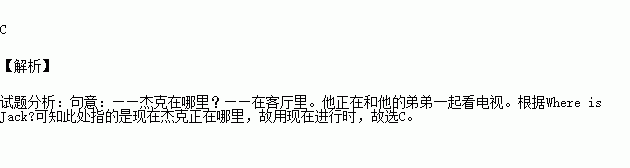
—Where is Jack?
— In the sitting room. He _______ TV with his brother.
A. watch B. watched
C. is watching D. was watching
 提分百分百检测卷单元期末测试卷系列答案
 小学期末标准试卷系列答案
科目:初中英语 来源:2015-2016学年江苏张家港二中初二下期中考试英语试卷(解析版) 题型:单项填空
If you _______ go, at least wait until the rain stops.
A. can B. may C. must D. will
查看答案和解析>>
科目:初中英语 来源:2015-2016学年江苏东台八校七年级下期中考试英语试卷(解析版) 题型:阅读理解
任务型阅读
阅读下面的短文,根据短文内容完成表格中所缺信息,每空一词。
Our Earth is welcoming a great day soon. April 22 is Earth Day. It’s a day for us to take care of the Earth. So what can we do to help? Around the world, many cities and countries find ways to make themselves green.
Chicago is famous for its green roofs(屋顶). There are plants on these roofs. These plants store(储存) much rainwater. Later, the water goes back to the air to make the city cool and clean.
Singapore is home to the first zero-energy(能量) building in Southeast Asia. Zero energy means a building makes more energy than it uses.
Curitiba, Brazil, has buses called BRT. BRT runs on special lanes(车道) so it will always be on time, even in traffic jams. Thanks to BRT, the air in the city is very clean. Today, many other countries have BRT, such as China and Mexico.
We only have one Earth, so we have to take care of her.
Something about 1. Day
2. | April 22nd | |
Aims (目的) | It’s a day for us to look after it. | |
3. | Chicago | It is 4. for green roofs. The people plant small trees and 5. on the roof to keep the water. And the water makes the city 6. and clean. |
7. | It is home to the first zero-energy building in 8. Asia. | |
Curitiba | They use 9. to make the 10. in the city clean. | |
查看答案和解析>>
科目:初中英语 来源:2015-2016学年江苏东台八校七年级下期中考试英语试卷(解析版) 题型:单项填空
Both Hangzhou and Shanghai are _______ the east of China. Shanghai lies _______ the northeast of Hangzhou.
A. in; to B. to; in C. in; in D. to; on
查看答案和解析>>
科目:初中英语 来源:2015-2016学年湖北鄂州鄂城区初一下期第二次月考英语卷(解析版) 题型:阅读理解
May 5th is Japanese Children’s Day. In fact, it is usually called Boy’s Day because it is mainly celebrated (庆祝)by boys. The celebration of Boy’s Day has a long history. It is said that the festival comes from the Dragon Boat Festival in China.
On Boy’s Day, Japanese boys eat a special kind of rice cake. It is covered with a leaf and filled with bean paste (豆沙 ). Children love to eat it very much.
On this day, children don’t have to go to school. Each family with a boy hangs up huge carp-shaped flag (鲤鱼旗 ). The flags are usually three colors: black, red and blue. Black stands for the father, red stands for the mother and blue stands for the son. Japanese parents believe that the flags will bring their boys good luck and give them courage and power.
1.When is Japanese Boy’s Day?
A. It’s on June 1 st.
B. It’s on May 5 th.
C. It’s on March 8 th.
D. It’s on June 6 th.
2.Japanese Boy’s Day is probably comes from ________.
A. the Dragon Boat Festival
B. The Spring Festival
C. Thanksgiving Day
D. Children’s Day
3.On Boy’s Day,__________.
A. only boys don’t have to go to school.
B. each family with a child hangs up three flags.
C. Japanese boys eat a special kind of rice cake.
D. boys need to clean their rooms by themselves.
4.Black of the carp-shaped flags stands for _______.
A. the father B. the mother
C. the son D. the parents
5.Japanese parents believe that the carp-shaped flags will ________.
A. bring their boys good luck
B. give their boys courage.
C. give their boys power
D. All the above.
查看答案和解析>>
科目:初中英语 来源:2015-2016学年湖北鄂州鄂城区初一下期第二次月考英语卷(解析版) 题型:单项填空
―What do you want to be in the future, John?
― I want to be _____ fashion designer. It is ______ interesting job.
A.a; the B. a; / C. a; an D. an; the
查看答案和解析>>
科目:初中英语 来源:2015-2016学年湖北鄂州鄂城区初一下期第二次月考英语卷(解析版) 题型:单项填空
—How far is it from your home to school?
─It’s fifteen ______ walk.
A. minute B. minute’s
C. minutes D. minutes’
查看答案和解析>>
科目:初中英语 来源:2015-2016学年广东深圳龙岭学校第二学期初一期中考试英语卷(解析版) 题型:单项填空
Sara found _____interesting photo yesterday. ______ photo was of her grandma.
A. a, the B. an, The C. the, the
查看答案和解析>>
科目:初中英语 来源:2016届山东邹城八中九年级下期第一次月考英语试卷(解析版) 题型:阅读理解
Do you have a lucky number? What is it? Many people have a special number that they hope will bring them good luck.
In Chinese culture, some numbers are believed to be lucky or unlucky based on the Chinese word that the number sounds similar to.
For example, the word for the number 8 sounds similar to the word for “making a fortune(发财)”. So, people consider it a very lucky number. Some people will even spend a lot of money to have 8s in their phone numbers or vehicle license plate (车牌照) numbers. The opening ceremony of the Beijing Olympics began at 8:08 p.m. on August 8, 2008.
The number 9 is also a lucky number because of its connection to the emperors of China. There were nine dragons on emperors’ robes (龙袍) and Chinese myth held that the dragon has nine children. The number 9 also stands for “long lasting”. That’s why a man always proposes to(向---求婚)a woman with 99 or 999 roses.?
So what’s a “bad luck” number in China? It might be 4. Many Chinese people see 4 as a “bad luck” number because it sounds similar to the character for “death”.
Because of this, many buildings skip(跨过) the fourth floor, and simply call it the fifth floor. In Hong Kong, some buildings even skip all floors numbered with 4, such as, 4, 14, 24, 34 and all 40-49 floors. Some buildings also skip the 13th floor, as this is considered an unlucky number in many Christian countries. As a result, a building whose highest floor is 50 may have only 35 physical floors.
1.What makes Chinese people believe a number is lucky or unlucky?
A. the shape of the number
B. the sound of the number in Chinese
C. the history of the numbers
D. the sound of the number in English
2.Chinese people regard the number 9 as______?
A. becoming beautiful B. living a long life
C. making a fortune D. living a happy life
3.From the passage, we know that_______.
A. Many Chinese people don’t like the number 4.
B. all people have the same lucky number
C. the number 9 is lucky because it means “wealth”
D. the number 8 is a lucky number for foreigners
4.What does this passage mainly talk about?
A. Meanings of different unlucky numbers.
B. Meaning of different lucky numbers.
C. Lucky or unlucky numbers in Western culture.
D. Lucky or unlucky numbers in Chinese culture.
查看答案和解析>>
湖北省互联网违法和不良信息举报平台 | 网上有害信息举报专区 | 电信诈骗举报专区 | 涉历史虚无主义有害信息举报专区 | 涉企侵权举报专区
违法和不良信息举报电话:027-86699610 举报邮箱:58377363@163.com