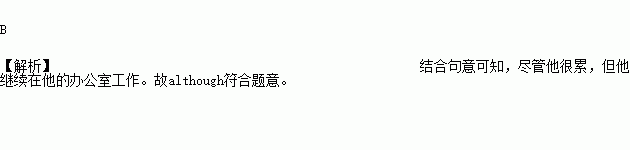
(2014天津)________he was very tired,he continued working in his office.
A.Since
B.Although
C.As soon as
D.Because
科目:初中英语 来源:2015年人教版初中英语七年级下册Unit 1 练习卷1(解析版) 题型:单项填空
Yao Ming can play ________ basketball,but he can’t play ____ violin.
A.the:/
B./;the
C.a;the
D.the;a
查看答案和解析>>
科目:初中英语 来源:2015年人教版初中英语九年级下册期中练习卷(解析版) 题型:单项填空
(2013北京)I don’t remember the________book yesterday.
A.where I put
B.where did I put
C.where will I put
D.where I will put
查看答案和解析>>
科目:初中英语 来源:2015年人教版初中英语九年级下册期末练习卷(解析版) 题型:单项填空
(2013牡丹江)Nick is never late for work.He always gets to the office________.
A.on time B.in time C.at times
查看答案和解析>>
科目:初中英语 来源:2015年人教版初中英语九年级下册Unit14练习卷(解析版) 题型:阅读理解
阅读理解
(2014杭州)
How quickly can you count from one to ten?Do you use ten different words to do it?Can you do it in English,or do you have to use your first?language?Do you count on your fingers?Many
people think that numbers and math are the same all over the world.But scientists have discovered that it is not true.
People in different parts of the world use different ways to count on their fingers.In the United States,people begin counting with their first finger,which they extend or stick out.They then extend the rest of their fingers and finally the thumb(拇指)to count to five.Then they repeat this with the other hand to get to ten.In China,people count by using different finger positions.In this way,a Chinese person can easily count to ten on only one hand.
Besides ways of finger counting,scientists have found that cultures and languages are also different when it comes to numbers.Some languages have only a few words for numbers,and others have no words for numbers.A group of scientists studied aboriginal(土著的)people in Australia.There people don’t have hand movements to stand for numbers.They don’t even have words for numbers.However,they are still able to understand different ideas about numbers.
In a similar study,researchers from the Massachusetts Institute of Technology discovered that people of the Piraha tribe(部落)in northwestern Brazil don’t have words for numbers such as“one”or“three”.They are not able to say“five trees”or“ten trees”but can say“some trees”.“more trees”.or“many trees”.Professor Edward Gibson said that most people believe that everyone knows how to count,“but here is a group that does not count.They could learn,but it’s not useful in their culture,so they’ve never picked it up.”
Although all humans are able to understand quantities(数量),not all languages have numbers and not all people use counting.Number words in a certain language are a result of people needing numbers in their daily lives.Now we know that people have different ideas about numbers and math,too.
1.The writer begins with the four questions in order to________.
A.make a survey
B.interest readers
C.tell a story
D.solve math problems
2.What do we learn from the difference in finger counting between the US and China?
A.People from China count much faster than people from the US.
B.People from China need two hands to count from one to ten.
C.People of different cultures may use different ways of finger counting.
D.People of different cultures use the same way of finger counting.
3.Which of the following is true about aboriginal Australians?
A.They have only a few words for numbers.
B.They have hand movements to stand for numbers.
C.They can only count to five on their fingers.
D.They can understand different ideas about numbers.
4.The study of the Piraha tribe shows that________.
A.people all over the world know how to count
B.people of the tribe have words for numbers
C.some groups of people are not smart enough to count
D.counting is not useful in the culture of the tribe
5.What is the main idea of the passage?
A.People from different cultures have different ideas about numbers and math.
B.Chinese people can count more easily on their fingers than Americans.
C.In some aboriginal cultures,people don’t even know how to count.
D.Some languages don’t have number words because people don’t need numbers.
查看答案和解析>>
科目:初中英语 来源:2015年人教版初中英语九年级下册Unit14练习卷(解析版) 题型:单项填空
They were________their invention.They thought they could invent more things to make our life easier.
A.angry with
B.proud of
C.strict in
D.tired of
查看答案和解析>>
科目:初中英语 来源:2015年人教版初中英语九年级下册Unit14SectionB练习卷(解析版) 题型:单项填空
—Who will be responsible the matter?
—Mr.Zhang.
A.with B.of C.for D.from
查看答案和解析>>
科目:初中英语 来源:2015年人教版初中英语九年级下册Unit14SectionA练习卷(解析版) 题型:单项填空
(2013泰安)—Excuse me,could you tell me where________?
—Sure,sir.You can try www.taobao.com.
A.can I join in the group-buying
B.did I join in the group-buying
C.I can join in the group-buying
D.I joined in the group-buying
查看答案和解析>>
科目:初中英语 来源:2015年人教版初中英语九年级下册Unit13SectionA练习卷(解析版) 题型:单项填空
(2013河北)Henry will give us a report as soon as he________.
A.arrives
B.arrived
C.is arriving
D.will arrive
查看答案和解析>>
湖北省互联网违法和不良信息举报平台 | 网上有害信息举报专区 | 电信诈骗举报专区 | 涉历史虚无主义有害信息举报专区 | 涉企侵权举报专区
违法和不良信息举报电话:027-86699610 举报邮箱:58377363@163.com