– I’m going on a trip to Hong Kong after the exam. – Really? __________.
A. Have a nice time. B. Congratulations. C. Ok. D. It’s nice of you.
A 【解析】试题分析:句意:在考试后我打算去香港旅行。--真的吗?祝你玩的愉快。A. Have a nice time. 祝你玩得愉快;B. Congratulations.祝贺你;C. Ok. 行;D. It’s nice of you.你真是太好了,表示感谢对方。根据句意,故选A。科目:初中英语 来源:人教版九年级Unit 12 单元测试英语试卷 题型:看图作文
2016·济宁书面表达
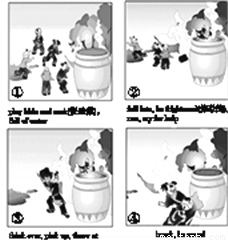
假如你是李梅。你的美国笔友Tom在昨天的e?mail中告诉你,最近他对中国文化产生了浓厚的兴趣,希望你能给他介绍一些经典故事。请你根据下面所给图画,给Tom回复一封e?mail,向他讲述这一经典故事,并希望知道他对该故事及主人公的看法。
Sima Guang hit the tank(缸)
________________________________________________________________________
________________________________________________________________________
________________________________________________________________________
________________________________________________________________________
________________________________________________________________________
________________________________________________________________________
________________________________________________________________________
________________________________________________________________________
________________________________________________________________________
Dear Tom, I'm very happy that you are interested in traditional Chinese stories. Well, let me tell you a famous one with the name “Sima Guang hit the tank”. Once Sima Guang was playing hide and ...查看答案和解析>>
科目:初中英语 来源:广东省深圳市龙岗区2016-2017学年七年级下学期期末考试英语试卷 题型:单选题
—What do you think of Mr Lee’s classes?
— _______________. He teaches us in a relaxing way.
A. boring B. lively C. convenient
B 【解析】句意:——你觉得李先生的课怎么样?——很活泼,他以一种轻松的方式教我们。考查形容词辨析题。A. boring无聊的;B. lively活泼的;C. convenient方便的。根据下文“放松的方式”,可知李老师的课堂应该是活泼轻松的,故选B。查看答案和解析>>
科目:初中英语 来源:考点57 短文填空之首字母填空-备战2018年中考英语考点一遍过 题型:单词填空
Lan Lan, a student of Grade Seven in Lushan, was taking a drawing class in a tent on April 23. Guess what she drew—a house with wings. When the teacher asked why she did so, Lan said if her house could f 1. , it wouldn’t fall down in an earthquake.
Lan’s hometown was hit by a s 2.earthquake on April 20. At least 196 people were killed and more than 11,000 were injured. Many people became homeless. Soldiers and doctors q 3.arrived in the area, saving people and rebuilding homes. Lots of money was sent there to help all those in need.
Although we can’t prevent (阻止) an earthquake from happening, we can use some methods to r 4.harm. During an earthquake, do not jump out of high buildings because it is very d 5.. Another method is to cover your head and neck u 6.a strong table or desk. If there is no shelter (躲避处) nearby, you can also stay by a wall, and cover your head and neck with your arms and hands. And then you must keep calm and stay there u 7. the shaking stops.
Japan is a c 8. which lies on the earthquake belt (地震带) and it is very good at dealing with earthquakes. From a very young age, the Japanese are already taught how to survive (幸存) them. Students often receive earthquake training. Almost in every Japanese family you can find a survival kit (救生装备) with a flash-light, a radio, water and enough food for several days. This helps people to stay a 9.after an earthquake.
“There should be more safety t 10.at schools in our country,” said Xu Jiannong, an education expert in Beijing. There is no more truth than this when one’s life is the most important of all.
1.fly 2.strong 3.quickly 4.reduce 5.dangerous 6.under 7.until 8.country 9.alive 10.training 【解析】本篇文章难度适中,主要讲述地震以及地震中的自救方法。 1.句意“当老师问她为什么这么做,兰说,如果她的房子会飞,它就不会在地震中倒下”。fly...查看答案和解析>>
科目:初中英语 来源:2017-2018学年江苏沭阳如东实验学校八年级第二学期第一次阶段检测(有答案) 题型:阅读单选
Almost every Chinese person can recite(背诵) the two lines of the famous poem, “______________________”. But sadly, many of us don’t actually get the real meaning of these lines: Don’t waste food.
A CCTV program reported that the food Chinese people throw away every year is enough to feed 200 million people for a year. Do we have too much food? Absolutely not. According to the UN World Food Program, there were 925 million hungry people around the world in 2011, especially in developing countries. Six million children die of hunger every year.
Chinese people are well-known for being friendly and generous. Many even feel that they lose face if their guests have eaten all the food on the table. Luckily, a number of people have realized the importance of saving food. What should we do in our daily lives to waste less food?
1. Don’t order too much in a restaurant. Only order as much as you want to eat. If you cannot eat all the food you ordered, take the rest of it home.
2. Don’t leave any food in your bowls while having meals.
3. Keep an eye on what food you have at home. Don’t buy too much, especially for vegetables and fruit.
1.What’s the real meaning of the underlined sentence?
A. 春种一粒粟,秋收万颗籽 B. 谁知盘中餐,粒粒皆辛苦。
C. 吏禄三百石,岁晏有余粮 D. 足蒸暑土气,背灼炎天光。
2.According to the UN report, how many hungry people were there in 2011?
A. 6 million. B. 925 million. C. 200 million. D. 725 million.
3.What should we do to waste less food?
A. Order more food in a restaurant.
B. Every time you eat, leave some food in your bowls.
C. Take all the food you ordered home.
D. Don’t store too much food like vegetables and fruit.
4.Which of the following is NOT true?
A. A number of people have realized the importance of saving food.
B. The food Chinese people throw away every year is enough to feed 200 million people for a year.
C. 200 million children die of hunger every year.
D. Many Chinese feel that they lose face if guests have eaten all the food on the table.
5.What’s the main idea of this passage?
A. Don’t waste food.
B. Chinese people are friendly and generous.
C. We can’t die of hunger.
D. Every grain is grown by farmers.
1.B 2.B 3.D 4.C 5.A 【解析】试题分析:这篇短文主要是倡导人们不要浪费粮食。结合实际例子告诉人们节约的重要,并给出了几条如何做可以减少粮食浪费的建议。 1. 2. 3. 4. 5.查看答案和解析>>
科目:初中英语 来源:2017-2018学年江苏沭阳如东实验学校八年级第二学期第一次阶段检测(有答案) 题型:单选题
-_______ did your uncle leave his hometown? – He _______ for nearly twenty years.
A. When; has left B. When; has been away
C. How long; has left D. How long; has been away
B 【解析】句意:-你的叔叔什么时候离开的他的家乡?-他离开了将近20年了。when什么时候;how long多长时间;has left现在完成时,已经离开了;has been away已经离开了,是系表结构。leave是瞬间性动词,不能和一段时间连用,故疑问词应用When,谓语动词用系表结构,故选B。查看答案和解析>>
科目:初中英语 来源:2017-2018学年江苏沭阳如东实验学校八年级第二学期第一次阶段检测(有答案) 题型:单选题
The old man lives _______ , but he never feels ________.
A. alone, alone B. lonely, lonely C. alone, lonely D. lonely, alone
C 【解析】试题分析:句意:这个老人独自生活,但是他从不感到孤独。alone只是陈述一个客观事实,意思是“独自一人”、“没有同伴或助手”,只用作表语。有时放在名词或代词后,表示“仅仅”、“只有”,可作形容词。 另外,alone 可用作副词,表示“独自地”、“单独地”; lonely 则有浓厚的感情色调,指因缺少朋友、同情、友谊时所发生的一种悲伤的和忧郁的感情,意思是“孤独”、“寂寞”,作形容...查看答案和解析>>
科目:初中英语 来源:江苏省常州市天宁分校2017-2018学年八年级3月学情调研英语试卷 题型:完型填空
Dear Mary,
Thanks a lot for your letter and the great photos. I like them very much. Here are some of my photos. In the first photo, I am swimming in the pool. In the second one, I am playing soccer on the playground(操场) in our school. In the third one, you can see my family at home. We’re having dinner. In the last one, I am with my little sister Beth. She’s watching TV and I am doing my homework.
Best wishes to you and you family. Please write to me soon.
Jim
1.This letter is from _____ to _____.
A. Mary; Jim B. Jim; Mary C. Ann; Beth
2.Jim likes ______ very much.
A. the letter B. the beautiful photos C. A and B
3.In the first photo, Jim is __________.
A. playing soccer B. swimming C. A and B
4.Jim has one ________.
A. sister B. brother C. friend
5.In the last photo, Jim is ______ and Beth is______.
A. watching TV; doing homework
B. doing homework; watching TV
C. having dinner; writing a letter
1.B 2.C 3.B 4.A 5.B 【解析】本文是一封书信。介绍了两张照片里吉姆一家的情况。 1.细节理解题。由书信的格式可知,这封信是吉姆写给玛丽的。故选B。 2.细节理解题。由句子Thanks a lot for your letter and the great photos. I like them very much. 可知, 非常感谢你的来...查看答案和解析>>
科目:初中英语 来源:甘肃省张掖市2016-2017学年七年级下学期第一次月考英语试卷(word版附答案) 题型:单选题
There is homework to do every day and there are____ rules at school.
A. too many; too many B. too much; too much
C. too many; too much D. too much; too many
D 【解析】句意:每天有太多的家庭作业要做,学校的规章太多了。too much修饰不可数名词; too many修饰可数名词复数。homework为不可数名词,用too much;rules为可数名词复数,用too many。故选D。查看答案和解析>>
湖北省互联网违法和不良信息举报平台 | 网上有害信息举报专区 | 电信诈骗举报专区 | 涉历史虚无主义有害信息举报专区 | 涉企侵权举报专区
违法和不良信息举报电话:027-86699610 举报邮箱:58377363@163.com