
Before my first summer vacation at college, my roommate Ted asked me to work with him on his father’s farm in Argentina. The idea of spending two months in Argentina was exciting. But I was afraid of it. I had never been far from New England. What would it be like in a strange country? What about the language? The more I thought about it, the more the idea worried me.
In the end I turned down the invitation. As soon as Ted asked somebody else to go, I began kicking myself. I had turned down something I wanted to do because I was afraid, and had ended up feeling depressed (沮丧的) . That unhappy summer taught me a valuable lesson out of which I developed a rule for myself: do what makes you worried; don’t do what makes you depressed.
At the end of my senior year, I began to think about becoming a writer. But my professor was telling me to aim at teaching. I hesitated (犹豫). The idea of trying to live by writing was a lot scarier than spending a summer in Argentina . Back and forth I went, making my decision, unmaking it. Suddenly I realized that every time I gave up the idea of writing, that downhearted feeling went through me.
Giving up on what I really wanted to do depressed me. Right then I learned another lesson. To avoid that kind of depression meant having to bear a certain amount of worry and concern.
When I first began writing articles, I was frequently required to interview big names. Before each interview I would get anxieties (焦虑) in the mind and my hands would shake. One person I particularly admired was the great composer Duke Ellington. On the stage and on television, he seemed the very model of confidence. Then I learned Ellington still got stage fright and had anxiety attacks. I went on doing those frightening interviews. Then I realized that I was even looking forward to the interviews. What had happened to those anxieties?
Well, in truth, the anxieties were still there, but there were fewer of them. I had benefited from a process of overcoming them. If you put an individual in an anxious situation often enough, he will eventually learn that there isn’t anything to be worried about. This brings me to a conclusion: you’ll never get rid of anxiety by avoiding the things that caused it. The point is that the new, the different, is definitely scary (可怕的). But each time you try something, you learn, and as the learning piles up, the world opens to you.
1.What does the phrase “turned down” mean in the second paragraph?
A. To say “No” to his roommate. B. To say in a low voice.
C. To put away the invitation. D. To take the invitation.
2.We can infer from the passage that the writer________.
A. finds it difficult to make decision
B. has found out what causes anxiety
C. was inspired (受启发的) by Duke Ellington’s stage fright
D. no longer feels anxious about new experiences
3.Which of the following opinions does the writer probably accept?
A. Hesitation leads to depression.
B. Anxiety can be a positive drive.
C. Avoiding anxiety reduces depression.
D. Depression is a signal that one is growing up.
1.A
2.C
3.B
【解析】
试题分析:这篇短文中作者结合自己的亲身经历,告诉我们要想最后不会感到沮丧,就必须要忍受一些担心和焦虑。事实上,有时候焦虑会成为你上升的一种动力。如果你经常处在焦虑的状况中,你会发现这其实并没有什么可担心的,你可以从中学到很多。
1.词义猜测题。根据上文第一段中作者的这些顾虑以及这个短语所在的句子可知,the more I thought about it, the more the idea worried me作者想得越多,就会越担心,所以最后拒绝了Ted的邀请。turn down在这里表示拒绝。故选A。
2.推理判断题。根据短文第五段的内容可知,当作者刚开始写作的时候,他经常去采访一些名人。在采访之前,他通常会变得很紧张。而他采访过的一个名人叫Duke Ellington,Duke Ellington在舞台上,在电视上表现得很自信,但其实他也很害怕上台。Duke Ellington给了他很大的启发。从此作者不再害怕这些采访。故选C。
3.推理判断题。根据短文最后一段的内容可知,作者在战胜焦虑的过程中收获了很多,如果你经常处在一种焦虑的情况中,你就会觉得这根本就没有什么可担心的。所以有时候焦虑是你上升的一种动力,每次你尝试一些新的东西的时候,你就会从中学到很多。故选B。
考点:人生哲理类短文阅读。

科目:初中英语 来源:2014年北京市西城区中考一模英语试卷(解析版) 题型:书面表达
根据中文和英文提示,写一封意思连贯、符合逻辑、不少于50词的回信。信的开头和结尾已给出,其词数不计入所要完成的回信内。所给提供的英文提示词语仅供选用。请不要写出你的校名和姓名。
假如你叫李明,你的笔友David要来北京旅行。他给你发来邮件,想了解北京的情况。请你根据他的问题回复邮件。
提示词语: the Summer Palace, the Great Wall, amazing, fantastic, crowed

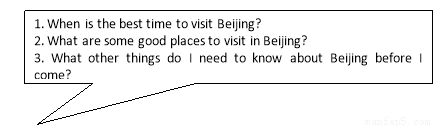
查看答案和解析>>
科目:初中英语 来源:2014年北京市石景山区中考二模英语试卷(解析版) 题型:单项填空
— ______ do you go to the gym?
— Twice a week
A. How often B. How soon
C. How many D. How long
查看答案和解析>>
科目:初中英语 来源:2014年北京市石景山区中考一模英语试卷(解析版) 题型:单项填空
She likes tennis and she thinks it’s ______ of all sports.
A. interesting B. more interesting
C. most interesting D. the most interesting
查看答案和解析>>
科目:初中英语 来源:2014年北京市石景山区中考一模英语试卷(解析版) 题型:单项填空
I like the little girl, so I tried to help ______.
A. him B. her C. it D. them
查看答案和解析>>
科目:初中英语 来源:2014年北京市燕山区中考一模英语试卷(解析版) 题型:单项填空
Betty is going to London. But I don’t know ________.
A. when she sets off B. when does she set off
C. when she will set off D. when will she set off
查看答案和解析>>
科目:初中英语 来源:2014年北京市燕山区中考一模英语试卷(解析版) 题型:单项填空
We had a bad weekend. It ________ all the time.
A. rains B. has rained C. is raining D . was raining
查看答案和解析>>
科目:初中英语 来源:2014年北京市海淀区中考一模英语试卷(解析版) 题型:单项填空
Gina_____ a lot since she joined the art club.
A. learns B. learned C. will learn D. has learned
查看答案和解析>>
湖北省互联网违法和不良信息举报平台 | 网上有害信息举报专区 | 电信诈骗举报专区 | 涉历史虚无主义有害信息举报专区 | 涉企侵权举报专区
违法和不良信息举报电话:027-86699610 举报邮箱:58377363@163.com