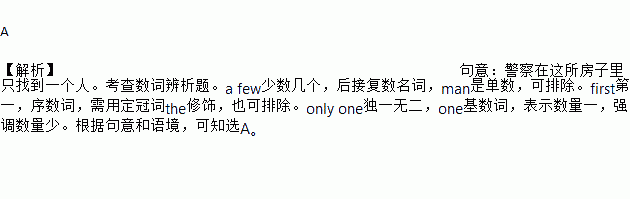
The police found only_______ man in the house.
A. one B. first C. a few
A 【解析】句意:警察在这所房子里只找到一个人。考查数词辨析题。a few少数几个,后接复数名词,man是单数,可排除。first第一,序数词,需用定冠词the修饰,也可排除。only one独一无二,one基数词,表示数量一,强调数量少。根据句意和语境,可知选A。科目:初中英语 来源:人教版七年级下册英语 unit3 第1课时 练习 题型:句型转换
1.I often go to school by bus.(同义句转换)
I often____a bus____school.
2.Jane rides the bike to work on Mondays.(同义句转换)
Jane goes to work____ ____on Mondays.
3.He gets to school on foot every day.(同义句转换)
He____to school every day.
4.Mary goes to work by subway.(同义句转换)
Mary____________to work.
5.Jim goes to Shanghai by train.(对画线部分提问)
____ ____Jim go to Shanghai?
1.taketo 2.bybike 3.walks 4.takes the subway 5.How does 【解析】 1.原句意:我经常乘公共汽车上学。动词短语 “take a/the bus to..”乘坐公共汽车去,与”go/get to...by bus”意思相近。所以答案为: take; to。 2.原句意:简每天骑自行车上班。动词短语 “ri...查看答案和解析>>
科目:初中英语 来源:初二下册Module10单元测试含答案 题型:阅读单选
As we know, some children live in the countryside , and some live in the city. Their lives are a little different. Please look at the following table.
In the countryside | In the city | |
Ways of going to school | On foot | By bus or car |
Classroom facilities(设施) | Recorders and radios | VCD, DVD, TV sets, recorders, radios, loudspeakers |
Ways of learning | Classes only, without many reference books(参考书) | Many extra classes, tutors(家庭教师), lots of reference books |
Eyesight | Less than 45% are near-sighted | About 75% are near-sighted |
After-class activities | Playing with balls | English corners and other school clubs |
Homework | Homework can usually be finished at school | Homework never ends |
Chores(杂事) to do | Washing, cleaning , farming, looking after younger sisters or brothers, cooking | Usually no chores |
Family members | Big families with three generations(三代人) | Small families with three members |
Ideal jobs | Teachers, drivers, scientists, nurses, secretaries | Scientists, professors, doctors, computer programmers, managers, university presidents, the UN chief |
1.The survey was done among the _____ between the countryside and the city.
A. teachers B. students C. parents D. adults
2.About _____ of children in the countryside have good eyesight, but only ____ of children in the city have good eyesight.
A. 45%; 75 % B. 55%; 75% C. 55%; 25% D. 45%; 25 %
3.Which of the following is not included in the survey?
A. Ideal jobs B. After-class activities C. Ways of learning D. Results of tests
4.A classroom in the countryside often has____ according to the survey.
A. recorders B. DVD C. TV sets D. loud-speakers
5.Which if the following is not true according to the survey?
A. Children in the countryside often go to school on foot.
B. Children in the city often have too much homework to do.
C. Children in the countryside often have lots of chores to do
D. Children in the city don’t want to be computer programmers.
1.B 2.C 3.D 4.A 5.D 【解析】试题分析:本表格是针对农村孩子和城市儿童所做的调查,揭示了他们不一样的生活。 1.题意:这项调查是在农村和城市之间的 进行的。考查细节理解题。A. teachers老师;B. students学生;C. parents父母;D. adults成年人。根据开头As we know, some children liv...查看答案和解析>>
科目:初中英语 来源:初二下册Module10单元测试含答案 题型:单选题
How many ______ were lost in the fire?
A. life B. lives C. lifes
B 【解析】句意:有多少人在火灾中丧生?考查名词的数。how many多少,问数量,后接复数名词,可排除A;life生命,是以-fe结尾的名词,变为复数需将-fe先变为v再加+es。根据句意结构,可知选C。查看答案和解析>>
科目:初中英语 来源:初二下册Module10单元测试含答案 题型:单选题
________any food in the fridge?
A. Are there B. Is there C. There is
B 【解析】句意:冰箱里有食物吗?考查there be结构。there be结构遵循就近原则,food(食物)是不可数名词,系词需用is,可排除A。本句是一般疑问句,可排除C,根据句意结构,可知选B。查看答案和解析>>
科目:初中英语 来源:牛津译林版8A英语期中专题练习-阅读表达 题型:回答问题
Winter is a time for many exciting sports: sledding (乘雪橇), skating and skiing. Skating and skiing need lots of skills. Sledding gives you good exercise and is lots of fun!
A sled looks like a boat. It can move easily over snow or ice. Early sleds were made of wood. Now some better sleds are made of glass.
Sleds can be pulled(被拉)by animals. In some very cold parts of the world, people make animals like dogs, horses, and reindeer (驯鹿) pull(拉) goods(货物) or people in sleds.
People also sled for sports and fun. Driving a sled does not need much skill. The driver gives a kick(踢) in the snow to start the sled. He or she can also ask someone else for help. In a sled, there can be one person(人) or several(几个).
Usually, you have to lie on your back, feet first in a sled. As you travel, you move your body and feet to keep it in the right direction (方向).
There is a special sled called the skeleton sled (骨架雪橇). It’s very different.
On a skeleton, you lie on your stomach and drive the sled in a head-first way. It is very fast! Many people are afraid to ride it. But once they try it, they want to do it again!
1.What were early sleds made of?
_______________________________________________________________________________
2.What kind of animals can pull sleds?
_______________________________________________________________________________
3.Besides(除...外) pulling goods or people, what are sleds also used for?
_______________________________________________________________________________
4.How many people can stay in a sled?
_______________________________________________________________________________
5.How do many people feel when they ride a skeleton?
_______________________________________________________________________________
1.They were made of wood./Wood. 2.Dogs,horses and reindeer. 3.Sports and fun. 4.One person or several. 5.They are afraid./ Once they try it, they want to do it again. 【解析】文章讲述了关于滑雪橇的事情。...查看答案和解析>>
科目:初中英语 来源:浙江省外研版七年级英语下册同步测试:Module4 Life in the future Unit 1 Everyone will study at home. 题型:语法填空
阅读下面短文,按照句子结构的语法性和上下文连贯的要求,在空格处填入一个适当的词或使用括号中词语的正确形式填空(每空不多于2个单词)。
In the year 2050, there will be different1.(kind) of materials(面料) for clothes. Special materials will 2.(keep) the clothes clean for ever. They will never get dirty or be worn out(穿破). We will have less house-work 3. we won’t have to wash them. So we can save water
4. money. And children won’t worry 5.what to wear to school every day. Maybe they
6.(not) go to school any more. They’ll stay at home in front of 7.(they) computers to study. They can8.(wear) their favourite “Saturday Clothes” every day. It 9.(be) fun. Do you think so? 10. do you think school clothes and school life will be like in 2050?
1.kinds 2.keep 3.because 4.and 5.about 6.won’t 7.their 8.wear 9.will be 10.What 【解析】主要谈论了2050年的服装。 在2050,将会有各种各样的衣服材料。特殊材料将使衣服永远保持清洁。他们永远不会弄脏或穿破了。我们将会有更少的家务,因为我们不必洗衣服了。这样...查看答案和解析>>
科目:初中英语 来源:牛津译林版八年级下2单元测试 题型:单选题
–_____ to the United States?
–No, never. But I went to Canada a few years ago.
A. Have you been B. Have you gone
C. Did you go D. Will you go
A 【解析】试题分析:句意:你去过美国吗?没有,但我在几年前去过加拿大。have/has been to,曾经去过某地 ,表示有过这种经历; have/has gone to 去了某地,表示某人不在此地; 根据题意故用现在完成时;根据句意,故选A查看答案和解析>>
科目:初中英语 来源:初二下册Module9单元测验含答案 题型:完型填空
There are twenty-seven bridges ____ London’s River Thames. ____ all the bridges, Tower Bridge is the most famous. Do you know what ____ Tower Bridges so famous? ____ do so many visitors from all over the world come to see it?
The surprising thing about Tower Bridge is that it is open ____. It does this to let the big ships go ____ the pool(水域) of London. If you are lucky enough to see the bridge with its two opening arms high in the air, you will never ____ it, it’s really exciting.
On the north side of the river, there is the Tower of London. The Tower of London and London Bridge look the same, but the Tower of London is much ____ than London Bridge, the Tower of London is almost one thousand years old and the Tower Bridge is only about one hundred. Before they began to build Tower Bridge, the designers(设计师) argued (争论) about it for more than thirty years. It ____ them quite a long time to argue and decide to build the Tower Bridge because they had two ____, they were very difficult to solve(解决).
1.A. on B. above C. over D. from
2.A. In B. From C. About D. Of
3.A. makes B. let C. has D. does
4.A. What B. Why C. When D. How
5.A. on the left B. in the middle C. on the right D. all the time
6.A. past B. on C. through D. into
7.A. remember B. know C. understand D. forget
8.A. younger B. smaller C. older D. cheaper
9.A. took B. spent C. paid D. cost
10.A. questions B. problems C. arms D. bridges
1.C 2.D 3.A 4.B 5.B 6.C 7.D 8.C 9.A 10.B 【解析】试题分析:这篇说明文简单介绍了著名的伦敦塔桥的独特之处,并通过对比介绍了伦敦塔的历史久远。 1.句意:伦敦泰晤士河上有二十七座桥。考查介词辨析题。A. on在……上面,强调表面接触;B. above在……上面,强调垂直方向;C. over在……...查看答案和解析>>
湖北省互联网违法和不良信息举报平台 | 网上有害信息举报专区 | 电信诈骗举报专区 | 涉历史虚无主义有害信息举报专区 | 涉企侵权举报专区
违法和不良信息举报电话:027-86699610 举报邮箱:58377363@163.com