
Garbage(垃圾) Island
You can’t see it from the air. It’s almost impossible to see from a ship. But somewhere in the North Pacific is a huge island of garbage, just below the water surface.
What is the island made of?
The garbage island is not an island, but a collection of millions of plastic and other objects(物体). The water movements of the Pacific Ocean bring the objects together and cause them to go around in a big circle.
Charles Moore found it in 1997 and named it “the Great Pacific Garbage Patch”.
Where does all the plastic come from?
Much of the garbage comes from everyday objects, such as shopping bags and water bottles. Some of these objects finally reach the ocean. Garbage from the western coast of North America takes about six years to reach it. Objects from East Asia take about a year. Other garbage comes from ships passing through the area.
Is the Garbage Patch dangerous?
The larger pieces of garbage are a problem for wildlife. For example, sea turtles(海龟) and seabirds often think the plastic is their food. They eat the plastic and die.
In addition, the plastic stops sunlight from reaching deeper water. Without sunlight, very small sea animals die. Then, there is less food for larger fish to eat.
What can we do to help stop it?
Cleaning up the island isn’t easy. But we can make people realize the problem. One environmentalist(环保主义者), David de Rothschild, is sailing around the world on a boat made of plastic bottles to teach people about the problem of garbage in the sea.
Another idea is that we can recycle the plastic garbage. Environmental engineer Cesar Harada is building a robot that collects pieces of plastic. Harada hopes to use his robot in the Pacific. Harada also has a website for reporting environmental problems. He says, “I hope everybody can become an environmental activist.”
1.What is the garbage made of?
___________________________________________________________
2.How long does it take objects from East Asia to reach the island?
___________________________________________________________
3.Is the garbage island dangerous?
___________________________________________________________
4.Why is David de Rothschild sailing on a bottle boat?
___________________________________________________________
5.According to the writer, what can we do to help stop garbage island?
___________________________________________________________
1.It is made of millions of plastic and other objects. 2.About a year. 3.Yes, (it is) 4.Because he wants to teach people about the problem of garbage in the sea. 5.We can make people reali...科目:初中英语 来源:人教版七年级下册英语 unit1 第1课时 测试1 题型:单选题
—Can you play ________ guitar?
—Sure. It’s a piece of cake for me.
A. a B. an C. the D. /
C 【解析】 试题分析:句意:——你会弹吉他吗?-当然了。对我来说这只是小菜一碟。a/an是不定冠词,表示泛指一个……;the 表示特指,是定冠词。这里play the guitar是一个固定的短语,在表示乐器的名词前必须用定冠词。故选C。查看答案和解析>>
科目:初中英语 来源:2018年徐州市中考总复习专项练习-词语运用(七--九)(含答案) 题型:单词填空
用括号中所给动词的正确形式填空,使短文完整。
I can't use my arms or legs well, and life has always been difficult for me. One day last year, a friend of mine said that she 1. (like) to help me out.
After training with a dog at "Animal Helpers", I was able2. (bring) him home. My dog's name is "Lucky" --a good name for him because I feel very lucky to have him,
How does Lucky help me, you might ask? Well, he 3. (train) to understand different instructions during the past 6 months. Forexample, I say, "Lucky! Bring me the book," and he does it at once. He is very clever, and understands many English words, even some difficult ones like "upstairs".
Lucky is an amazing dog. I 4. (send) you a photo of him if you like, and I could show you how he helps me too. Thank you again for5. (support) "Animal Helpers". With your donation, my life 6.(become) better and easier now.
1.would like 2.to bring 3.has been trained 4.will send 5.supporting 6.is becoming/has become 【解析】本文讲述了作者生活不方便,一个名叫Lucky的狗,给了作者很大的帮助。 1.句意:去年的一天,我的一个朋友说她愿意帮我走出困境。would like想,愿意 ...查看答案和解析>>
科目:初中英语 来源:2018年北京市中考英语题型专项复习题库:阅读回答20篇 题型:回答问题
阅读短文,根据短文内容回答问题。
It’s about Time
Do you know what time it is? If you do, you probably are looking at a clock or Long ago, people didn’t have clocks or watches like you do. When the sun rose, they got up and when the sun went down, they went to bed. They told timeby the position of the sun in the sky.
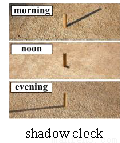
People discovered that they could use a stick and the sun to tell time. This was called a shadow clock. They put a stick in the ground, pointing straight up. The direction of the stick’s shadow and how long or shortit was told them the time.
A better kind of shadow clock was called a sundial. Sundial had a pointer and a base. The pointer cast a shadow on marks around the base. People could tell time by reading the marks.
But shadow clocks were not good for telling time on cloudy days or at night.
One kind of clock that didn’t need the sun was a water clock. A water clock was container with a tiny hole in the bottom. Water would steadilydropout of the hole. Marks on the inside of the container showed the time. It took one hour for the water to go down one mark.
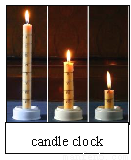
Another kind of clock that didn’t need the sun was a candle clock. You would know the time by how much of the candle had melted(熔化). The candle had marks down its side to show the hours.
Sometimes people used candle clocks as alarm clocks. They put a nail(钉子)in the candle at the time they wanted to wake up, hanging a shoe on the nail. When the candle melted down, the nail fell outand the shoe hit the floor with a BANG! Now there are all kinds of timepieces, from tall grandfather clocks to watches we wear on our wrists(手腕). Most clocks run on electricity from batteries.
There are many more types of clocks, too. Clocks hang in and on buildings. Clocks are everywhere!
1.Did people have clocks or watches like you do long ago?
2.What did sundial have?
3. How long did it take for the water to go down one mark in water clock?
4.How would you know the time when you use a candle clock?
5.What does the writer want to tell us?
1.No./ No, they didn’t. 2.Apointer and a base. 3.One hour. 4.By how much of the candle had melted. 5.The changes/ typesof the clock. 【解析】 试题分析:这篇文章主要是讲了人们判断时间的方式的变化。 1.根据文中信息 Long...查看答案和解析>>
科目:初中英语 来源:2018年北京市中考英语题型专项复习题库:阅读回答20篇 题型:回答问题
Television is one of the greatest technological inventions of the 20 century. A Scottish man called John Logie Baird invented it. Inventors in the USA and Europe were working on electronic television systems but Baird used a mechanical(机械的) system. In 1925, he was able to send the first black and white picture—of the head of a doll—from one end of his flat to the other. He then used a local office boy, not the doll, and this teenager was the first person ever to appear on TV.
In January 1926, Baird invited scientists to his flat and showed them his invention. He called it a “televisor”. Later that year, Baird started the world’s first TV station and gave it the name 2TV. In 1927, he sent images 730 kilometres from London to Glasgow using telephone cables(电缆). A year later, his company sent the first transatlantic(大西洋彼岸的) TV images from London to New York. Baird made the first television programmes for the BBC in 1929. These programmes had sound, not just pictures.
However, Baird's system was very limited and basic( 基本的). A totally electronic American system was more popular and practical. The inventor of this electronic system was an American, Philo Farnsworth. In 1936, the BBC started using Farnsworth's system because the picture was better than Baird’s.
More and more people had televisions after the Second World War. Colour TV began in the USA in the 1940s but only a small number of people had colour televisions in their houses. They were very expensive. In Britain and the USA, the first regular(有规律的) colour TV programmes only began in1967.
Now in the 21 century, we have digital television. TV has changed a lot since the face of a boy appeared on TV in John Logie Bairds flat.
1.Is television a great technological invention of the 20century?
_________________________________________________________
2.How far were the images sent from London to Glasgow in 1927?
_________________________________________________________
3.Who invented the totally electronic system?
___________________________________________________________
4.When did colour televisions go into their houses in America?
__________________________________________________________
5.What is the passage mainly about?
__________________________________________________________
1.Yes. / Yes, it is. 2.730 kilometres. 3.Philo Farnsworth 4.In the 1940s. 5.The development of the television. 【解析】本文主要介绍电视发展史。电视是20世纪最伟大的科技发明之一。苏格兰的叫约翰·罗杰·贝尔德的人发明的。美国和欧洲的发明家们致力于电子电视系统,...查看答案和解析>>
科目:初中英语 来源:2017-2018学年南京市七年级(下)英语unit1单元测试卷 题型:单词填空
首字母填空
I'm Wilson. My d1. home isn't very large, but it is near the sea and has a beautiful b2., I can play with my friends there. We can look out at the b3. and the sea. There are always a lot of people there.
I want to have bunk (双层) beds in all the bedrooms. It means (意味着) many people can be with me, and it also m4. I can sleep in any one of them. I will ask my friends to s5.the weekends with me and then we can have great fun in the house, on the beach o6. in the sea. I don't need a kitchen because I don't like c7. We can eat at restaurants. There are always many good ones n8. the sea. I like flowers and trees, so I want to have two beautiful gardens, one is in front of the house and the other is at the b9.. My pet dog likes to sleep and play in them. Of course, my house must have many showers. And each bedroom has a TV. I will put a
c 10. in the living room. We all like playing computer games. That's my dream home.
1.dream 2.balcony 3.beach 4.means 5.spend 6.or 7.cooking 8.near 9.back 10.computer 【解析】文章介绍了作者的梦想的家是什么样的。 1.句意:我梦想中的家不是太大。根据That's my dream home和首字母故填dream 2.句意:它靠近...查看答案和解析>>
科目:初中英语 来源:2017-2018学年南京市七年级(下)英语unit1单元测试卷 题型:单选题
The girl is very excited and her eyes are ______ tears.
A. full with B. filled of C. full of D. filled into
C 【解析】句意:这个女孩非常激动,她的眼睛里充满了泪水。be filled with充满;be full of充满;故选C查看答案和解析>>
科目:初中英语 来源:2018年春学期人教版七年级英语下Unit 11单元检测含答案 题型:单词填空
阅读下面短文,按照句子结构的语法性和上下文连贯的要求,在空格处填入一个适当的词或使用括号中词语的正确形式填空(每空不多于3个单词)。
Last weekend our 1.(math) teacher, Mr. Green, 2. us to Greentown on a school trip. We left home at 7:00 a.m. on Saturday morning. Mr. Green drove the school bus. The trip took two3.(hour)! Some of us were asleep on the way 4. we got up very early in the morning. We finally(最后) 5.(arrive) in Greentown at about 11:30 a.m.. Then it started to rain hard.
At lunchtime, one of the 6.(boy) fell into the river. Luckily, Mr. Green was very good at 7.. He heard the boy's shouts and ran out to save him.
Sunday afternoon was terrible, too. Two girls went to the center of the town and didn't tell Mr. Green. They got 8.(lose). A policeman brought them back to our hotel. Mr. Green was very angry.
We went back to our city 9. Sunday evening. We 10.(feel) cold, wet and tired. Never again.
1.math 2.took 3.hours 4.because 5.arrived 6.boys 7.swimming 8.lost 9.on 10.felt 【解析】本文介绍了上个周末的一次糟糕的旅行。 1.名词做定语,我们的数学老师,故填math 。 2.take sb to sp带某人去某地,因为叙述的是上个周末的情况,...查看答案和解析>>
科目:初中英语 来源:冀教版七年级英语下册Unit 1 A Trip to the Silk Road 单元检测卷 题型:单选题
London is the capital of _____.
A. America B. Japan C. England D. Canada
C 【解析】句意:伦敦是英国的首都。考查(国家)名词辨析题。London伦敦,英国的首都;根据句意,可知选C。查看答案和解析>>
湖北省互联网违法和不良信息举报平台 | 网上有害信息举报专区 | 电信诈骗举报专区 | 涉历史虚无主义有害信息举报专区 | 涉企侵权举报专区
违法和不良信息举报电话:027-86699610 举报邮箱:58377363@163.com

