Experts believe that there are more than 8 million restaurants in the world today. So it might surprise you to learn that restaurants, as we know them, have only existed for a few centuries. Before 1765, there were no restaurants. That is, there were no places that provided the restaurant experience. There was nowhere in which a waiter brought you food and drink that you picked from a menu. In fact, there were no menus anywhere.
There were eating places travellers could go to centuries before that. The countryside was full of inns that would serve food. And there were taverns where one could get drinks. The rich could also eat special meals prepared by private cooks. But none of them could be called a “restaurant”.
A man called Boulanger changed that. In 1765, he opened a place in Paris that sold soups(汤). On his sign he used the word "restaurant" to describe what he was selling. At that time, soups were considered something that could help "restore"(恢复)your health — in French the word "restore" is “restaurer” — so he called the soups "restaurants". Soon, people started buying Boulanger's soups even when they were not ill. And over time, people began to use the word "restaurant" to refer to a place selling soup rather than the soup itself. More "restaurants" opened in France, and people began to buy soups more often.
Later, restaurants in Paris began to serve other food besides soup. In the 1790s, menus started to appear. By the mid-1800s, there were many types of restaurants throughout the world. The United States offered coffee shops. Tea houses became popular throughout China. Paris created beautiful restaurants for the rich. The British began to copy the French, and the restaurant idea spread throughout the British Empire.
Today cities are filled with all types of restaurants. Diners have millions of options from which to choose.
1.What is the passage mainly about?
A. How restaurants developed.
B. What made a good restaurant.
C. Who created the first restaurant.
D. Why restaurants became popular.
2.According to the first paragraph, what made restaurants different from earlier eating places?
A. Restaurants only served food.
B. Restaurants were more expensive.
C. Restaurants were mainly in cities.
D. Restaurants had a list of meal choices.
3.Who did Boulanger expect to come and eat at his restaurant?
A. Rich people.
B. Sick people.
C. Travellers.
D. Workers.
4.When it was first used. what did the word "restaurant" refer to?
A. A person.
B. A place.
C. Illness.
D. Soup.
5.When did restaurants begin to grow internationally?
A. In the 1600s.
B. In the 1700s.
C. In the 1800s.
D. In the 1900s.
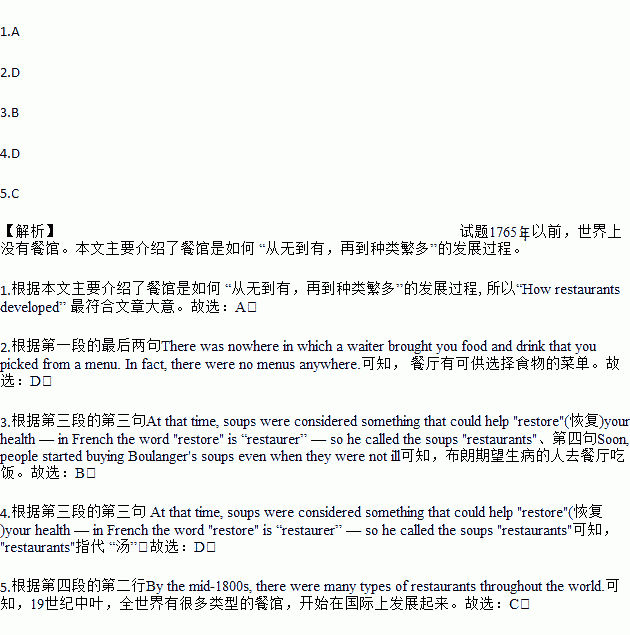
1.A 2.D 3.B 4.D 5.C 【解析】试题1765年以前,世界上没有餐馆。本文主要介绍了餐馆是如何 “从无到有,再到种类繁多”的发展过程。 1.根据本文主要介绍了餐馆是如何 “从无到有,再到种类繁多”的发展过程,所以“How restaurants developed” 最符合文章大意。故选:A。 2.根据第一段的最后两句There was no... 津桥教育计算小状元系列答案
科目:初中英语 来源:江苏省牛津译林版八年级英语下册Unit 5 Good manners 单元测试卷 题型:单选题
—Mr Green has decided to try a third time.
—I admire him very much. He isn't the kind of man who easily.
A. gets up B. wakes up C. gives up D. opens up
C 【解析】句意:——格林先生决定再试一次。——我非常敬佩他,他不是那种容易放弃的人。A. gets up 起床; B. wakes up 叫醒; C. gives up 放弃; D. opens up打开,开发;根据Mr Green has decided to try a third time.可知是不轻易放弃;故选C。查看答案和解析>>
科目:初中英语 来源:中考英语典型例题解析-动词 题型:单选题
---Would you like to try some pizza?
--- Yes, please. It ______ lovely and ______ nice.
A. sounds; sees B. hears; turns C. looks; smells D. watches; taste
C 【解析】试题句意:——你愿意试一下一些披萨吗?——好的,它看起来可爱闻起来香甜。食物首先从视觉和味觉上感觉到。看起来是look,闻起来是smell。故选C。查看答案和解析>>
科目:初中英语 来源:河北省2018年中考英语试卷 题型:单选题
Bob, dinner is ready. Please wash your hands ________ you eat.
A. until B. after C. while D. before
D 【解析】句意:鲍勃,晚饭准备好了。请在吃饭之前洗手。考查连词辨析题。A. until直到……才;B. after在……以后;C. while当……的时候,用于主句和从句动作同时发生;D. before在……以前。根据wash your hands(洗手),结合卫生常识,可知选D。查看答案和解析>>
科目:初中英语 来源:广东省广州市2018年中考英语试卷 题型:书信作文
书面表达
你是英语校报编辑李华。校报收到初一新生Ben的来信,他提出了所面临的两个问题。
请你根据以下提示写一封回信,说明Ben的问题,提出你的建议并陈述理由。
Ben's problems | Your advice and reasons |
朋友少,感觉孤单 | 1.参加学校社团(club)---结识更多朋友 |
2.?(请你补充) | |
英语单词难记 | 1.多阅读英语故事、新闻一在运用中学单词 |
2.?(请你补充) |
Dear Ben,
I am sorry to hear that you are having trouble getting used to life in middle school. In your letter you said that…
…
Good luck with everything!
Li Hua
注意:
(1)回信应包括所有要点;
(2)词数80左右(信的开头和结尾已给出,
不计入词数);
(3)不得透露学校、姓名等任何个人信息,否则不予评分。
Dear Ben, I am sorry to hear that you are having trouble getting used to life in middle school. In your letter you said that you always felt lonely because of having few friends. I think it is a go...查看答案和解析>>
科目:初中英语 来源:2017人教版英语八年级下册期末单选练习题 题型:单选题
I love the countryside,________ in spring.
A. especially B. hardly C. instead D. heavily
A 【解析】句意:我喜欢农村,尤其是春天。A. especially 特别,尤其; B. hardly 几乎不; C. instead 代替; D. heavily重地;根据I love the countryside和 in spring之间的关系,可知是尤其;故选A查看答案和解析>>
科目:初中英语 来源:2017人教版英语八年级下册期末单选练习题 题型:单选题
I will meet Jane at the station. Please________ what time she will arrive.
A. count B. choose C. check D. catch
C 【解析】 试题句意:我要去车站接简。请检查一下他什么时间到达。count计算,数;choose选择;check检查,核对;catch赶上,抓住。结合语境可知选C。查看答案和解析>>
科目:初中英语 来源:2017人教版英语八年级下册期末单选练习题 题型:单选题
________ she comes,she always brings a friend.
A. Because B. Although C. So D. Whenever
D 【解析】句意:她无论什么时候来,她经常带一个朋友来。A. Because 因为; B. Although 尽管; C. So 因此; D. Whenever无论何时;根据she comes,she always brings a friend.可知是无论何时;故选D查看答案和解析>>
科目:初中英语 来源:2017人教版英语八年级下册期末单选练习题 题型:单选题
—Mom, I want to drive to my grandparents’ home.
—Don’t be ______. You are too young to drive.
A. silly B. noisy C. nervous D. sad
A 【解析】 句意:-妈妈,我想开车去爷爷奶奶家。 -别傻了。你太小了,不能开车。A. silly傻的;B. noisy吵闹的;C. nervous 紧张的;D. sad难过的。选B项的意思是:不要吵闹;选C项的意思是:不要紧张;选D项的意思是:不要难过;B/C/D三项都不符合句意。故选A。查看答案和解析>>
湖北省互联网违法和不良信息举报平台 | 网上有害信息举报专区 | 电信诈骗举报专区 | 涉历史虚无主义有害信息举报专区 | 涉企侵权举报专区
违法和不良信息举报电话:027-86699610 举报邮箱:58377363@163.com