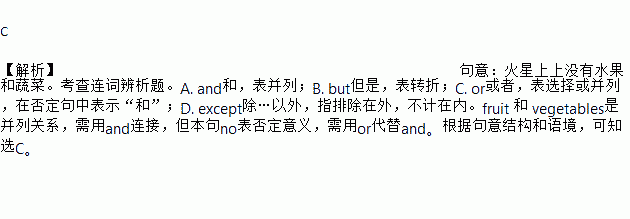
There’s no fruit ____ vegetables on Mars.
A. and B. but C. or D. except
C 【解析】句意:火星上上没有水果和蔬菜。考查连词辨析题。A. and和,表并列;B. but但是,表转折;C. or或者,表选择或并列,在否定句中表示“和”;D. except除…以外,指排除在外,不计在内。fruit 和 vegetables是并列关系,需用and连接,但本句no表否定意义,需用or代替and。根据句意结构和语境,可知选C。科目:初中英语 来源:江苏省盐城市盐都区2018届九年级第一次模拟考试英语试卷 题型:单选题
Many people found to see the sunset by the sea.
A. it’s a pleasure B. it’s pleasant C. it pleasant D. that pleasant
C 【解析】句意:许多人觉得在海边看日落很愉快。本题考查形式宾语it的用法,it做found的宾语,后面直接加宾语补足语pleasant,不定式结构做真正意义的宾语;故答案选C。查看答案和解析>>
科目:初中英语 来源:江苏省盐城市2018届九年级下学期第一次月考英语试卷 题型:听短对话回答问题
(题文)Where are the two persons?
A.  B.
B.  C.
C. 
查看答案和解析>>
科目:初中英语 来源:牛津译林版九年级下册英语 Unit 3 Robots-Study skills 测试 题型:单选题
They have to work at once, _______?
A. can they B. can’t they C. don’t they D. haven’t they
C 【解析】句意:他们必须马上工作,不是吗?反义疑问句,前面是肯定句,后面是否定形式,have to 是一般现在时,用助动词don’t。故此处为don’t they,故选C。查看答案和解析>>
科目:初中英语 来源:牛津译林版九年级下册英语 Unit 4 Life on Mars-Welcome to the unit 练习 题型:汉译英:整句
翻译句子
1.这棵苹果树太高了,我够不着那个苹果。
___________________________________________________________________
2.将来住在火星上会是什么样的呢?
___________________________________________________________________
3.由于重力问题,我们在火星上将不得不穿特殊的靴子。
___________________________________________________________________
4.据报道,火星上既没有水果也没有蔬菜。
__________________________________________________________________
1.The apple tree is so tall that I can’t get to the apple. 2.What would it be like to live on Mars in the future? 3.Because of the gravity, we would have to wear special boots. 4.It’s reporte...查看答案和解析>>
科目:初中英语 来源:同步训练 九下单元测试Unit 3(上海牛津版) 题型:回答问题
D. Answer the following questions (根据短文内容,回答下列问题)
In 1826, a Frenchman named Niepce needed pictures for his business. But he was not a good artist. So he invented a very simple camera. He put it in a window of his house and took a picture of his garden. That was the first photo.
The next important date in the history of photography was in 1837. That year, Daguerre, another Frenchman, took a picture of his reading room. He used a new kind of camera in a different way. In his picture you could see everything very clearly, even the smallest thing. This kind of photo was called a Daguerreotype.
Soon, other people began to use Daguerre’s way. Travellers brought back wonderful photos from all around the world. People took pictures of famous buildings, cities and mountains.
In about 1840, photography was developed. Then photographers could take pictures of people
and moving things. That was not simple. The photographers had to carry a lot of films and other machines. But this did not stop them, for example, some in the United States worked even harder.
Mathew Brady was a famous American photographer. He took many pictures of great people. The pictures were unusual because they were very lifelike.
Photography also became one kind of art by the end of the 19th century. Some photos were not just copies of the real world. They showed feelings, like other kinds of art.
1.Was the first photo a picture of a window of a house?
2.What was the Daguerreotype?
3.If a photographer wanted to take pictures of moving things in 1840, what did he have to do?
4.Why were Mathew Brady’s pictures special?
5.What does this passage mainly tell us?
6.Can you name another kind of art that shows feeling?
1.No, it wasn't. 2.A kind of photo. 3.He had to carry a lot of films and other machines. 4.Because his pictures were lifelike. 5.It tells us the history of the photography./It tells us how...查看答案和解析>>
科目:初中英语 来源:同步训练 九下单元测试Unit 3(上海牛津版) 题型:单选题
The fish soup tasted so______ that the guests asked for more.
A. bad B. terrible C. well D. good
D 【解析】句意:鱼汤味道很好,客人们要的更多。考查形容词辨析题。so...that...引导结果状语从句,so如此,后接原级形容词或副词。taste尝起来,后接形容词,well是副词,可排除。根据the guests asked for more,结合句意语境,可知鱼汤的味道鲜美。bad不好的,terrible很糟的,都不合句意,可排除,故选D。查看答案和解析>>
科目:初中英语 来源:牛津译林版9B英语一模复习专题练习-单项选择 题型:单选题
---Reading is a good way to pass the time on the plane.
--- . I never go travelling without a book.
A. You’re joking B. That’s true C. I don’t think so D. It sounds fun
B 【解析】句意:-阅读是在飞机上消磨时间的一个好方法。-你说的对,只要我旅行的时候我都带着一本书。You’re joking.你在开玩笑吧;That’s true.那是对的;I don’t think so.我不这样认为;It sounds fun.那听起来很有趣。根据句意I never go traveling without a book可知,说话人同意对方的话,故应选B。 ...查看答案和解析>>
科目:初中英语 来源:牛津译林版9B英语一模复习专题练习-单项选择 题型:单选题
---I’m going to spend my summer vacation with my parents in Hainan Island.
---______! And remember to send me a postcard.
A. What a pity B. That’s all right C. It’s a pleasure D. Have a nice time
D 【解析】句意:-我打算和我的父母一起去海南岛度暑假。-祝你玩得开心!记得给我寄明信片。What a pity.真遗憾!That’s all right.没关系;It’s a pleasure.很乐意;Have a nice time.祝你玩得开心。根据对话的意思可知,对方要去度假了,所以应祝他玩得开心,故选D。这个短语的同义短语是have a good time。查看答案和解析>>
湖北省互联网违法和不良信息举报平台 | 网上有害信息举报专区 | 电信诈骗举报专区 | 涉历史虚无主义有害信息举报专区 | 涉企侵权举报专区
违法和不良信息举报电话:027-86699610 举报邮箱:58377363@163.com