
Most of us check our smart phones 47 times on an average(平均)day, and ______ double between the ages of 18 and 24.
A. hardly B. nearly C. mostly D. widely
 鸿图图书寒假作业假期作业吉林大学出版社系列答案
科目:初中英语 来源:河南省招第二次模拟考试试卷英语试卷 题型:单选题
Shanghai is a little larger than city in Japan.
A. another B. other C. any D. any other
查看答案和解析>>
科目:初中英语 来源:江苏省盐城市阜宁县2018-2019学年七年级下学期期中考试英语试卷 题型:单选题
— enjoy Beijing Opera this weekend?
—Good idea.
A. Why don’t B. What about C. Shall we D. Would you like
查看答案和解析>>
科目:初中英语 来源:浙江省宁波地区2018-2019学年第二学期八年级期中测试-英语试卷卷 题型:阅读单选
Look at your calendar. Can you see daxue and dongzhi on it? They are jieqi. In China, there are 24 jieqis. In English, we call them the 24 solar terms. Now, not only Chinese people but also the rest of the world knows about them.
On Nov. 30, 2016, UNESCO made a decision. It added the 24 solar terms to the list of the Intangible Cultural Heritage of Humanity.
About 2,000 years ago, Chinese people studied the changes of different seasons. Later, they made 24 solar terms to help people live and work. For example, it is usually snowy on xiaoxue. After lichun, the weather gets warm. People then begin to work on the farm.
Today, the 24 solar terms are still helpful in our life. Here are two examples. One is hanlu and the other is dongzhi. Did your grandma tell you “don’t show your feet after hanlu”? That’s because cold days are coming! On the day of dongzhi, your parents always cook dumplings for you. It is said that eating dumplings can protect your ears in the cold winter.
1.How did Chinese people make 24 solar terms?
A. By studying the weather in China. B. By studying the changes of seasons.
C. By studying people’s everyday life. D. By studying people’s farm life.
2.How many examples are given in the last paragraph?
A. Two. B. Three. C. Four. D. Five.
3.If we read the passage from a magazine, the name of the magazine might be .
A. Chinese History B. World weather C. Eating Habits D. Medical Care
查看答案和解析>>
科目:初中英语 来源:江苏省无锡市惠山区2019届九年级一模英语试卷 题型:阅读单选
He was an old man who fished alone in a small boat on the sea and he had gone eighty—four days now without taking a fish. In the first forty days a boy had been with him. But after forty days without a fish, the boy’s parents had told him that the old man was now salao, and ordered the boy to join another boat, which caught three good fish the first week. It made the boy sad to see the old man come in each day with his boat empty. The sail looked like the flag of failure(失败)forever.
The old man was thin with deep wrinkles(皱纹)in the back of his neck. His face was terribly brown because of the strong sunlight on the sea every day and his hands had the deep scars(伤疤) from dealing with heavy fish on the lines. But none of these scars were fresh. Everything about him was old except his eyes and they were the same color as the sea and were cheerful. “Santiago,” the boy said to him as they climbed the bank from the sea.“I could go with you again. We’ve made some money.” The old man had taught the boy to fish and the boy loved him. “No,” the old man said. “You’re with a lucky boat. Stay with them.”
“But remember how you went eighty—four days without fish and then we caught big ones every day for three weeks. ”
“I remember,” the old man said. “It was papa who made me leave. I am a boy and I must follow him.”“Iknow,” the old man said. “It is quite normal(正常的).”“He hasn’t much faith(信心).”“No,” the old man said. “Butwe have. Haven’t we?”“Yes,” the boy said. “Can I offer you a beer?”“Why not?” the old man said “Between fishermen.”
1.The underlined word “salao” in the first paragraph probably means ________.
A. lonely B. unlucky C. dishonest D. stubborn(固执的)
2.The old man refused the boy to go fishing with him again because____.
A. he wanted to fish by himself B. he could really understand the boy’s parents
C. the boy asked for some money D. the boy had already learnt how to fish
3.From the story we can know that __________.
A. the boy was worried about the old man’s health
B. the boy’s parents believed in the old man
C. everyone laughed at the old man’s bad luck
D. the old man was always full of hope
查看答案和解析>>
科目:初中英语 来源:江苏省无锡市惠山区2019届九年级一模英语试卷 题型:单选题
— Bob, ___________ can you have your product ready?
— I’m not sure. I’m still waiting for the final design.
A. how soon B. how long C. how often D. how far
查看答案和解析>>
科目:初中英语 来源:江苏省阜宁县2018-2019学年八年级下期中联考英语试卷 题型:材料作文
书面表达
发展中的中国,使我们的生活变得越来越好。请根据下面提示,以“Changes around us”为题用英语写一篇短文。
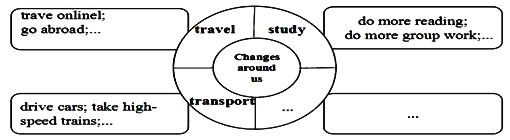
要求:1.不得使用真实的姓名和学校名;2.短文需要包括所有要点,并适当发挥。3.词数不少于90词 (文章开头已给出,不计入总词数)。
Changes around us
Great changes have taken place in our life around us.___________________________
____________________________________________________________________________________
查看答案和解析>>
科目:初中英语 来源:江苏省阜宁县2018-2019学年八年级下期中联考英语试卷 题型:单选题
Dr Ma loves his job and he going to work early now.
A. has used to B. was used to C. used to D. is used to
查看答案和解析>>
科目:初中英语 来源:广东省江门市2018-2019学年八年级下学期期中考试英语试卷 题型:单选题
It takes me less than 4 hours ______ a high-speed rail from Xi’an to Chengdu.
A. takes B. to take C. take D. taking
查看答案和解析>>
湖北省互联网违法和不良信息举报平台 | 网上有害信息举报专区 | 电信诈骗举报专区 | 涉历史虚无主义有害信息举报专区 | 涉企侵权举报专区
违法和不良信息举报电话:027-86699610 举报邮箱:58377363@163.com

