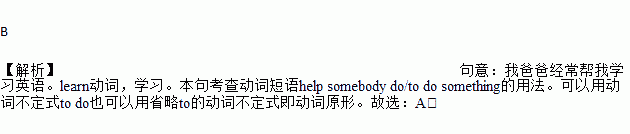
My father often helps me ________ English.
A. learning B. learn C. learns D. learned
B 【解析】句意:我爸爸经常帮我学习英语。learn动词,学习。本句考查动词短语help somebody do/to do something的用法。可以用动词不定式to do也可以用省略to的动词不定式即动词原形。故选:A。 天天向上一本好卷系列答案
 小学生10分钟应用题系列答案
科目:初中英语 来源:人教版七年级下Unit 11 How was your school trip巩固练习 题型:单选题
There isn’t _______ in the box.
A. something B. anything C. nothing D. everything
B 【解析】试题分析:句意:盒子里没有什么东西。not anything = nothing;故选B。查看答案和解析>>
科目:初中英语 来源:2018届人教版七年级英语下册练习:unit6测试卷(大卷) 题型:null
—Hello,can I speak to John,please?
—________
A. Do you know John? B. What's up?
C. This is John speaking. D. Oh!No!
C 【解析】句意:------喂,请找约翰接电话好吗?----我就是约翰。A. Do you know John? 你认识约翰吗? B. What's up? 什么事?C. This is John speaking. 我就是约翰;D. Oh!No! 哦,不。结合语境可知,答案为C。查看答案和解析>>
科目:初中英语 来源:人教版2017-2018学年新目标英语七年级下册unit 12 What did you do last weekend?巩固练习 题型:材料作文
书面表达。
根据所给的提示以“Jenny的周末”为题,写一篇短文。
1. 上星期六早上在家做作业、练习说英语。 下午看电视、打网球。 晚上看电影。
2. 星期天的早上打扫房间,然后去海滩。下午购物、访友。晚上参加晚会。
3. 他的周末繁忙但有趣。
________________________________________________________________________________________________________________________________________________________________________________________________________________________________________________________________________________________________________________________________________________________________________________________________________________________________________________________________________
Jenny had a busy weekend. Last Saturday morning, she did her homework and practiced speaking English at home. She watched TV and played tennis on Saturday afternoon. That night, she went to the movies...查看答案和解析>>
科目:初中英语 来源:人教版2017-2018学年新目标英语七年级下册unit 12 What did you do last weekend?巩固练习 题型:单选题
—Were you born in 1992?
—Yes, I __________.
A. am B. were C. was D. are
C 【解析】句意:-你是1992年出生的吗?-是的,我是。由此可知句子是一般过去时,主语是I ,故谓语应该用was。故选:C。查看答案和解析>>
科目:初中英语 来源:人教版2017-2018学年新目标英语七年级下册unit 12 What did you do last weekend?巩固练习 题型:单选题
We look on our students ______our sons and daughters.
A. as B. like C. to D. look like
A 【解析】句意:我们把学生看做自己的儿女。look on as意为“把……看作……”。 look like看起来像。故选:A。查看答案和解析>>
科目:初中英语 来源:人教八上Unit4 what 题型:单选题
-Of the three TV programs, which one do you think is ________?(2016年黑龙江龙东中考)
-I think A Bite of China is.
A. interesting B. more interesting C. the most interesting
C 【解析】本题意为:——这三个电视节目,你认为哪一个是最有趣的?——我认为《舌尖上的中国》是最有趣的;此处三者相比较,应为interesting的最高级形式;故答案选C。查看答案和解析>>
科目:初中英语 来源:牛津译林版2017-2018学年九年级英语上册Unit 8 Detective stories 单元提优测试卷 题型:阅读单选
With society developing fast, people's life standard has improved greatly. More and more people own their personal cars, thus causing many problems, such as air pollution, traffic jams(堵塞)and even traffic accidents.
In big cities,traffic jams happen every now and then,especially in rush hours. Cars cannot move smoothly and people feel upset on the way to work or home. For this, they are often late for work and even lose their jobs.
To solve these problems, the government has taken many measures(措施),such as broadening(拓宽)the roads, building more roads and subways, increasing buses and so on. The government has also suggested people taking public transports and using less personal cars.
1.The passage mainly tells us .
A. people's life has improved
B. the influence of more cars and the measures taken by the government
C. the government's measures
D. more people own their personal cars
2.What problems do more personal cars bring?
A. Air pollution. B. Traffic accidents.
C. Traffic jams. D. All the above.
3.When do the traffic jams often happen according to the passage?
A. In the rush hours of people going to work or home.
B. In the morning.
C. In the afternoon.
D. In the evening.
4.What's the meaning of the underlined word "smoothly" in the passage?
A. 慢地 B. 光滑地 C. 快速地 D. 顺利地
5.Which is NOT true according to the passage?
A. The government has broadened the roads.
B. The government has built more and more subways.
C. The government has increased buses.
D. The government encourages people to buy personal cars.
1.B 2.D 3.A 4.D 5.D 【解析】这篇短文讲述了由于人们拥有的私家车越来越多,从而导致了很多的问题,如交通堵塞、交通事故、空气污染等,因此政府正在采取一些措施来解决这个问题。 1.主旨大意题。根据短文的开头More and more people own their personal cars, thus causing many problems...查看答案和解析>>
科目:初中英语 来源:Unit9 My favorite subject is science巩固练习 题型:单选题
After class I usually play sports ______ two hours.
A. for B. of C. to D. in
A 【解析】句意:课后我通常做两个小时的运动。A. for为了,给,对于;B. of…的,属于;C. to到,朝;D. in在…里。for+时间段:表示做某事做了多长时间;结合句意和语境可知选A。查看答案和解析>>
湖北省互联网违法和不良信息举报平台 | 网上有害信息举报专区 | 电信诈骗举报专区 | 涉历史虚无主义有害信息举报专区 | 涉企侵权举报专区
违法和不良信息举报电话:027-86699610 举报邮箱:58377363@163.com