
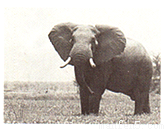
A young man from a village called Nawalapitiya married a young woman from Maiyuwa, a small village. They lived with the man's big family--his parents, his brothers, their wives and children. The family kept an elephant, in which the woman soon took a great interest. Every day she fed it with fruit and sugar.
Three months later, the woman went back to her parents' home after having quarreled (争吵) with her husband. Soon the elephant refused (拒绝) to eat or work. It appeared to be ill and heartbroken. One morning after several weeks, the animal disappeared from the house.
It went to the woman's home. On seeing her, the elephant waved its trunk and touched her with it. The young woman was moved by the act of the animal. So she went back to her husband's home.
1.The woman left her new home_________.
A. to visit her own parents in Maiyuwa
B. to see if the elephant would follow her
C. because she was angry with her husband
D. because she was tired of the large family
2.The underlined word "disappeared" in the reading means___________.
A. ran away B. lost C. hid D. remained
3.After the young woman left her husband's home, the elephant__________.
A. returned to the forest B. was sad because it missed her
C. went to look for a new home D. was sick because nobody fed it
4.How did the elephant express its feeling when it saw the young woman?
A. It waved its trunk and smiled. B. It touched her with its trunk.
C. It touched her and cried. D. It waved its trunk and ran around her.
5.The writer wrote the story in order to___________.
A. show that elephants are very clever
B. tell how a woman trained a wild animal
C. show that women care more for animals than men do
D. tell how an animal got a husband and a wife together again
1.C 2.A 3.B 4.B 5.D 【解析】本篇文章难度适中,主要讲述一个男的和一个女的结婚,男的家有一头大象,这个女的天天喂他,但是有一天,女的因为吵架生气回了娘家,大象很伤心,有一天,大象独自去了女方家,这个女的很感动,女子又回到了男方家。 1.细节理解题。根据Three months later, the woman went back to her ... 优质课堂快乐成长系列答案
科目:初中英语 来源:牛津译林版九年级下册英语 Unit 3 Robots 单元检测 题型:单选题
—Do you know ________ this dictionary belongs to?
—Let me see. Oh, it’s ________.
A. who; mine B. who; me
C. whose; mine D. whose; me
A 【解析】试题分析:句意:你知道这本词典属于谁吗?让我看看。哦,这是我的。Who谁;whose谁的;me我;mine我的。所以选A。查看答案和解析>>
科目:初中英语 来源:河南省郑州市2018届九年级上学期期末考试英语试卷 题型:完型填空
As a child, I truly feared the dark. I was also afraid of getting lost and not being liked by others. These fears were very real and caused me some___ moments.
Maybe sometimes the things in my room looked and sounded strange, which made me feel frightened. My mother always kept a small nightlight on for me. There was___ total darkness inside, but a street light or passing car lights made clothes hanging over a chair become the shape __a wild animal. Out of the comer of my window, I saw the curtains (窗帘)seem to move when there was no ___ .A tiny sound would seem a hundred times ___ than in the daytime. My heart would beat fast. All I could do was to ___ still (静止的)in bed so that the “enemy” would not discover me.
Another of my childhood fears was that I would get lost, especially on my way home from school. Every morning I ___ the school bus right near my home. That was no problem. After school, all the buses were lined up along the street, but I was afraid that I would get on the ___ one and be taken to some other strange places. On school trips to a park, I wouldn’t let the leaders out of my sight.
One of the processes (过程)of growing up is being able to ___ our fears. It can help us to deal with our lives when we grow up ____ we understand the things that scared us when we were children.
1.A. happy B. dangerous C. relaxing D. uncomfortable
2.A. sometimes B. usually C. always D. never
3.A. like B. in C. for D. against
4.A. sunlight B. rain C. wind D. snow
5.A. lower B. louder C. heavier D. lighter
6.A. hide B. lay C. spread D. lie
7.A. got off B. got on C. got in D. got up
8.A. fast B. slow C. wrong D. direct
9.A. overcome B. refuse C. support D. avoid
10.A. though B. if C. until D. before
1.D 2.D 3.A 4.C 5.B 6.D 7.B 8.C 9.A 10.B 【解析】试题分析:讲叙的是作者战胜对黑暗和迷路的恐惧,但是当孩子长大后,如果能理解孩子时那些让人害怕的事情,就能帮助他们应对生活。 1.句意:这些恐惧是非常真实的,给我带来了一些不舒服的时刻。A. happy形容词,高兴的; B. dangerous形...查看答案和解析>>
科目:初中英语 来源:河南省郑州市2018届九年级上学期期末考试英语试卷 题型:听长对话回答问题
听下面一段对话,回答以下小题。
1.Where is the woman now?
A. In a market. B. In a hotel. C. In a street.
2.What did the woman order for breakfast?
A. Sandwiches. B. Milk. C. Eggs.
1.B 2.A 【解析】此题为听力题,解析略。 1.此题为听力题,解析略。 2.此题为听力题,解析略。查看答案和解析>>
科目:初中英语 来源:河南省郑州市2018届九年级上学期期末考试英语试卷 题型:听短对话回答问题
What happened to Mary?
A. She missed the train. B. She took the wrong seat. C. She lost her wallet.
C 【解析】此题为听力题,解析略。查看答案和解析>>
科目:初中英语 来源:牛津译林版8下Unit 6 Sunshine for all 单元测试卷 (含答案) 题型:单选题
______ children Simon and Jim are! They help Mrs. Li clean the house every day.
A. How nice B. How brave
C. What nice D. What brave
C 【解析】考查感叹句的用法。根据下一句,可知这两个孩子“好”,使用nice;其中被强调部分的中心词是名词,用what。查看答案和解析>>
科目:初中英语 来源:初中英语情态动词练习题 题型:单选题
. —I hear you’ve got a set of valuable Australian coin. _______ I have a look? —Yes, certainly.
A. Do B. May C. Shall D. Should
B 【解析】句意:--我听说你有一套珍贵的澳大利亚硬币。我可以看一下吗?--当然可以。A. Do是助动词,没有词义,当一般疑问句是以do开头的问句时,答语可以用do来回答,这里答语没有用do,故排除A; B. May可以, May I+动词原形? 是表示请求对方许可的句型,多用于较正式的场合, 这个句型的肯定回答: (1) Certainly. Sure. (2) That’s OK/all...查看答案和解析>>
科目:初中英语 来源:初中英语情态动词练习题 题型:单选题
The poor man needs our help, ___ he?
A. need B. needn't C. does D. doesn't
D 【解析】句意:这位可怜的男士需要我们的帮助,是吗?这里是反义疑问句,指的是在陈述句后面附加一个简短的一般疑问疑问,用于对陈述句所说的事实或观点提出疑问或表示证实。陈述部分与附加部分的动词时态和动词性质应保持一致,但是肯定和否定形式却彼此相反,即陈述部分为肯定式时,疑问句部分用否定式;陈述部分为否定式时,附加部分用肯定式。在通常情况下,当陈述部分含有情态动词时,反意疑问句会重复前面同样的情...查看答案和解析>>
科目:初中英语 来源:广东省汕头市龙湖区2017-2018学年七年级上学期期末质量检测英语试卷 题型:单选题
---What _____ your friend ____?
--- Chicken.
A. do; like B. is; likes C. are; like D. does; like
D 【解析】句意:----你的朋友喜欢什么?----鸡肉。like作动词讲:喜欢。本句主语your friend三单,要借助助动词does, What does your friend like?:你的朋友喜欢什么?询问人的爱好;like作介词讲:像;本句主语your friend三单,be动词用单数is,What is your friend like?:你的朋友是什么样的人?询问某人的性...查看答案和解析>>
湖北省互联网违法和不良信息举报平台 | 网上有害信息举报专区 | 电信诈骗举报专区 | 涉历史虚无主义有害信息举报专区 | 涉企侵权举报专区
违法和不良信息举报电话:027-86699610 举报邮箱:58377363@163.com

