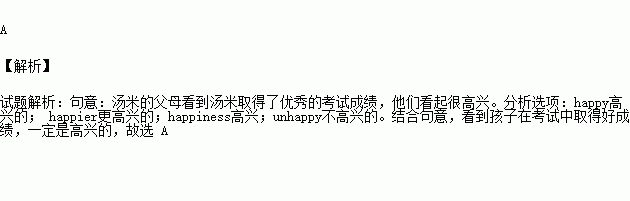
Tommy’s parents looked _______ when they saw his excellent exam results.
A.happyB.happier
C.happinessD.unhappy
科目:初中英语 来源:2015-2016学年天津津南区东片学区初一下期中考试英语卷(解析版) 题型:单项填空
—Is this _________ ruler?
—No. ________ is over there.
A. her; Her B. hers; Hers
C. her; Hers D. hers; Her
查看答案和解析>>
科目:初中英语 来源:2015-2016学年江苏无锡南长区初一下期中考试英语试卷(解析版) 题型:单词拼写
根据句意和汉语注释,写出单词的正确形式
1.There are a lot of (长椅) in the park. We can sit there and chat.
2.Don’t you know the new ___________ (经理) names?
3.“Is anybody there?” Jim asked, but nobody ___________ (答复) to him.
4.Do you know any (信息) about your sister’s school?
5.I went _________ (穿过) the bridge to find a new shop yesterday.
(B)词形变化
6.Today is my grandma’s __________ (ninety-nine) birthday.
7.My mother tells me not to play on the road. It’s very (danger).
8.Betty is very (luck) to win a prize (奖品) like this.
9.We like Li Ming because he listens to the teacher (care) in class.
10.Your camera is not as expensive as (she), but it works well, too.
查看答案和解析>>
科目:初中英语 来源:2014年上海市静安区中考三模英语试卷(解析版) 题型:单项填空
Edward doesn’t like his car. He thinks ________ is more modern than his.
A.IB.meC.mineD.my
查看答案和解析>>
科目:初中英语 来源:2014年上海市静安区中考三模英语试卷(解析版) 题型:单项填空
His pronunciation is better, for he kept ______ a short passage after the tape every morning.
A.to readB.reading
C.readD.reads
查看答案和解析>>
科目:初中英语 来源:2015年北京市海淀区中考二模英语试卷(解析版) 题型:阅读理解
All the time you spent memorizing multiplication tables(乘法表)may have made you a better mathematician, according to a new study. A team of scientists from Stanford University, in California, have shown how the brain reorganizes itself as kids learn math.
After a certain amount of time spent practicing math, kids can put away the calculator(计算器). They don’t even need to count on their fingers. They simply know the answers to subtraction(?), addition (+), and multiplication (×) facts. The quicker kids can recall basic math facts, the easier it is for them to solve more difficult math problems.
The Stanford University researchers observed(观察)the brain activity of 28 students, ages 7 to 9, for the study. They took scans of the students’ brains as the students solved math calculations without the help of a calculator, pen or paper. A calculation—three plus four equals seven, for example—flashed on a screen. The students pushed a button to say if the answer was right or wrong. The scientists also recorded the response speed, and what parts of the brain became active as the kids pushed the button.
These observations showed a process called fact retrieval. Rather than using their fingers to count, or scrawling out equations(列算式)on a piece of paper, the students pulled the answers from memory. It’s as if the answers to basic subtraction, addition, and multiplication problems are kept in a long-term storage part in the brain. The storage part was built from repetition. “Experience really does matter,” said Dr. Kathy Mann Koepeke of the National Institutes of Health.
Children make the changefrom counting to fact retrieval when they are 8 to 9 years old, the study says. This is the time when most students are learning basic addition and subtraction. When kids have basic math facts memorized, the brain has more free space to learn more difficult math.
This process has benefits for the future. The study showed, as kids got older, their answers relied more on memory and became quicker and more correct. Less brain activity was involved in counting. Some children make this change quicker than others.
Scientists hope to use this research to develop new strategies(策略)to help kids learn math at all levels. One strategy the study suggests is for students to test themselves in different orders—solving five times three before five times two, for example. Mixing up the order keeps the brain active. Keep these trainings up, and you may be a math whiz in no time.
1.In the study, kids put away calculators because they can ______.
A.use calculators well
B.scrawl out equations
C.recalling basic math facts
D.count on their fingers
2.The process of “fact retrieval”in Paragraph 4probably means ______.
A.picking out results by working together with their partners
B.finding out answers based on practicing carefully and patiently
C.trying out ways of dealing with problems by attending training
D.working out problems according to what they have remembered
3.What can we know from the study?
A.Kids need to practice using calculators to keep their brains active.
B.Math learners should change to counting practice at the age of 8 to 9.
C.Training by mixing up the order of multiplication tables can help learn math better.
D.Less brain activity may be involved in solving difficult problems when kids get older.
4.What is the best title of the passage?
A.Math from Memory
B.Strategy Development
C.Brain Reorganization
D.Training by Repetition
查看答案和解析>>
科目:初中英语 来源:2015年北京市海淀区中考二模英语试卷(解析版) 题型:单项填空
Henry______in a bank for four years since he left school.
A.worksB.worked
C.has workedD.is working
查看答案和解析>>
科目:初中英语 来源:2016届天津红桥区九年级下学期第二次模拟考英语试卷(解析版) 题型:单项填空
—Wish you good luck in this English exam.
—____
A. That’s OK. B. Thank you.
C. Congratulations! D. You’re welcome.
查看答案和解析>>
科目:初中英语 来源:2016届辽宁丹东第十七中学九年级第一次模拟考英语试卷(解析版) 题型:单项填空
The box is_____heavy____I can’t carry it.
A. so; that B. such; that
C. such a ; that D. so a ; that
查看答案和解析>>
湖北省互联网违法和不良信息举报平台 | 网上有害信息举报专区 | 电信诈骗举报专区 | 涉历史虚无主义有害信息举报专区 | 涉企侵权举报专区
违法和不良信息举报电话:027-86699610 举报邮箱:58377363@163.com