
I will go out for a walk if it tomorrow.
A. won’t rain B. isn’t rain
C. doesn’t rain D. doesn’t rainy
 名校课堂系列答案
科目:初中英语 来源:2014年吉林省长春市南关区九年级二模英语试卷(解析版) 题型:其他题
How do you pay for things? Do you usually use cash (现金), or do you like to pay by credit card(信用卡)? If you are like a lot of people, you probably have at least one credit card. Also, you might use it more often than you probably should.
Credit cards first became popular in the 1920s. At that time, businesses, such as hotels and companies, gave credit cards to their best customers (顾客). Unlike today’s credit cards, customers could only use these cards at the store or business that gave out the card. Customers had to pay for things in full. They couldn’t pay for something a little at a time.
In 1950, a businessman named MCNamara started a credit card company-Diners Club. Unlike earlier credit cards, this card could be used by customers at many restaurants. Customers liked the card because they didn’t have to carry a lot of cash with them. Restaurant owners liked the card, too. Why? They found out that customers usually spent more money when they could pay by credit cards.
In its first year of business, Diners Club provided 200 cards. The customers who got the cards from the diners Club could use them at 27 different restaurants. Today, Diners Club has 8 million customers, and they can use their cards in over 7.6 million businesses in more than 200 countries.
根据短文内容,回答问题。(10分)
1.Who could get credit cards in 1920s?
2.In 1920s, could the customers pay for something a little at a time?
3.Why did the customers like credit cards?
4.What made the restaurant owners happy when the customers used credit cards?
5.In how many countries can the credit card owners of Diners Club use their cards today?
查看答案和解析>>
科目:初中英语 来源:2014年吉林省长春市毕业生试测英语试卷(解析版) 题型:单项填空
—I don’t know how _______ this weekend
—Why not consider going hiking in JingYue Park? There are many places of interest there.
A. relax B. relaxed
C. to relax D. relaxed
查看答案和解析>>
科目:初中英语 来源:2014年吉林省九台市四模英语试卷(解析版) 题型:补充句子
A: Hello. Is that Uncle Sam’s Restaurant?
B: Yes. 1.
A: I want to know if you send take—away food.
B: Sure.
A: I’d like to order for dinner.
B: 2.
A: I’d like to have beef with potatoes and a hamburger.
B: OK. 3.
A: No, thanks. Please tell me how I can pay for you?
B: 4. By the way, what time do you expect your dinner?
A: About 6:00 pm.
B: Could you please leave your address?
A: Oh, yes. 5.
B: Thank you. See you then.
A. What would you like to have? B. What can I do for you, Madam? C. Anything else? D. How much would you like? E. Room 101 in Green Building. F. You can pay us when your food is sent. |
查看答案和解析>>
科目:初中英语 来源:2014年吉林省九台市四模英语试卷(解析版) 题型:单项填空
Would you mind me how this math problem ?
A. telling, to solve B. telling, solve
C. to tell, to solve D. to tell, solve
查看答案和解析>>
科目:初中英语 来源:2014年吉林省九台市四模英语试卷(解析版) 题型:单词拼写
1.Alice is my and I’m her father.
2.The post office is the supermarket and the bank.
3.Reading is a good hobby and I think we may learn from it.
4.My bike isn’t here. Could you yours to me?
5.All the students in Class 3 listen to the teacher .
查看答案和解析>>
科目:初中英语 来源:2014年合肥市九年级第四次段考英语试卷(解析版) 题型:其他题
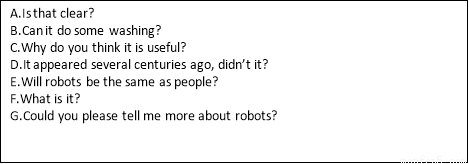
A: Today we are going to talk about a great invention. It looks like a human being. 1.
B: It’s a robot. 2.
A: Of course not. The first robot was invented in 1921.
B: 3. .
A: Sure. They can take the place of humans to do some boring work. They can also do a lot of dangerous work instead of humans.
B: 4.
A: No. Robots can do a lot of work instead of people in many ways, but people wouldn’t be replaced by robots. 5.
B: We get it.
查看答案和解析>>
科目:初中英语 来源:2014年合肥市九年级第四次段考英语试卷(解析版) 题型:单项填空
— I have just cup of milk for breakfast.
—That’s not enough.
A. a, aB. the, the
C. a, /D. / /
查看答案和解析>>
科目:初中英语 来源:2014年北京市门头沟区中考二模英语试卷(解析版) 题型:单项填空
—Lucy, let me __________ a look at your new watch.
—Ok, dad.
A. has B. have
C. to haveD. having
查看答案和解析>>
湖北省互联网违法和不良信息举报平台 | 网上有害信息举报专区 | 电信诈骗举报专区 | 涉历史虚无主义有害信息举报专区 | 涉企侵权举报专区
违法和不良信息举报电话:027-86699610 举报邮箱:58377363@163.com
