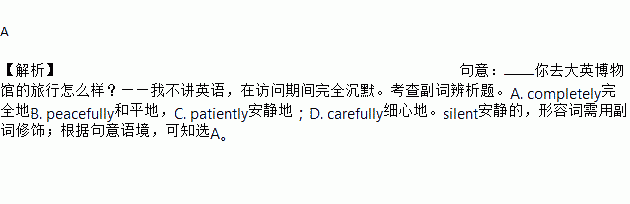
—How was your trip to the British Museum?
—I spoke no English and was _______ silent during the visit.
A. completely B. peacefully C. patiently D. carefully
A 【解析】句意:——你去大英博物馆的旅行怎么样?——我不讲英语,在访问期间完全沉默。考查副词辨析题。A. completely完全地B. peacefully和平地,C. patiently安静地;D. carefully细心地。silent安静的,形容词需用副词修饰;根据句意语境,可知选A。科目:初中英语 来源:人教版八年级上学期 Unit7 单元测试卷 题型:单选题
Tom will visit our farm _____two weeks.
A. in B. during C. before D. later
A 【解析】 句意:汤姆将在两周后参观我们的农场。in+时间段,表示将在某时之后;during+时间段, 表示在某段时间期间;before+时间段,表示在某段时间之前;时间段+later,表示“在某段 时间之后”,根据will visit可知此处是一般将来时,故与in two weeks连用。故选A。查看答案和解析>>
科目:初中英语 来源:2018年江苏省无锡市中考英语试卷 题型:单选题
The air pollution in the small town is getting worse. People have to wear thick masks almost every day. __________ !
A. What a shame B. What shame C. What a surprise D. What surprise
A 【解析】句意:小城镇的空气污染越来越严重,人们几乎每天都要戴厚厚的口罩。真遗憾!B,D表达错误,What a shame! 真可惜!What a surprise! 多么令人吃惊!结合语境可知,答案为A。查看答案和解析>>
科目:初中英语 来源:江苏省镇江市区2018届九年级英语二模试卷(无听力部分) 题型:材料作文
书面表达
初三的学习生活繁忙中有困惑、泪水,也有进步、喜悦。请根据表格提示,写一篇题为“Our school life in Grade Nine”的短文,介绍九年级的学校生活,并提出希望和建议。
在校 | 老师 | 工作认真负责,充满爱心 |
学生 | …… (至少发挥两点) | |
周末 | 作业 | 作业多.舍弃爱好 |
其它活动 | 锻炼,电视 | |
愿望 | …… (发挥一到两点) |
要求:
1.所写内容必须包括以上表格提供的所有信息,并适当发挥:
2.文章不少于90词,开头和结尾已给出,不计入总词数;
3.语意通顺,意思连贯,条理清楚,书写规范;
4.文中不得出现真实姓名、校名等信息。
Our school life in Grade Nine
It is more than half a year since we became a Grade Nine student. Here is what our school life is like now.
Our school life in Grade Nine It is more than half a year since we became a Grade Nine student. Here is what our school life is like now. At school, all of our teachers work very hard. Most of t...查看答案和解析>>
科目:初中英语 来源:江苏省镇江市区2018届九年级英语二模试卷(无听力部分) 题型:完型填空
In the US, most parents put lots of thought into which neighborhood they choose to live in. That’s because they want their children to ______ in a positive (正面的) environment.
I grew up in Point Breeze, a neighborhood in the East End of my hometown, Pittsburgh, Pennsylvania, US. It’s probably best known ______ Frick Park, a public park with many picnic areas, gardens, paths for hiking and biking and fields for playing sports. Frick Park is a _____ resource (资源) that the whole neighborhood ______. People use it for exercise and relaxation.
In addition to great green ______,Point Breeze has excellent public and private schools. _____, until age 14, my whole world was in Point Breeze.
My neighborhood was, in my ______, a world ruled by kids. I remember how my friends and I would walk around with a baseball, a football or - in later years -a video camera, exploring, ______
other kids and getting into adventures.
We’d race to the candy store on foot. We’d chase (追赶) down the ice cream truck on bikes. We’d come home when it got ______ outside, tired from play but eager (渴望) to wake| up and do it all again. We ______ felt scared, and we also never felt bored. That’s how childhood should be.
1.A. pick up B. end up C. save up D. grow up
2.A. to B. for C. as D. of
3.A. wonderful B. successful C. natural D. personal
4.A. celebrates B. shares C. buys D. refuses
5.A. forest B. food C. spaces D. lights
6.A. Therefore B. Because C. However D. Otherwise
7.A. life B. sunrise C. memory D. dream
8.A. searching B. controlling C. playing D. meeting
9.A. dark B. rainy C. angry D. excited
10.A. sometimes B. never C. often D. usually
1.D 2.B 3.A 4.B 5.C 6.A 7.C 8.D 9.A 10.B 【解析】试题这是一篇记叙文,文章讲述了美国父母对于孩子居住环境的重视。通过“我”居住环境的舒适和童年生活的美好告诉我们环境对成长的重要性。 1.句意:这是因为他们希望自己的孩子在一个积极的环境中成长。考查动词短语辨析题。A. pick up捡起;B. ...查看答案和解析>>
科目:初中英语 来源:江苏省镇江市区2018届九年级英语二模试卷(无听力部分) 题型:单选题
_______ big success the charity show was! We have raised a lot of money.
A. How B. What C. How a D. What a
D 【解析】句意:慈善演出是多么成功啊!我们筹集了很多钱。考查感叹句。感叹句通常有以下形式:1.How+形容词〔或副词〕+S+V…!2. What a/an +形容词+名词+S+V…! 若名词为不可数或复数的话,就不能用不定冠词。3. How+形容词+ a/an +名词+S+V…!本句big success是形容词短语,big以辅音因素开头,需用what a +形容词+名词+S+V…!结构。...查看答案和解析>>
科目:初中英语 来源:外研版八年级英语下期末复习试卷 题型:阅读单选
One day, an old dog walked into Noah’s yard. The dog didn’t look hungry or sick, just very tired. Noah gave the dog a few pats on the head. The dog followed Noah into the house, slowly walked down the hall, and fell asleep in the corner.
An hour later, the dog woke up, walked to the door, and Noah let him out.
The next day the dog was back. Once again the dog followed Noah into the house and stayed in the corner for an hour. It was the same story the next day, and the next, and the next one after that.
Noah was very curious (好奇的). “What’s up with this dog?” he wanted to know. He had an idea. Noah pinned a note to the dog’s collar (项圈):
To the owner of this dog,
Do you know that your dog comes to my house every afternoon and has a short sleep? Why?
Noah
The next day the dog came to Noah’s house with a new note pinned to its collar:
He lives in a home with 6 children, 3 under the age of 2. He’s trying to catch up on his sleep. He can’t find a quiet corner here. Neither can I! Can I come with him tomorrow?
1.When the dog walked into Noah’s yard, how did the dog look?
A. He looked hungry. B. He looked sick. C. He looked tired. D. He looked excited.
2.The underlined word “pats” means “______” in Chinese.
A. 奖赏 B. 敲击 C. 狗链 D. 轻拍
3.Why did the dog often come to Noah’s house?
A. To get some food. B. To take a short sleep.
C. To look after Noah’s children. D. To look for its children.
4.Which of the following is TRUE?
A. The dog slept in Noah’s house for a whole night.
B. The owner of the dog was tired of the children.
C. The owner of the dog is Noah’s best friend.
D. The owner of the dog didn’t ask his dog to stay at home.
5.Which is the best title for this passage?
A. A Tired Dog B. Noah Kept a Dog C. A Helpful Dog D. Noah Loved a Dog
1.C 2.D 3.B 4.B 5.A 【解析】本文讲述了一只狗因为主人家的孩子多,他睡不着觉,因此他非常累,跑到诺亚家来睡一小觉。 1.C 细节理解题。根据One day, an old dog walked into Noah’s yard. The dog didn’t look hungry or sick, just very tired.可知当...查看答案和解析>>
科目:初中英语 来源:江苏省牛津译林版八年级英语下册:Unit8 单元检测 题型:单选题
Hundreds of animals home if the forest disappear.
A. lost B. will be lost C. are lost D. will lose
D 【解析】句意:如果森林消失,成百上千的动物会失去家。动物和动作失去之间是主动关系,不需要使用被动语态,故排除B/C,这是主将从现的句型,if从句用一般现在时表示条件,主句用将来时表示可能出现的结果,意思是“成百上千的动物将会失去家”,用will lose来表示,故选D。查看答案和解析>>
科目:初中英语 来源:江苏省七年级下学期Unit7 单元练习 题型:单选题
— Mrs Lin is writing on the blackboard!
— Yes. And her handwriting (笔迹) is beautiful.
A. What a quickly B. How a quickly C. What quickly D. How quickly
D 【解析】句意:——林女士正在黑板上写得多么快啊!——是的。她的笔迹非常漂亮。修饰动词write,故用副词quickly,修饰副词quickly的感叹句,用how,故选D。查看答案和解析>>
湖北省互联网违法和不良信息举报平台 | 网上有害信息举报专区 | 电信诈骗举报专区 | 涉历史虚无主义有害信息举报专区 | 涉企侵权举报专区
违法和不良信息举报电话:027-86699610 举报邮箱:58377363@163.com