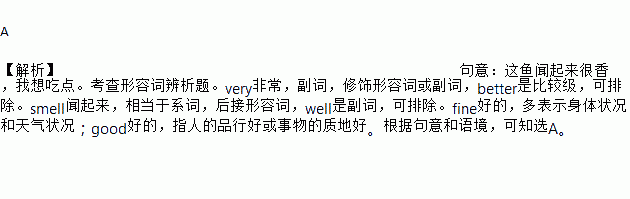
The fish smells very ______, I want to eat some.
A. good B. well C. better D. fine
A 【解析】句意:这鱼闻起来很香,我想吃点。考查形容词辨析题。very非常,副词,修饰形容词或副词,better是比较级,可排除。smell闻起来,相当于系词,后接形容词,well是副词,可排除。fine好的,多表示身体状况和天气状况;good好的,指人的品行好或事物的质地好。根据句意和语境,可知选A。科目:初中英语 来源:初二下册Module10单元测试含答案 题型:单选题
Which ship over there will you take,______ small one?
A. a B. the C. 不填
B 【解析】句意:你要哪条船,小的这个?考查冠词辨析题。a是不定冠词,泛指,一个,用于辅音因素开头的单数可数名词前;an不定冠词,泛指,一个,用于元音因素开头的单数可数名词前;the定冠词,特指,用在独一无二名词前,像地球,月亮,太阳。句末的one指代ship,small one是指“小的这个”,属于特指,需用定冠词the。根据句意和语境,可知选B。查看答案和解析>>
科目:初中英语 来源:人教版七年级下册英语 unit3 第6课时 测试1 题型:单选题
Forty and sixty is ________.
A. ninety B. eighty
C. seventy D. one hundred
D 【解析】句意“四十加六十等于一百”。one hundred一百,根据句意,故选D。查看答案和解析>>
科目:初中英语 来源:2018年徐州市中考总复习专项练习-词语运用 题型:语法填空
用括号中所给动词的正确形式填空,使短文完整。
Chen Qingyue, an eighth grader at Jane Lathrop Stanford Middle School, California, is a "star" on WeChat now. He 1. (start) using WeChat last August. "My Chinese classmate's mother advised me 2. (write) articles about my US experience. Then I got the idea," he said.
At the beginning, few of his stories 3. (read). But he didn't give up. "Gradually, I realized that followers prefer things that are"useful’ to them." His most popular article was how to deal with interviews when hoping for a US private high school.
Many readers encourage and thank him by 4. (send) messages and money. So far he 5.(receive) about 1,500 yuan. "I 6. (keep) writing at least until high school," he said.
1.started 2.to write 3.were read 4.sending 5.has received 6.will keep 【解析】短文大意:本文介绍了八年级学生陈青月在微信上写美国经历的事情。 1.句意:去年8月他开始用微信。start动词,开始;去年发生的事,所以谓语动词使用过去式started。故填:started。 2.句意:...查看答案和解析>>
科目:初中英语 来源:初二下册Module9单元测验含答案 题型:阅读单选
Going to a friend’s house is very exciting. You may spend time with a friend and get to see where he lives. So remember to be polite.
When to arrive
The first thing to remember is that when a friend invites you to his/her house, you need to arrive on time. If your friend tells you to come “around 3:00”, that means you can arrive a few minutes after 3:00, but it is also a good idea to arrive at the right time.
What to bring
Often it is also nice to bring something to your friend’s house. This could be a box of chocolates for you two to share(分享), or maybe a movie that you can watch together. You can also bring some flowers. A little gift(=present) is a nice way to show your friend that you are excited to be at his house.
How to greet (问候)
When you visit your friend’s house, you may also meet his parents. You should tell them who you are and they may tell you their names. As a child, I went to visit my friend Paul. I called his parents by their first names John and Mary. But now I know it is more polite to call them Mr. or Mrs. Smith. This will show them more respect(尊重).
It is a cool thing to visit a friend’s house. Be polite to your friend’s parents, and you will be invited again!
1.If your friend asks you to get to your friend’s house around 5:00 p. m, it is polite to arrive at ____ p.m.
A. 5:02 B. 4:50 C. 4:30 D. 5:30
2.The passage mainly(主要)tells us ______.
A. when to arrive at your friend’s house B. how to greet people
C. what to bring to your friend D. how to be a good visitor
3.It’s not good to bring your friend ____ when you go to his/her house.
A. a box of chocolates B. some flowers C. a movie D. some money
4.It’s the most respect for you to call your friend’s father _____ when you go to the friend’s house.
A. Mr Smith B. John C. Mary D. Smith
5.The passage may be from ________.
A. a notice(通知) on a wall B. a letter to a friend
C. an article in a magazine D. a piece of news in a newspaper
1.A 2.D 3.D 4.A 5.C 【解析】试题分析:本文从“什么时候到”“带些什么”和“怎样致意”三个方面,介绍了去朋友家做客需要注意的细节问题。 1.题意:如果你的朋友邀请你大约5:00到朋友家, 到达是礼貌的。考查细节理解题。根据If your friend tells you to come “around 3:00”, that means you...查看答案和解析>>
科目:初中英语 来源:初二下册Module9单元测验含答案 题型:单选题
You should ____ sorry to him when you do something wrong.
A. talk B. speak C. tell D. say
D 【解析】句意:当你做错某事时,你应该向他道歉。考查动词辨析题。A. talk谈话;B. speak说(某种语言);C. tell告诉/讲述;D. say说,后接说的话。say hello/ sorry to sb.向某人问好/道歉,是固定短语;根据句意和语境,可知选D。查看答案和解析>>
科目:初中英语 来源:初二下册Module9单元测验含答案 题型:单选题
—_____. Where is the Tian’an men Square?…—Go along this street and you'll not miss it.
A. Sorry B. Excuse me C. Hi D. Stop
B 【解析】句意:——请原谅。天安门广场在哪里?-沿着这条街走。考查日常交际用语。A. Sorry对不起,用于道歉;B. Excuse me请原谅,用于打扰别人的情况;C. Hi嗨,用于打招呼;D. Stop停止,表禁止。根据句意和语境,可知选ACD都不合语境,故B。查看答案和解析>>
科目:初中英语 来源:人教版七年级下册英语 unit3 第3课时 练习2 题型:句型转换
句型转换
1.Most students take trains to school in Japan.(对画线部分提问)
_________do most students_________ to school in Japan?
2.It usually takes me two hours to exercise every day.(对画线部分提问)
_________ _________does it usually take you to exercise every day?
3.Rueben gets to school by bus.(改为一般疑问句)
_________ Rueben_________ _________school by bus?
4.Miss Brown usually gets to school on foot.(同义句转换)
Miss Brown usually_________ _________school.
5.I take the subway to the factory.(同义句转换)
I get to the factory_________ _________.
1.Howget 2.How long 3.Doesgetto 4.walks to 5.by subway 【解析】 1.将take trains划线,问方式,用how,get to school到达学校,且空位于句首,故填How和get。 2.将two hours划线,问时间长短,how long多长时间,且空位于句首,故填How long。 3...查看答案和解析>>
科目:初中英语 来源:牛津英语八下unit1综合知识点单项选择专项训练75题 题型:单选题
—__________ten years ago? —It was a town with many trees in the past.
A. What did the town like B. How was the town like
C. What was the town like D. How did the town like
C 【解析】句意:——10年前这个城镇像什么?——在过去它是一个有许多树的城镇。根据be like像---,所以排除A/D;像什么,故选C查看答案和解析>>
湖北省互联网违法和不良信息举报平台 | 网上有害信息举报专区 | 电信诈骗举报专区 | 涉历史虚无主义有害信息举报专区 | 涉企侵权举报专区
违法和不良信息举报电话:027-86699610 举报邮箱:58377363@163.com