
科目:初中英语 来源:考前百天点拔与千题解答(中考阅读) 题型:050
It shook, rattled (嗄嗄作响), and groaned (呻吟). It wasn't pretty. It looked like a black box sitting on high, skinny wheels. But it could go anywhere, and it was cheap.
What was it? It was Henry Ford's Model-T ca-better known as the Tin Lizzie. This car was the most popular of all for nearly 20 years. It changed the American way of life forever.
Model T's were sold as fast as they were made. Eleven thousand were sold in 1908. They cost $850 each. Of course, you can't buy a new car for $850 any longer. The prices of new cars keep changing.
The line graph below shows how the average prices of American cars have been changing.
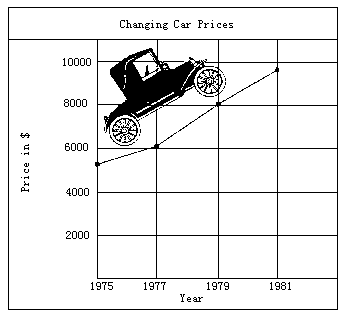
A line graph shows how something has changed. This kind of graph uses a simple line to show changes. If the line goes up, that means things have gone up in some way. If the line goes down, then something has gone down.
Suppose you want to find the average price of cars for 1977. Find 1977 at the bottom of the graph. Find the dot over the year. Then find the price across from the dot.
Use the line graph to answer the questions below.
1.What was the average price of a car in 1979?
[ ]
2.What does the line graph show about car prices?
[ ]
3.In what year did cars cost more than $4000 but less than $6000?
[ ]
4.Suppose you were looking for a new car in 1981. What would the average price have been?
[ ]
5.How did the average price of cars change from 1977 to 1979?
[ ]
查看答案和解析>>
科目:初中英语 来源:2013届江苏省南京市鼓楼区中考一模英语试卷(带解析) 题型:阅读理解
As you are soon on your way to Eastern Europe, here are a few tips on what you should pack. In general, pack lightly, with only the most basic clothes. People dress casually(随便地) in Eastern Europe, so you don’t need to bring along your smartest clothing.
Batteries: If your camera, flash, or other appliances run on batteries, bring enough supply along. Certain types of batteries don’t exist in Eastern Europe, and those that do often don’t last very long.
Cash: We have found it good to have supply of small-unit U.S. bills($1and $5) to use in hard–currency stores, to buy international train tickets, etc. The hard–currency stores never seem to have the right change.
Electric Current Adapter(转换器): If you bring any appliances, remember that the electricity in Eastern Europe uses 220 volts A.C., not the standard 110 volts of North America. A 110 volts appliance will soon burn out when attached to an unchanged 220-volt plug.
Language Tools: One of Europe’s biggest challenges is communicating with the local people since their languages are so different from our own. To help overcome difficulties, you might buy phrasebooks before you go — you won’t find them once you are in Eastern Europe.
Money Belt: A money belt is especially helpful when you have many documents to carry around ( as you always do in Eastern Europe). The best one we find is made by Eagle Greek Travel Gear, 143 Cedros Ave. (P. O. box 651), Solona Beach, CA 92075 (tel. 619/755 – 9399, or toll free 800/874 – 9925) outside California.
Traveler’s Checks: These are necessary. Bring your traveler’s checks in small to medium unit ($10, $20, or $50) to change a little bit at a time, so as not to be left with a lot of local money. To be on the safe side, be sure to copy down the check numbers in two places, just in case something happens to the checks.
【小题1】How many tips are mentioned in the passage?
| A.6 | B.7 | C.8 | D.9 |
| A.Appliances. | B.Money. | C.Language. | D.Clothes. |
| A.To tell you it’s not easy to stay in Eastern Europe. |
| B.To give you some advice on what you should pack when you’re in Eastern Europe. |
| C.To tell you something about the life in Eastern Europe. |
| D.To show you the life in Eastern Europe is different from that in your country. |
| A.1; 3 | B.3; 3 | C.2; 3 | D.2; 2 |
查看答案和解析>>
科目:初中英语 来源:2012-2013学年江苏省南京市鼓楼区中考一模英语试卷(解析版) 题型:阅读理解
As you are soon on your way to Eastern Europe, here are a few tips on what you should pack. In general, pack lightly, with only the most basic clothes. People dress casually(随便地) in Eastern Europe, so you don’t need to bring along your smartest clothing.
Batteries: If your camera, flash, or other appliances run on batteries, bring enough supply along. Certain types of batteries don’t exist in Eastern Europe, and those that do often don’t last very long.
Cash: We have found it good to have supply of small-unit U.S. bills($1and $5) to use in hard–currency stores, to buy international train tickets, etc. The hard–currency stores never seem to have the right change.
Electric Current Adapter(转换器): If you bring any appliances, remember that the electricity in Eastern Europe uses 220 volts A.C., not the standard 110 volts of North America. A 110 volts appliance will soon burn out when attached to an unchanged 220-volt plug.
Language Tools: One of Europe’s biggest challenges is communicating with the local people since their languages are so different from our own. To help overcome difficulties, you might buy phrasebooks before you go — you won’t find them once you are in Eastern Europe.
Money Belt: A money belt is especially helpful when you have many documents to carry around ( as you always do in Eastern Europe). The best one we find is made by Eagle Greek Travel Gear, 143 Cedros Ave. (P. O. box 651), Solona Beach, CA 92075 (tel. 619/755 – 9399, or toll free 800/874 – 9925) outside California.
Traveler’s Checks: These are necessary. Bring your traveler’s checks in small to medium unit ($10, $20, or $50) to change a little bit at a time, so as not to be left with a lot of local money. To be on the safe side, be sure to copy down the check numbers in two places, just in case something happens to the checks.
1.How many tips are mentioned in the passage?
A.6 B.7 C.8 D.9
2.Which of the following things may be the biggest challenge in Eastern Europe?
A.Appliances. B.Money. C.Language. D.Clothes.
3.Which of the following statements is NOT a fact according to the passage?
A. No shop in Eastern Europe accepts hard currency.
B. Travelers may need to carry many documents in Eastern Europe.
C. The electricity in Eastern Europe uses 220 volts A.C.
D. Eastern European languages can be a problem to foreign travelers.
4.What’s the writer’s purpose of writing this passage?
A.To tell you it’s not easy to stay in Eastern Europe.
B.To give you some advice on what you should pack when you’re in Eastern Europe.
C.To tell you something about the life in Eastern Europe.
D.To show you the life in Eastern Europe is different from that in your country.
5.What do the underlined words “change” and “check” probably mean according to the given dictionary entries(词条)?
change
1. [V] to become different 改变;变化
2. [V] to exchange money into the money of another country 兑换
3. [U] the money that you get back when you have paid for sth giving more money than the amount it costs 找给的零钱;找头
check
1. [V] to examine sth to see if it is correct, safe or acceptable 检查;审查
2. [C] an act of making sure that sth is safe, correct or in good condition by examining it 检查;查看
3. [C] a printed form that you can write on and sign as a way of paying for sth instead of using money 支票
A.1; 3 B.3; 3 C.2; 3 D.2; 2
查看答案和解析>>
科目:初中英语 来源:福建省中考真题 题型:阅读理解
| 阅读理解。 | |
If you buy any Good Life breakfast cereal ( 谷类食物), you'll get a ticket. Write your name and address on it and send it to PO Box 44, Brownsville, CA. Good Life will choose winners from all the tickets received. Prize winners will be announced in October. Good Luck! | |
Task1:选择下列正确选项填人文章空白处,使文章恢复原貌.
| |
Task2: 根据文章内容,给下列奖品标出正确的等级选项.  6 7 8 9 10 6. _____ 7. _____ 8. _____ 9. _____ 10. _____ |
查看答案和解析>>
科目:初中英语 来源:同步题 题型:阅读理解
| 阅读理解。 | ||||||||||
A. David B. King C. David Smith D. Smith 2. He lives in _______. A. No.6 Street B. the USA C. street D. China 3. His telephone number is _______. A. 93051 B. 213 -4669 C. 213 D. 213 - 4661 4. "E-mail "_______ " A. 地址 B. 邮编 C. 电子邮件 D. 传真 5. davidsmith@yahoo.com "_______" A. a computer B. fax C. a telephone D. a post-box | ||||||||||
查看答案和解析>>
湖北省互联网违法和不良信息举报平台 | 网上有害信息举报专区 | 电信诈骗举报专区 | 涉历史虚无主义有害信息举报专区 | 涉企侵权举报专区
违法和不良信息举报电话:027-86699610 举报邮箱:58377363@163.com
