精英家教网 > 初中英语 > 题目详情
12.听下面一段对话,回答第8至10小题
8.Why does the girl go to Peter's house?
A.To borrow his CD.       B.To chat with him.    C.To return his bike.
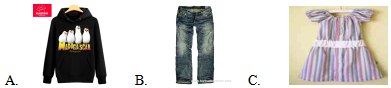
9.What does Peter want to buy?
A.Some food.B.Some books.C.Some clothes.
10.What is Jane going to do next Sunday?
A.To go to the secondhand bookstore.
B.To go hiking with Peter.
C.To go to Sunshine Home.

分析

解答 CBC

点评

练习册系列答案
相关习题

科目:初中英语 来源: 题型:填空题

2.请听一段对话,完成第7至第8小题.
7.Where is the woman going?
A.To France.
B.To Australia.
C.To China.
8.How is the woman going to visit her brother?
A.By plane.
B.By train.
C.By bus.

查看答案和解析>>

科目:初中英语 来源: 题型:填空题

3.请听一段对话,完成第6至第7小题.
6.Whe re is the man going?
A.TheGreat Wall.   B.Beijing Zoo.   C.The Summer Palace.
7.How will the man goth ere?
A.Bybike.   B.By car.   C.By bus.

查看答案和解析>>

科目:初中英语 来源: 题型:填空题

20.听第13段对话,回答第15至17小题.
15.What does the man want to buy?
A.Trousers.   B.Socks.  C.Shoes.
16.What color does the man like best?
A.White.   B.Black.   C.Blue.
17.How much money does the man spend?
A.$50.   B.$150.   C.$11.

查看答案和解析>>

科目:初中英语 来源: 题型:填空题

7.听第六段材料,回答第7~8小题.
7.What color is Lucy's pet?
A.White.B.Black.C.Brown
8.What does Bob keep?
A.A dog.B.Fish.C.Birds.

查看答案和解析>>

科目:初中英语 来源: 题型:听力题

17.听第三段对话,回答第5-6两个问题.
5.When is the man leaving for Venice?
A.tomorrow        B.next week       C.next month
6.What's the weather like in Venice at this time of year?
A.hot         B.warm         C.cold.

查看答案和解析>>

科目:初中英语 来源: 题型:填空题

4.听第一段对话回答11-12小题.
11.Where are the man and the woman?
A.At  home         B.At  school      C.In a shop
12.Where is the clock?
A.On the table    B.On  the bookcase      C.We don't know.

查看答案和解析>>

科目:初中英语 来源: 题型:听力题

1.11.How does Li Lei's mother go to work when it rains?

12.What does the woman want to buy?

13.What does the girl want to be when she grows up?
A.An engineer.
B.A youth worker.
C.A doctor.

查看答案和解析>>

科目:初中英语 来源: 题型:阅读理解

2.Many years ago,a French naturalist,Comte de Buffon,wrote some books about natural history.The books were a great success even though some critics(批评家)did not like them.
Thomas Jefferson did not like what Comte de Buffon had said about the natural wonders(奇观)of the New World.It seemed to Jefferson that Comte de Buffon had spoken of natural wonders in America as if(好像)they were unimportant.
This troubled Thomas Jefferson.He was also a naturalist,as well as a farmer,an inventor,a historian,a writer and a politician(政治家).He had seen the natural wonders of Europe.To him,they were no more important than those of the New World.
In 1788,Thomas Jefferson wrote about his home state,Virginia.While writing,he thought of its natural beauty and then of the words of Comte de Buffon.At that moment,Jefferson created a new word-belittle.He said,"Comte de Buffon believes that nature belittles her productions on this side of the Atlantic(大西洋)."
Noah Webster,the American word expert,liked this word.He put it in the English language dictionary in 1806,"Belittle-to make small,unimportant."
Americans had already accepted Jefferson's word and started to use it.In 1797,the Independent Chronicle(独立纪事报)used the word to describe a politician the paper supported."It is an honorable man,"the paper wrote,"so let the opposition try to belittle him as much as they please."
In 1872,a famous American word expert decided that the time had come to kill this word.He said,"Belittle shouldn't become English.And more critical writers of America,like those of Britain,feel no need of it."
This expert failed to kill the word.Today,belittle is used where the English language is spoken.
53.Thomas Jefferson was NOT aD.
A.naturalist         B.historian       C.politician     D.musician
54.We can infer(推断)that Jefferson created the word"belittle"out of hisA.
A.anger         B.excitement       C.kindness      D.responsibility
55.What can we know about the word"belittle"from the passage?B
A.It has already disappeared from the English language.
B.It had been used before it was put in the English language dictionary.
C.It is used to describe natural wonders now.
D.An American politician decided to kill this word in 1872.
56.What's the passage mainly about?A
A.How the word"belittle"came into being.
B.The argument about natural wonders.
C.Every word has a long history behind.
D.Noah Webster supported Jefferson's idea.

查看答案和解析>>

同步练习册答案