
Wheat ________ in before autumn in that place.
A. not was got
B. was got not
C. was not got
D. not got
科目:初中英语 来源: 题型:054
完型填空
Today more and more people live in cities. So there is usually ___1___ in a city to grow food. ___2___ of the land in a city is used for homes, shops, roads and parks. Most food for city people is grown in the country. It is often brought to the city by ___3___, train and plane. Some food ___4___ come into the city by car. Do you live in a city7 If you ___5___, think of all kinds of food you eat in a day. All of the food comes from the country. The wheat for your bread is grown on farm in the country. So are vegetables.
Water is ___6___ thing that cities get from the country. Everyone needs water every day. We use a little of it for drinking. But we use even more to ___7___ bathtub, run showers and wash streets.
The water used by cities comes mostly from rain. But people can not use the rain that falls on cities. The rain becomes dirty as it falls ___8___ dirty air. Once it hits city buildings or streets, the rain will pick up more dirt. It is not good for drinking or bathing.
So cities must reach out to the ___9___ country for water. There the rain falls through air onto trees and grass. The fallen rain runs ___10___ rivers and lakes. So it is important to keep both cities and the country clean.
|
(1) A .small place |
B .little |
C .a small place |
|
(2) A .Some |
B .Most |
C .Many |
|
(3) A .truck |
B .bike |
C .car |
|
(4) A .ever |
B .even |
C .once |
|
(5) A .live in |
B .do |
C .don't |
|
(6) A .one |
B .others |
C .another |
|
(7) A .fill |
B .fall |
C .full |
|
(8) A .across |
B .past |
C .through |
|
(9) A .tidy |
B .clean |
C .nice |
|
(10) A .down |
B .along |
C .into |
查看答案和解析>>
科目:初中英语 来源:2006年江苏省徐州市初中毕业、升学考试英语试题 题型:001
听力(共30小题,每小题1分,满分30分)
A)听句子,选出与句子内容相符的图画。每个句子读一遍。
A.

B.

C.

D.

E.

F.

B)听句子,选择相应的答语。每个句子读两遍。
7.A.Sorry, I haven't got one.
B.Thank you very much.
C.Leave it here.
8.A.That's true.
B.Go down this street.
C.Good idea!
9.A.Of course.
B.That's OK.
C.All right.
10.A.10 yuan.
B.Yes, I'll take it.
C.No, thank you.
11.A.I don't think so.
B.Last month.
C.I like it very much.
12.A.Really? Wonderful!
B.I go to school at seven.
C.It's time to go to school.
13.A.Is that David?
B.I'm sorry to hear that.
C.Hold on, please.
14.A.She is better now.
B.She likes dancing.
C.She is tall and pretty.
C)听下面6段对话。你将有10秒钟的时间来回答有关小题和阅读下一小题。每段对话读两遍。
听第一段对话,回答第15题。
15.Where does the dialogue probably happen?
A.In the classroom.
B.In the hospital.
C.In the factory.
听第二段对话,回答第16题。
16.How does the woman feel?
A.Angry.
B.Happy.
C.Surprised.
听第三段对话,回答第17和18题。
17.Who is the girl locking for?
A.Her classmate.
B.Her teacher.
C.Her mother.
18.What color is the hat?
A.Blue.
B.White.
C.Blue and white.
听第四段对话,回答第19和20题。
19.Where was the boy when the window was broken?
A.In the park.
B.Near the shop.
C.Under the window.
20.What does the woman do?
A.A nurse.
B.The owner of the shop.
C.A policewoman.
听第五段对话,回答第21和22题。
21.Where is the woman going?
A.Tianjin.
B.Nanjing.
C.Beijing.
22.Why does the man tell the Woman to be careful next time?
A.Because she is a person with bad luck.
B.Because she has got a chance to travel.
C.Because she fell off her bike and hurt her arm.
听第六段对话,回答第23和25题。
23.Can Mary write French well?
A.Yes, she can.
B.No, she can't.
C.We don't know.
24.What does the man think of Japanese?
A.It's difficult.
B.It's easy.
C.It is the same as German.
25.How many languages can Mary speak besides(除……之外)English?
A.One.
B.Two.
C.Three.
D)听短文,选择正确的答案。短文读两遍。
26.Peter Brown is ________.
A.an old farmer
B.a young farmer
C.an old doctor
27.The most modern building on the farm is ________.
A.the farmhouse
B.the building for cows
C.the chicken house
28.They have about ________ hens and ducks.
A.twenty
B.twelve
C.ten
29.What crop do they NOT grow?
A.Wheat.
B.Corn.
C.Rice.
30.Which sentence is WRONG?
A.The farmhouse is very nice.
B.Peter doesn't like riding horses.
C.Peter likes farming very much.
查看答案和解析>>
科目:初中英语 来源:2011年江苏省常州市中考模拟试卷(英语) 题型:阅读理解
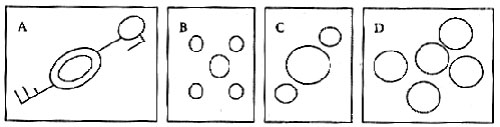
In the summer of 1978 an English man named Steven was driving his tractor through a field of wheat when he discovered something strange. Some of his wheat was lying on the ground. The flattened wheat formed(形成)a circle about six meters across . Around this circle were four smaller circles of flattened wheat.
Three years later a farmer who lived nearby discovered almost the same circles in one of his fields. These circles were larger—nearly 15 meters across . That same year , another English farmer discovered three circles of flattened wheat on his land—one large circle between two small circles. During the following years, farmers in England found circles in their fields more and more often.
The circles are called “crop circles” because they usually appear in fields of wheat or corn. The wheat in the circles lies on the ground but is never broken; it keeps on growing, and the farmers can later harvest it. Farmers always discover the crop circles in the morning, so the circles probably form at night. They appear only in the months from May to September. What causes the crop circles?
At first, people thought that some kids were making them as a joke, or that farmers were making them to attract tourists.(In fact, in 1991, two men said they made the circles themselves, but many scientists don’t believe them.) People tried to copy them: They tried to make circles exactly like the ones the farmers had found. They couldn’t do it. They couldn’t enter a field of wheat without leaving tracks, and they couldn’t flatten the wheat without breaking it.
Several times people reported seeing stranger objects near the fields where crop circles later appeared. Many people believe that these crop circles are the messages sent by living things from outer space(外层空间)or the marks left by their spaceships.
Scientists who have studied the crop circles try to find out what causes them. In the summer of 1990 some scientists spent three weeks in the part of England where many circles have appeared. They had all the latest high-tech equipment(最新高科技设备). The equipment—worth 1.8 million dollars—got nothing. But one night, as the scientists were watching a field, crop circles formed in the field behind them, which were quite different from the others. The scientists had neither seen nor heard anything.
When Steven discovered the crop circles on his land in 1978, he said, “It was just like something that had landed in the field from the air and gone back up again. I don’t know what to make of these things.”
Crop circles have appeared in England, Japan, the United States and Russia. Experts from all over the world have studied them, and they say what Steven said: They don’t know what to make of these things.
1.Which picture is probably the one formed in the field behind the scientists?
2.“Flattened wheat” means ___________.
A. broken wheat B. lying wheat
C. harvested wheat D. growing wheat
3.The passage is mainly about something ___________ .
A. that is done by living things from outer space
B. that cannot be solved but found all around the world
C. that cannot be made clear or understood
D. that is discovered and copied by the farmers
查看答案和解析>>
科目:初中英语 来源: 题型:阅读理解
Today 1 people live in cities.So there is usually little room in a city to grow food.2 of the land in a city is used 3 homes, shops, roads and parks.
Most food for city 4 is grown in the countryside.It is often brought to the city by truck, train and plane.Some food is even carried into the city by car.
Do you live in a city? If you 5 , think of all kinds of food you eat in a day.All of the food comes from the countryside.The wheat(小麦)for your bread is grown on farms in the countryside.So are vegetables.
Water is 6 thing that cities get from the countryside.Everyone needs water every day.We use a little of it for 7.But we use even more to 8 bathtubs (浴缸), run showers, and wash streets.
The 9 used by cities comes mostly(主要的) from rain.But people cannot use the rain that frills on cities.The rain 10 dirty as it falls 11 dirty air.Once it hits city buildings or streets, the rain will 12 more dirt(尘埃).It is not good for drinking 13 bathing.
So cities must reach out to the 14 countryside for water.There, the rain falls through 15 onto trees and grass.The fallen rain runs into rivers and lakes.So it is important to keep both cities and the countryside clean.
1.A.less and less B.more and more C.quite a few D.lots of
2.A.Some B.Most C.Many D.Few
3.A.for B.of C.by D.from
4.A.men B.women C.person D.people
5.A.live in B.don’t live in C.do D.don’t
6.A.one B.other C.others. D.another
7.A.eating B.drinking C.washing D.watering
8.A.fill B.fall C.full D.drop
9.A.water B.food C.tea D.vegetables
10.A.looks B.keeps C.changes D.becomes
11.A.across B.along C.through D.past
12.A.pull up B.pick up C.put up D.catch up
13.A.and B.but C.or D.so
14.A.clean B.tidy C.clear D.nice
15.A.smoke B.light C.cloud D.air (空气)
查看答案和解析>>
科目:初中英语 来源: 题型:阅读理解
 Speaking of farms, many people will think of the countryside at first. In their ideas, cities are usually very crowded and citizens(市民) don’t have enough space(空间) to grow vegetables and fruit there. However, American artists Britta Riley and Rebecca Bray wanted to find a way to solve the environmental problems in cities. They started the “Windowfarms Project” in New York in 2009 to turn cities’ windows into vertical(垂直的) vegetable farms.
In fact, Windowfarms are indoor window gardens built with recycled materials such as plastic bottles. The special hydroponic system(营养液栽培方式) makes it possible to grow plants in the rooms with windows. The project cares about innovation(创新), calling on people to research and develop(发展) gardening systems themselves. Britta and Rebecca have set up a website(网站) which asks everyone to share his or her ideas about window gardening with others. During the past three years, the site has got about 20,000 members around the world and they have created and tested at least 12 models for vertical hydroponic vegetable gardens. Britta got the idea of the Windowfarms Project from her dead grandpa who was an environmental engineer(工程师). Her goal is to give people a way of taking part in the “green revolution(革命)” by becoming window farmers. By growing their own vegetables inside, citizens will not only get healthy food, but also help make the air cleaner.
51. ____________ people think citizens don’t have enough space to grow vegetables and fruit.
A. No B. Lots of C. Few
52. ____________ started the “Windowfarms Project”?
A. Britta Riley B. Rebecca Bray C. both A and B
53. Which is NOT true?.
A. Windowfarms are indoor window gardens built with recycled materials.
B. They have created and tested 21 models for vertical hydroponic vegetable gardens. C. The project calls on people to research and develop gardening systems themselves.
54. Britta got the idea of the Windowfarms Project from __________.
A. herself B. her dead grandpa C. her aunt
55. Which is the best title for this passage?
A. Come and start Windowfarms together
B. Let’s do farm work
C. Grow wheat in the cities
查看答案和解析>>
湖北省互联网违法和不良信息举报平台 | 网上有害信息举报专区 | 电信诈骗举报专区 | 涉历史虚无主义有害信息举报专区 | 涉企侵权举报专区
违法和不良信息举报电话:027-86699610 举报邮箱:58377363@163.com
