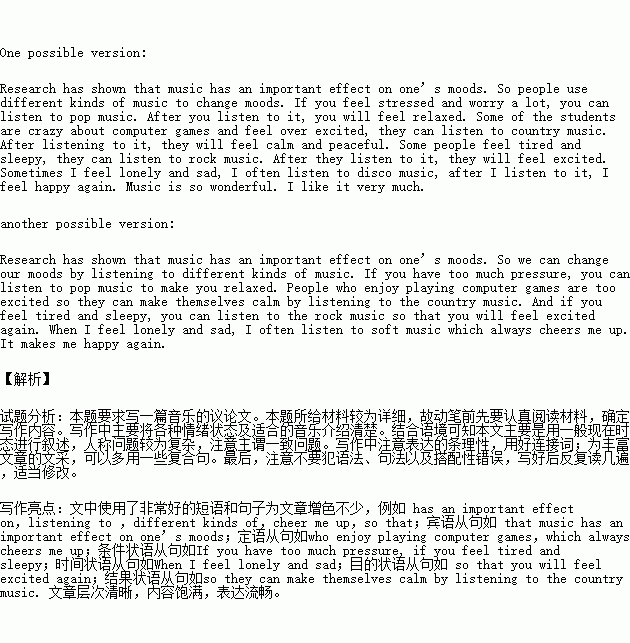
书面表达
研究表明音乐对人们的情绪有着重要的影响,因此人们用不同的音乐来调节心情。请根据下表提示内容,写一篇英语短文。
听音乐前的情绪状态 | 适用音乐 | 听音乐后的心境 |
压力大,过分焦虑 | 流行音乐 | 放松 |
沉迷电脑游戏,兴奋过度 | 乡村音乐 | 平静 |
困倦,疲劳 | 摇滚音乐 | 振奋 |
孤独,悲伤 | (考生自似) | (考生自拟) |
注意:1.词数80左右,开头已经写好,不计入总词数;2.内容必须包括上表中的要点;3.条理清楚,语句连贯;4.文中不得出现真实的地名、校名和人名等信息。
(参考词汇:摇滚音乐rock music)
A research has shown that music has an important effect on one’s moods.
 暑假衔接培优教材浙江工商大学出版社系列答案
 欣语文化快乐暑假沈阳出版社系列答案
科目:初中英语 来源:2015-2016学年重庆永川中学教研共同体七年级上学期期中英语试卷(教师版) 题型:句型转换
句型转换
根据所给提示,完成句子。每空一词,含缩略词。
1.He is an English boy . (改为一般疑问句)
_________ ________ an English boy?
2.His jacket is blue. (对划线部分提问)
_________ ________ is his jacket?
3.Her name’s Gina. (改为同义句)
_________ _________ Gina.
4.They are my cousins. (对划线部分提问)
_________ _________they?
5.She is my sister.(变否定句)
She________ ________ my sister.
查看答案和解析>>
科目:初中英语 来源:2015-2016学年安徽芜湖市七年级上学期期末考试英语试卷(解析版) 题型:阅读理解
阅读下列短文,从每小题所给的A.B.C.D四个选项中选出最佳选项。
Jenny is a nice girl. She likes to playing soccer. And she watches soccer games on TV every day. But she doesn't like playing baseball. She has some friends in her class. They are Tom, Mary, Susan and Linda.
Tom likes playing ping - pong. He has some nice ping - pong bats, He usually plays ping - pong with his friends after school. Mary likes playing volleyball. She is in a volleyball club(俱乐部).But she doesn't like playing basketball. Susan likes singing. She has many CDs. They are in her desk. Linda is ten years old. She doesn't like doing any sports, but she likes making model planes.
1.What does Jenny watch on TV every day?
A. Soccer. games. B. Baseball games.
C. Ping - pong games. D. Basketball games.
2.How many friends does Jenny have in her class?
A. Two. B. Three. C. Four. D. Five.
3.What does Tom usually do after school?
A. Play games with friends.
B. Play ping - pong with friends.
C. Make model planes by himself.
D. Play volleyball with classmates.
4.Where are Susan's CDs?
A. In the drawer. B. On the bed.
C. In the desk. D. On the bookcase.
5.Which of the following is True?
A. Jenny likes to play baseball.
B. Mary is in a basketball club now.
C. Susan likes singing and dancing.
D. Linda doesn't like playing soccer.
查看答案和解析>>
科目:初中英语 来源:2015-2016学年安徽芜湖市七年级上学期期末考试英语试卷(解析版) 题型:单项填空
You have tennis ball. Let's play____ tennis.
A. a; a B. a;/ C. a; the D. the: a
查看答案和解析>>
科目:初中英语 来源:2015-2016学年浙江海宁新仓中学七年级下学期自主学习测试英语试卷(解析版) 题型:阅读理解
We are learning English, but how can we learn English well? A student can know a lot about English, but maybe he can’t speak English.
If you want to know how to swim, you must get into the river. And if you want to be a football player, you must play football.
So, you see, you can learn by using it. You must listen to your teacher in class. You must speak English to your classmates every day and also you must write something in English. Then one day you may find your English very good.
1.You know a lot about English, but maybe _______ it
A. you can speak B. you can study
C. you can’t speak D. you can’t study
2.You must get into the water_______
A. to learn how to swim B. to skate
C. to jump D. to play
3.If you want to study English well, you must often________
A. speak English to your classmates
B. write something in English
C. listen to your teacher in class
D. A, B and C
4.Which is the best title(标题)for this passage?
A. How to study swimming
B. To be a good player
C. How to study English well
D. To learn English well is important
查看答案和解析>>
科目:初中英语 来源:2016届山西农业大学附属中学九年级12月月考英语试卷(解析版) 题型:阅读理解
A well-known poem by Tang dynasty poet Du Mu tells of a sad scene in early April: “Rains fall heavily as Qingming comes, and passers-by with lowered spirits go.”
This scene takes place on Tomb Sweeping Day, also known as Qingming Festival. Tomb Sweeping Day is a traditional Chinese festival. It began in the Zhou dynasty, over 2500 years ago. Chinese people celebrate it to remember and honor their ancestors(祖先). This year, it falls on April 4. Tomb Sweeping Day became a public holiday in the Chinese mainland in 2008. People have on day off for that day.
On this day, families bring flowers, food and wine to the grave sites(墓地)of their ancestors. They place cakes, fruits in front of the graves and some may burn joss paper, as money for the dead. After that, they sweep the tombs and cherish(怀念)the memories of their dead family members.
Tomb Sweeping Day gives us a chance to show respect to our ancestors and family members who have passed away and show that we miss them. This tradition shows that family values are an important part of Chinese culture.
Tomb Sweeping Day is also the beginning of the time for gardening and outdoor activities in China. Families often get together for outings or fly kites at this time.
1.The Chinese meaning of the underlined word “passers-by” is_______.
A、行人 B、陌生人 C、故人
2.Tomb Sweeping Day is celebrated for people to _______.
A、go out to fly kites
B、have a public holiday
C、remember and honor their ancestors
3.What can people take to the grave sites according to the passage?
A、Flowers, food, fruits and umbrellas.
B、Flowers, food, wine and joss paper.
C、Food, fruits, joss paper and kites.
4.Which of the following is NOT mentioned in the passage?
A、We have one day off for Tomb Sweeping Day.
B、Tomb Sweeping Day began in the Zhou dynasty.
C、People in the world celebrate Tomb Sweeping Day.
5.What does the passage mainly discuss?
A、People bring many things to the grave sites.
B、Du Mu wrote a poem about Qingming.
C、Tomb Sweeping Day is a traditional Chinese festival.
查看答案和解析>>
科目:初中英语 来源:2016届山西农业大学附属中学九年级12月月考英语试卷(解析版) 题型:单项填空
The little girl often makes his mother______her_____.
A、tell, something interesting
B、talk, something interesting
C、say, interesting something
查看答案和解析>>
科目:初中英语 来源:2014-2015学年山东省博兴市九年级上学期期中考试英语试卷(解析版) 题型:阅读理解
Dream culture is an important part of ancient Chinese culture. Dream interpreting(理解)is popular in China, and the most famous reference for dream interpreting is the book of Duke of Zhou Interprets Dreams.
Ancient Chinese people thought that dreams could suggest lucky and unlucky things. Since different dreams have different meanings, people can get meanings of good or bad luck by interpreting them. Actually, dream interpreting is not totally a superstition. It does have some scientific value.
● Dreams are the reflection of the facts. Many dreams are actually something about what happened in the daytime. This kind of dream can be easily understood without dream interpreting.
● Dreams are the body’s self-implication (自我暗示). Traditional Chinese medical science says that dreams are connected with the health condition of humans’ bodies. When Yin and Yang are imbalanced, dreams come into being. If someone dreamt that he or she was roasted by a big fire, it shows he or she might easily get angry or nervous.
● Dreams are usually different from the facts. It means that things will develop in the opposite direction when they become worse.
To some degree, Duke of Zhou Interprets dreams is scientifically reasonable. Over thousands of years has passed, the book still has many secrets waiting for us to explore.

1.According to the passage, dream culture .
A.is important in ancient Chinese culture
B.is unimportant in foreign culture
C.has no scientific value
D.is something about God
2.In the old days, Chinese people thought that dreams .
A.were very popular
B.could suggest lucky and unlucky things
C.couldn’t be interpreted
D.were always different from the facts
3.The underlined word “superstition” means “ ” in Chinese.
A.科学 B.预兆 C.梦魇 D.迷信
4.If you dream that you are roasted by a big fire, maybe you are
A.excited B. relaxed C.nervous D.bored
5.Which of the following is WRONG according to the passage?
A.Duke of Zhou Interprets Dreams is a book about dream interpreting.
B.When Yin and Yang are not balanced, you dream easily.
C.Dreams sometimes are the opposite of the facts.
D. There are no secrets in the book Duke of Zhou Interprets Dreams
查看答案和解析>>
科目:初中英语 来源:2014-2015学年内蒙古赤峰市宁城县九年级上学期期末考试英语试卷(解析版) 题型:单项填空
Look at our new school. It ____ last year.
A. built B. was built
C.is built D. will be built
查看答案和解析>>
湖北省互联网违法和不良信息举报平台 | 网上有害信息举报专区 | 电信诈骗举报专区 | 涉历史虚无主义有害信息举报专区 | 涉企侵权举报专区
违法和不良信息举报电话:027-86699610 举报邮箱:58377363@163.com