相关习题
 0  22847  22855  22861  22865  22871  22873  22877  22883  22885  22891  22897  22901  22903  22907  22913  22915  22921  22925  22927  22931  22933  22937  22939  22941  22942  22943  22945  22946  22947  22949  22951  22955  22957  22961  22963  22967  22973  22975  22981  22985  22987  22991  22997  23003  23005  23011  23015  23017  23023  23027  23033  23041  159627 

科目: 来源: 题型:

— Will you please take a message for the headteacher?
A. It doesn't matterB.Sure. I'll be glad to
C. Yes, I'll takeD.I can help you

查看答案和解析>>

科目: 来源: 题型:

 — Maths is as interesting as English, I think.
       . English is more interesting than maths.
A.I think soB.I don't think soC.I hope soD.I don't hope so

查看答案和解析>>

科目: 来源: 题型:阅读理解

Jim Green has been in China for more than two years. He has been to many interesting    31 in Beijing, but he has not yet been to many other parts of 32 . Last week he went to Mount Emei in Sichuan with his 33    .
Many people like to travel by 34 , but the Greens think that travelling by train is the best. It is much 35 and far more enjoyable than a rushed journey by air. They had a won­derful train ride to Chengdu 36  they went on to Mount Emei by bus.
The train was quite nice and tidy, and there weren't too many people in 37  sleeping car. The Greens could stand up and 38 around. It was a long journey, 39  none of them felt tired. They kept 40  the beautiful things out of the window. They talked, laughed and played cards. The conductor kept coming to give them hot water and 41  them newspapers. People nearby 42 with each other. A young man tried to speak English with Mr and Mrs Green. Jim thought the train was like a big moving party. He went to sleep quite 43 . He enjoyed listening to the sound of the running train and then fell asleep.
When Jim woke up the next morning, the train was already 44 Chengdu. His train ride seemed really 45 , but his memory (记忆) of the pleasant journey will last long.
【小题1】
A.schoolsB. placesC. villagesD. cities
【小题2】
A.EnglandB. AmericaC. ChinaD. the world
【小题3】
A.friendsB. classmatesC. fatherD. family
【小题4】
A.airB. busC. trainD. ship
【小题5】
A.cheaperB. dearerC. dirtierD. quicker
【小题6】
A.beforeB. whenC. afterD. while
【小题7】
A.myB. yourC. ourD. their
【小题8】
A.sitB. walkC. runD. dance
【小题9】
A.andB. soC. alsoD. but
【小题10】
A.lookingB. drawingC. watchingD. getting
【小题11】
A.readingB. buyingC. sellingD. writing
【小题12】
A.talkedB. spokeC. toldD. said
【小题13】
A.earlyB. lateC. easilyD. hard
【小题14】
A.besideB. toC. pastD. near
【小题15】
A.quickB. slowC. shortD. long

查看答案和解析>>

科目: 来源: 题型:

Most people in Britain live in small family groups. More than a quarter of houses in Britain have only got one person in them. Some of these are old people but some are people of twenty to thir­ty who choose to live alone. 35% of houses have two people in them, and another 17% have three people. 15% have four people in them, and the other homes have five or more.
The families in Britain are small. It is unusual for parents to have more than two children. When children are about eighteen or nineteen, they leave their parents' home, and they often go to a different city. Sometimes they only visit their parents two or three times a year.
【小题1】  How many houses in Britain have 3 people living in them?
A.8% of houses.B. 15% of houses.C.17% of houses.D.35% of houses.
【小题2】   At what age do children in Britain usually leave their parents' home?
A. About 18 or 19.B. About 20 or 21.
C. About 25 or 26.D. About 30 or 31.
【小题3】   What do you think the passage is?
A. An instruction.B. A report.C. A play.D. A joke.
【小题4】   What does the passage mainly tell us?
A. Young people in Britain.B. Old people in Britain.
C. Families in Britain.D. The population in Britain.
【小题5】   According to the passage, which of the diagrams is right?

查看答案和解析>>

科目: 来源: 题型:阅读理解

In a surprising result, the No. 69 Middle School girls' football team yesterday beat their school's boys' team. The boys' team often helped the girls with their training (训练). They had never lost to the girls before, but this time the girls beat them 4 — 3.
After the game, Wu Nai, head of the boys' team, was very unhappy. "We all thought this would be an easy game," he said. "We never thought a team of girls could beat us. This is the saddest day of my life. "
But Mr Hu, the boys' PE teacher, said he thought the girls should win. "The boys were too confident (自信)," he said. "I told them before the match that they needed to play well. They all thought that girls' football was a joke. Now they know better. They didn't play care­fully, and they lost."
The match had started well for the boys. After 30 minutes, they were winning 2 - 0. Their best player, Lu Ming, scored in the thirtieth minute. Earlier, the mid-field player, Ma Zhengquan, had scored the first goal in only the second minute of the match.
After the first half hour, the boys seemed to become too confident. At first, the girls had felt a bit nervous (紧张), but then they became more and more confident. Just before half time, Li Xiaolin made the score 2 - 1.
In the second half, the boys were the first to score. It was from Lu Ming. After that the boys became lazy, but the girls kept on working hard. Hao Meiling scored in the 68th minute, to make the score 3 — 2. Then Li Xiaolin scored twice in the last six minutes to make the last score 4-3. It was a surprising finish.
The girls' PE teacher, Miss Wang, was very pleased with their work. "They were great!" She said. "I told them they could win. I told them that the most important thing was teamwork. The boys' team had some good players, but my girls were a better team!"
【小题1】   Who scored the first goal in the match?
A.Lu Ming.B.Ma Zhengquan.C.Li Xiaolin.D.Hao Meiling.
【小题2】  How many goals did Li Xiaolin score?
A.One.B.Two.C.Three.D. Four.
【小题3】   Why could the girls' team beat the boys' in the football match?
A. Because the boys' team helped the girls with their training.
B. Because the boys had never lost to the girls before.
C. Because the boys' team won the first half.
D. Because the girls played together better and worked harder.
【小题4】   Which of the following is right?
A. The girls made only one goal in the first half.
B. The girls even made 3 more goals than the boys in the second half.
C. Many people thought the girls could beat the boys before the match.
D. The girls' team had some better players than the boys'.
【小题5】   Choose the right order according to the passage.
a.   The girls' PE teacher told them that they could win.
b.   Wu Nai, head of the boys' team was very unhappy.
c.   The match started well for the boys.
d.   The girls kicked the second goal in the match.
A. a-b-c-dB. b-c-d-aC. d-c-a-bD.a-c-d-b

查看答案和解析>>

科目: 来源: 题型:阅读理解

Except for a few times, Americans are not big present-givers. There's no exchange of presents among business people, and if one American tries to give another a present, it may look like that he wants to bribe (贿赂) him. Americans have learned that in some other countries people like to give presents to others, but among ourselves we don't see the need for presents.
Even friends may never exchange presents. When I go to foreign countries, I try to bring back little things for close friends, but nobody would feel unhappy if I didn't. I don't often re­member a friend's birthday, and few people outside of my family remember mine. If someone gave me presents too often, I'd get unpleasant. But a present from a foreigner - that kind from his or her homeland — won't go wrong, except to government employees (政府职员) who can't be given presents.
You usually open a present at once and in front of the person who gives it except Christmas and birthday presents. You should only say, "It's so nice. Thanks…" when you get Christ­mas or birthday presents.
You may want to bring a bottle of wine (葡萄酒) or flowers to a dinner party, but you're
never asked to.  Nobody will mind if you bring wine, but your friend may not use it that evening.
At Christmas we often give presents to our family and sometimes our friends. We also give presents to people who have been helpful during the year- doormen, babysitters, housecleaners, newspaper senders— anyone who has often helped us.
【小题1】   What does "close friends" mean in the passage?
A. The friends who are very kind.
B. The friends who live close to each other.
C. The friends who were once classmates.
D. The friends who you like most.
【小题2】  What kind of presents don't Americans usually open in front of the givers?
A.The small presents.B. Christmas or birthday presents.
C. The expensive presents.D. The presents for dinner party.
【小题3】           Why do Americans also give presents to housecleaners at Christmas?
A. To pay them.B. To help them.
C. To thank them.D. To make them work harder.
【小题4】   Which of the following do you think is right?
A. American business people don't want presents because they are rich enough.
B. The writer of this passage must be an American.
C. Everyone must give presents to one's family and friends at Christmas.
D. Government employees can get little presents from a foreigner.
【小题5】   What is the main idea of the passage?
A. Present-giving in the United States.
B. Customs (习俗) in the United States.
C. American people and present-giving.
D. When and how to give presents.

查看答案和解析>>

科目: 来源: 题型:

根据对话内容,从对话后的选项中选出能填入空白处的最佳选项。选项中有两项为多余选项。
A: Good morning, madam.
B:  【小题1】
A: Well, I'll try. What's the problem?
B:  【小题2】
A: I see. Well, we must get it down.
B:  【小题3】
A; By sending one of our police around to your house.
B:   【小题4】
A: Oh, I think so.
B:  【小题5】
A: How will you do that?
B: Oh, it is 21 Oxford Street.
C: It's my cat, Jennifer. She went up a tree, and she couldn't get down.
D: Hello, could you help me?
E: OK. Thank you.
F: Will he be able to help?
G: Good morning, sir.

查看答案和解析>>

科目: 来源: 题型:

根据下列句子中所给的汉语注释,写出句子空缺处各单词的正确形式。每个空格限填一个词。
【小题1】   The young man with glasses teaches        (我们) Chinese.
【小题2】   Will you please pass me a        (杯) of tea?
【小题3】  Your coat is green, but mine is        (红色的).
【小题4】   We had to stay        (在) home last Sunday, for it was raining all day.
【小题5】   He    (做) his homework late last night.
【小题6】   Both of the two girls look        (像) their father.
【小题7】   There are many        (公园) in Hangzhou.
【小题8】   Who's        (高), Lucy or Lily?
【小题9】   They go to        (上班) at eight every day.
【小题10】   Ann had her        (十) birthday in China. She felt very happy.

查看答案和解析>>

科目: 来源: 题型:

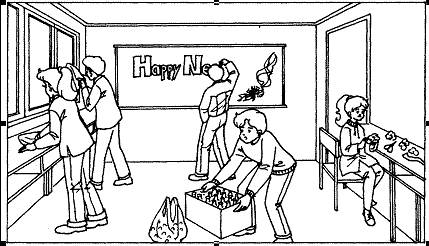
根据下面的图画,请你用英语写一篇短文。包括6—9个句子。短文要求达意、正确、连贯。

查看答案和解析>>

科目: 来源: 题型:

Math is a little difficult, but I still like it very much.
A.fewB.kindC.kind ofD.a few

查看答案和解析>>

同步练习册答案