
The forecast on Wednesday said no effective and widespread rainfall could be expected before May, _______ weak rainfall was likely in the second half of this month.
A. because B. so that C. although D. when
科目:高中英语 来源: 题型:阅读理解
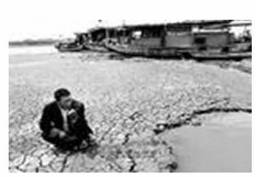 May 26, 2011—Cities and provinces along the Yangtze River in central China are struggling with the country’s worst drought in more than 50 years. Resource analysts say, the drought highlights(突出,强调) not only the impact of climate change, but also China’s long-lasting problem of lack of water and how it must balance that with the country’s enormous demand for energy and economic growth.
Poyang Lake is the largest freshwater lake in China and is just one example of how serious the drought has become. The lake, which is located in Jiangxi Province along the Yangtze River, has become smaller to less than half its usual size, and the lack of water has had a major impact on nearby fishing and farming.
With water levels so low, stretches of the Yangtze River have become impassable for cargo vessels(货轮), destroying supply chains that fuel factories along the river, and transport manufactured products and agricultural goods. Analysts say the river is used to transport about 100 billion tons of goods each year.
There is a lot of hydropower(水力发电)in the Yangtze River basin. For example, the Three Gorges Dam and power production from those sources have gone down by 20 percent according to some estimates(估算值) as a result of this drought. Any company that relies on that power is feeling the impact. Some are even being forced to ration their power use, he said.
According to Chinese state media, the drought has affected more than one million hectares of farmland in seven provinces in central China. Local government officials reportedly have fired more than 4, 000 cloud-seeding rockets into the sky to try to bring rain to dry regions along the river. The forecast, however, continues to be for little rain until at least next month.
64. What does the passage mainly talk about?
A. The Yangtze River.
B. The serious drought of the Yangtze River.
C. The negative effect of the drought along the Yangtze River.
D. The cause of the drought.
65. The areas along the Yangtze River haven’t had so serious a drought for _______.
A. 50 years B. more than 50 years
C. 10 years D. more than 20 years
66. Which of the following isn’t the cause of the drought?
A. The impact of climate change.
B. Long-time lack of water.
C. The increasing demand of energy and economy.
D. People’s attitude towards water.
67. What’s the meaning of the underlined word “ration” in Paragraph 4?
A. Increase. B. Limit. C. Affect. D. Stop.
查看答案和解析>>
科目:高中英语 来源: 题型:阅读理解
CHONGQING: A total
solar eclipse (日蚀) brought darkness to many places along the upper reaches of China’s
longest river, the Yangtze, at 9:15 am Wednesday. The moon’s shadow blocked out the sun, leaving only the solar corona (日冕) visible in west China’s Chongqing Municipality and Guang ’an City in neighboring Sichuan Province. The cities turned off many street lights to allow the public to better observe the total eclipse, which lasted about four minutes.
The July 22 eclipse is the longest total solar eclipse of the 21st Century. It is expected to pass across China from Tibet to the coastal city of Shanghai, where 300 million people live. Millions of eclipse-watchers crowded to the banks of the Yellow and Yangtze rivers early Wednesday to observe the spectacle. However, the weather in many Chinese cities along the full solar eclipse path is not favorable for observing the phenomenon, according to the China Meteorological Administration’s (气象局) forecast at 8 am.
Zhu Jin, head of the Beijing Astronomical Observatory (天文观测台), said although overcast (阴天) conditions blocked the view along the lower stream of Yangtze, the shadow of the moon was visible moving behind the clouds. The full solar blackout could be seen at 9:30 am from an observatory site in Anji, east China’s Zhejiang Province, a site chosen by Jay Pasachoff, head of the Solar Eclipse Working Group of the International Astronomical Union (IAU), and more 200 astronomers from more than 20 countries. “The weather is clear enough to observe the complete duration of the solar eclipse here in Anji. The forecast of the time of the eclipse proved to be accurate, ” said Zhang Hongqi, chief researcher of the National Astronomical Observatories.
It was raining in Shanghai, when the eclipse occurred at 9:35 am. The city put extra police on streets, and more than 30 police ships patrolled (巡逻) the coast. Only street lamps were left on, as the city turned off all landscape lighting to allow people to watch the solar eclipse.
1. Which of the following is RIGHT?
A. More than 20 foreign astronomers observed the eclipse.
B. The eclipse is the longest one in the history.
C. The eclipse brought darkness to many places in China.
D. The weather was clear enough for people to observe the eclipse.
2. The best place to observe the full solar blackout at 9:30 am could be in___________.
A. Chongqing B. Sichuan
C. Zhejiang D. Shanghai
3. The following has the same meaning as the underlined word EXCEPT____________.
A. went somewhere in large numbers
B. moved in a large crowd
C. gathered together
D. talked with each other excitedly
4. You can see the passage in a (n)__________.
A. newspaper B. guidebook
C. advertisement D. magazine
5. What can we infer from the passage?
A. Many cities turned off the lights on the streets to observe better.
B. The weather in some places isn’t favorable to observe the eclipse.
C. Shanghai sent out the police to observe the eclipse.
D. The eclipse attracted many astronomers from all over the world.
查看答案和解析>>
科目:高中英语 来源:2012届江苏省扬州市扬州中学高三开学考试英语卷 题型:阅读理解
In a natural disaster—a hurricane, flood, volcanic eruption, or other catastrophes—minutes and even seconds of warning can make the difference between life and death.Because of this, scientists are working to use the latest technological advances to predict when and where disasters will happen.They are also studying how best to analyze and communicate this information once it is obtained.
On September 29, 1998, Hurricane Georges made landfall in Biloxi, Mississippi, after damaging Haiti, the Dominican Republic, Puerto Rico, and several islands of the Caribbean badly with torrential rains and winds up to 160 km per hour.Few people lost their lives along the Gulf Coast of the United States, although hundreds died in the Caribbean.
This was a very different outcome from 1900, when a powerful Gulf Coast hurricane made an unexpected direct hit on Galveston, Texas, killing at least 6,000 people.
Vastly improved hurricane warnings explain the different circumstances at either end of the 20th century——residents of Galveston had no advance warning that a storm was approaching, while residents of Biloxi had been warned days in advance, allowing for extensive safety precautions(预防).
At the same time that people in Biloxi were thankful for the advance warning, some residents of New Orleans, Louisiana were less satisfied.A day before Georges made landfall, forecasters were predicting that the hurricane had a good chance of striking New Orleans.Because much of New Orleans lies below sea level, the city is at risk for flooding.Emergency management officials must begin evacuations(疏散)well before a storm strikes.But evacuation costs money: businesses close, tourists leave, and citizens take precautionary measures.The mayor of New Orleans estimated that his city' s preparations for Georges cost more than 50 million.After Georges missed New Orleans, some residents questioned the value of the hurricane forecasts in the face of such high costs.
The different views on the early warnings for Hurricane Georges show some of the complexities related to predicting disasters.Disaster prediction is a process of providing scientific information to the government officials and other decision makers who must respond to those predictions.
【小题1】What is the purpose of disaster prediction according to the passage?
| A.To identify the cause of disasters. |
| B.To save people' s lives and property. |
| C.To prevent natural disasters from happening, |
| D.To apply advanced technology to disaster prediction. |
| A.Puerto Rico. | B.New Orleans. |
| C.Biloxi, Mississippi. | D.Galveston, Texas. |
| A.the forecast hurricane did not hit the city |
| B.the hurricane warning arrived rather late |
| C.their preparations were made in vain |
| D.they suffered from a heavy hurricane attack |
| A.The different ways of disaster prediction. |
| B.Technological advances in disaster prediction. |
| C.The importance and uncertainty of disaster prediction. |
| D.The benefits and preparations of disaster prediction. |
查看答案和解析>>
科目:高中英语 来源:2010年高考预测试题英语(四) 题型:阅读理解
D
Wouldn't it be great if you could just look up at the sky and read the weather forecast right away?
Well, you CAN. The forecast is written in clouds. If you can read that writing, you can tell something about the atmosphere. With some practice, you can become a pretty good weather forecaster. Who knows, you might even do as well as meteorologists (气象学家).
Meteorologists use much more information than just the appearance of the clouds to make their forecast. They collect data from all over the world. Then they put it into powerful, high-speed computers.
This does give meteorologists an advantage, because they can track weather patterns as they move from west to east across the country.
But you have an advantage, too. You have your brains. You can look at the sky and get your data directly. A meteorologist uses a computer forecast that’s several hours old to make a local forecast.
What are you seeing when you look at a cloud? “A picture of what moisture (水气) is doing in the atmosphere,”says meteorologist Peter Leavit. There’s moisture throughout the atmosphere. Most of the time you don't see it, because it's in the form of an invisible gas called water vapor.
Sometimes, the temperature of the air gets cold enough to cause the water vapor to change to liquid water. That’s called condensation, and we see it happen all the time, for example, when humid air from the shower hits the cold glass of a mirror. When enough water vapor condenses, droplets form in the air. These droplets scatter light. A cloud is seen.
Watching clouds over a day or two tells you a lot more than a single cloud about the weather to come. Changes in clouds show changes in the atmosphere.
You should begin to notice patterns. Certain clouds, fol1owing each other in order, can signal an approaching storm. But don’t take our word for it; see for yourself.
53. According to the passage, ordinary people can tell the weather because __________.
| A. they can look up at the sky | B. they can read weather writings |
| C. information is stored in computers | D. clouds signal the weather to come |
| A. you can keep weather patterns in mind. |
| B. you have more powerful computers at home |
| C. your brain works as well as a high-speed computer |
| D. meteorologists give their data to you as soon as they get them |
| A. there are droplets in the air | B. light is scattered |
| C. moisture exists in the form of invisible gas | D. water vapor changes to liquid water |
| A. to become a weather forecaster | B. to collect data directly |
| C. to be an assistant to a meteorologist | D. to keep an eye on the weather |
查看答案和解析>>
科目:高中英语 来源:2013届江苏省高二上学期期中考试英语题 题型:完型填空
I will never forget the two impressive things that happened last winter. One of my classmates and I were 36 our project work late at night on my university's campus far from home. Since there was 37 in the forecast, I had worn a winter 38 to school that day with a raincoat in my bag.
Throughout our work on the project, I could 39 that my friend was tired from a very long day working. As we stepped outside to begin the 40 walk home, I 41 she was shivering(颤抖). The temperature had dropped to the low thirties (Fahrenheit) and she 42 had a sweater on. I 43 offered her my warm jacket. She accepted it and asked me what I 44 wear then. I told her I had another one and pretended that my 45 was a jacket. She said later that she 46 the next morning and the first thing on her mind was feeling moved about my 47 of the jacket.
Coincidentally(碰巧), the next day I went to an open-air play and I was freezing 48 I didn’t expect it to be so 49 . A person who I hardly 50 insisted that I wear his jacket. I was 51 touched by this warm gesture. He was so matter-of-fact(讲究实际的) about me 52 his coat, too: he simply took it off and handed it to me telling me that I should 53 it. I used to think that this vast universe was a cold 54 . It turns out that even when the temperature drops low, the people never 55 to warm each other's hearts.
1.A. starting B. destroying C. showing D. doing
2.A. rain B. fog C. snow D. cloud
3.A. suit B. jacket C. cap D. coat
4.A. think B. guess C. see D. check
5.A. easy B. short C. safe D. long
6.A. heard B. believed C. noticed D. expected
7.A. bravely B. nearly C. only D. usually
8.A. suddenly B. immediately C. madly D. calmly
9.A. would B. could C. should D. might
10.A. blouse B. sweater C. dress D. raincoat
11.A. ran away B. woke up C. fell ill D. got hurt
12.A. sale B. size C. color D. offer
13.A. though B. until C. since D. if
14.A. warm B. cold C. sunny D. dark
15.A. knew B. mattered C. loved D. blamed
16.A. deeply B. wrongly C. finally D. firmly
17.A. envying B. watching C. holding D. wearing
18.A. keep B. buy C. borrow D. throw
19.A. environment B. place C. wind D. situation
20.A. deny B. agree C. help D. stop
查看答案和解析>>
湖北省互联网违法和不良信息举报平台 | 网上有害信息举报专区 | 电信诈骗举报专区 | 涉历史虚无主义有害信息举报专区 | 涉企侵权举报专区
违法和不良信息举报电话:027-86699610 举报邮箱:58377363@163.com
