精英家教网 > 高中英语 > 题目详情
Eye See You
    Vision is the art of seeing what is invisible to others. -- Jonathan Swift
I walked into a wild third-grade classroom. Music was playing _36_, children were under tables applying make-up, kids were throwing a football indoors, and students were _37_ wherever they could find _38_. I was a mid-year _39_. The previous _40_ said he could no longer manage these children and _41_  without notice during the holiday break.
As soon as I walked in the room, I realized why he _42_. I sat down _43_  in my chair and began reading their _44_ softly. After each name, I _45_, asking God to help me understand that child. I then nailed a _46_ to the wall next to the chalkboard and began _47_ my name and a reading assignment on the board. I then asked each child to come to me, and tell me their names and what they wanted to learn. It was a _48_ task, because only two children there wanted to learn something! Rules were _49_, boundaries established, parents contacted. But the mirror saved the day -- no, the year! Unbeknownst(不知的) to the children, the mirror allowed me to see their every _50_ while I was writing on the board. They soon became _51_ as to how I knew who was misbehaving while I was writing on the board. When one student finally asked me, I told him I had a special teacher’s eye in the back of my head that my hair _52_. At first they did not believe me. _53_ they did begin to exhibit better behavior, especially while I wrote on the board, thinking I had magical _54_. I never told them differently. Why _55_ a good thing?
小题1:
A.softlyB.clearlyC.loudlyD.peacefully
小题2:
A.speakingB.laughingC.standingD.dancing
小题3:
A.spaceB.musicC.partnerD.joke
小题4:
A.representativeB.replacementC.referenceD.reward
小题5:
A.teacherB.headmasterC.directorD.leader
小题6:
A.retiredB.remainedC.resignedD.returned
小题7:
A.wentB.cameC.leftD.disappeared
小题8:
A.angrilyB.restlesslyC.indifferentlyD.quietly
小题9:
A.namesB.facesC.figuresD.minds
小题10:
A.preparedB.prayedC.protectedD.preferred
小题11:
A.boardB.mirrorC.crossD.picture
小题12:
A.notingB.copyingC.writingD.drawing
小题13:
A.difficultB.differentC.distantD.direct
小题14:
A.datedB.writtenC.workedD.set
小题15:
A.makeB.moveC.matterD.mind
小题16:
A.pleasedB.puzzledC.knownD.worried
小题17:
A.coveredB.hookedC.hungD.displayed
小题18:
A.SoB.HoweverC.AndD.But
小题19:
A.viewB.sceneC.eyesD.vision
小题20:
A.mix upB.bring upC.mess upD.burn up

小题1:C
小题2:D
小题3:A
小题4:B
小题5:A
小题6:C
小题7:C
小题8:D
小题9:A
小题10:B
小题11:B
小题12:C
小题13:A
小题14:D
小题15:B
小题16:B
小题17:A
小题18:D
小题19:D
小题20:C
文章讲述的是一个新来的老师利用墙上的一个镜子,让孩子们认为他有特殊的能力,从而制止了孩子们混乱的情况。
小题1:上下文,根据后面的children were under tables applying make-up, kids were throwing a football indoors可知,此时教室里肯定很吵闹,所以选择loudly
小题2:上下文,因为上文提到了在播放音乐,所以孩子们在跟着音乐跳舞。
小题3:句意理解,他们在能找到空的地方跳舞。
小题4:上下文,根据后文可知,一个老师辞职了,所以我是来代替他的。
小题5:上下文,没有老师能管得住他们。
小题6:句意理解,老师在假期里辞职了。
小题7:上下文,意为我理解了为什么老师会离开了,指的就是上文提到的辞职。
小题8:上下文,根据后面的内容可知,他是安静的坐在那里,
小题9:上下文,根据后面的each name可知,他是在读孩子们的名字。
小题10:上下文,根据后面的asking God to help me understand that child可知,他是在向上帝祈祷。
小题11:上下文,根据后面的But the mirror saved the day -- no, the year可知,此处是镜子
小题12:上下文,根据后面的on the board可知,他是在黑板上写下了他的名字和任务。
小题13:上下文,根据后面的because only two children there wanted to learn something可知,让孩子都过来是非常不容易的。
小题14:常用搭配,set rules意为制定规则,此处意为规则已经制定了
小题15:镜子让我能够看到孩子们的一举一动。
小题16:上下文,孩子们不知道我是通过镜子观察他们的,所以他们对于我是如何知道他们的一举一动,表示困惑。
小题17:句意理解,头发盖住的
小题18:此处表示转折,意思他们刚开始不相信我,但是他们开始表现好一点了。
小题19:上下文,根据前面的I told him I had a special teacher’s eye in the back of my head可知,此处值得是视力,能看得到他们的能力。
小题20:词组辨析,mess up弄糟 句意为为什么要毁掉一件好事情呢。
练习册系列答案
相关习题

科目:高中英语 来源:不详 题型:完形填空

I often read of incidents of misunderstanding or conflict. I ’m left 36 . Why do these people create mistrust and problems, especially with those from other 37
I was growing up in Kuala Lumpur in the early 1960s, 38  children from different races and religions played and studied 39  in harmony. At that time my family lived a stone s 40 from Ismail’s. And no one was bothered that Ismail was a Malay Muslim and Iwas an Indian Hindu——we just  41 our differences. Perhaps, our elders had not filled our heads with unnecessary advice,well 42  or otherwise.
We were nine when we became friends. During the school holidays, we'd   43  the countryside on our bicycles, hoping to   44 the unexpected. At times Ismail would accompany my family as we made a rare shopping trip to town. We would be glad of his 45 .
When I was twelve, my family moved to Johor. Ismail s family later returned to their village, and I   46   touch with him.
One spring afternoon in 1983, I stopped a taxi in Kuala Lumpur. I   47  my destination. The driver acknowledged my    48 but did not move off. Instead, he looked 49  at me. “Raddar?" he said, using my childhood nickname(绰号). I was astonished at being so 50 addressed (称呼). Unexpectedly! It was Ismail! Even after two 51 we still recognized each other. Grasping his shoulder, I felt a true affection, something 52  to describe.
If we can allow our children to be  53  without prejudice, they'll build friendships with people, regardless of race or religion, who will be 54  their side through' thick and thin. On such friendships are societies built and 55 we can truly be, as William Shakespeare once wrote, 44we happy few, we band of brothers".
小题1:
A.interestedB.pleasedC.puzzledD.excited
小题2:
A.partiesB.citiesC.villagesD.races
小题3:
A.whyB.whichC.howD.when
小题4:
A.togetherB.aroundC.aloneD.apart
小题5:
A.dropB.throwC.moveD.roll
小题6:
A.refusedB.madeC.soughtD.accepted
小题7:
A.paidB.meantC.preservedD.treated
小题8:
A.exploreB.searchC.discoverD.desert
小题9:
A.get throughB.deal withC.come acrossD.take away
小题10:
A.arrivalB.choiceC.effortD.company
小题11:
A.lostB.gainedC. developedD.missed
小题12:
A.statedB.orderedC.decidedD.chose
小题13:
A.attemptsB.instructionsC.opinionsD.arrangements
小题14:
A.anxiouslyB.carelesslyC.disappointedlyD.fixedly
小题15:
A.familiarlyB.strangelyC.fullyD.coldly
小题16:
A.departuresB.monthsC.yearsD.decades
小题17:
A.possibleB.funnyC. hardD.clear
小题18:
A.themB.themselvesC.usD.ourselves
小题19:
A.fromB.byC. withD.against
小题20:
A.stillB.otherwiseC.thenD.instead

查看答案和解析>>

科目:高中英语 来源:不详 题型:阅读理解

I still clearly remember that day. I was on the side of the road for close to four hours with my big Jeep. I put signs in the windows that said, “NEED A JACK(千斤顶)”.
Right as I was about to give up, a truck stopped and a man got off. He sized up the situation and went back to take a jack. After about two hours, we finished the job with sweats. We were both dirty. His wife produced a large water jug for us to wash our hands in.
I tried to put $20 in the man’s hand, but he wouldn’t take it, so instead I went up and gave it to his wife as quietly as I could. I thanked them up one side and down the other. I asked the little girl, their daughter, where they lived, thinking maybe I’d send them a gift. She said they lived in Mexico. They were in Oregon now so Mommy and Daddy could pick cherries for the next few weeks. After that, they were going to pick peaches, and then go back home.
After I said my goodbyes and started walking back to the Jeep, the girl called out and asked if I’d had lunch. When I told her no, she ran up and handed me a tamale(玉米粽子). I thanked them again and walked back to my car. When I opened the tamale, what did I find inside? My $20 bill! I ran to the van and the guy rolled down his window. He saw the $20 in my hand, started shaking his head smiling, and with what looked like great concentration said in English: “Today you, tomorrow me.” Then he rolled up his window and drove away, with his daughter waving to me from the back.
This family, working on a seasonal basis where time is money, took a couple of hours to help a stranger while others passed by quietly.
Since then I’ve helped many people like the Mexican family. I didn’t accept money. But every time I was able to help, I felt as if I was putting something in the bank.
小题1:From the passage we know that __________.
A.the Mexican man couldn’t speak English
B.the author’s car broke down on the road
C.the Mexican family came to Oregon for a visit
D.$20 was a small amount for the Mexican family
小题2:Why did the author give the money quietly to the man’s wife?
A.Because the man had refused to accept it.
B.Because the man’s wife needn’t wash her hands.
C.Because the author thought the Mexican family was poor.
D.Because the author thought the man’s wife would take it.
小题3:The Mexican man helped the author because he tended to think that ___________.
A.it was completely wrong for others to pass by quietly
B.it was quite easy to help the author mend the jeep
C.it was possible that everyone might get into trouble
D.the author was a polite stranger and deserved the help
小题4:Which of the following is TRUE about the author?
A.He hated those who didn’t offer help.
B.He would send a present to the family soon.
C.He wondered why they didn’t take the money.
D.He considered helping others as saving money in the bank.
小题5:What can we infer from the passage?
A.The Mexican family lived a richer life than the author.
B.The Mexican family did seasonal work in Oregon each year.
C.The author was inspired to help others by the Mexican family.
D.What made the writer moved was the tamale given by the girl.

查看答案和解析>>

科目:高中英语 来源:不详 题型:阅读理解

Normally when I pop in to see my parents, my mum bursts out of the house with a big smile. Not today. "Your brother," she says, "he's showered twice this afternoon. Does he know how much it costs to run this house?" Are we limiting water now? I didn't think the recession(萧条) had got that bad. My poor brother is a boomerang kid. Like 60 percent of guys immediately after university, he's back at home. Graduating £15,000 in debt and faced with unpaid internships(实习期) or low wages thanks to the flooding of the market with graduates, a lot of twenty some things simply don't have the necessary income or parental support to live independently.
Three years after getting their degree, most graduates are still not earning above the average salary. They have a near 50 percent tax burden, thanks to student loan repayments and council tax on top of income tax and national insurance. Unless you have parents who can afford to finance what is effectively a second home for them, returning to the parental nest is often the only affordable option.
The boomerang effect is becoming even more pronounced thanks to the recession. One in four of those losing their job during the downturn is under 25. Only 13 percent of final-year students have jobs. Home is the only place many are going: 111,000 16-29 year olds moved back home in 2008, five times the average of previous years.
Boomeranging is bad news. It poses serious problems for parents' finances. They've already supported their children through university, topping up loans with handouts, averaging £12,300 in total, to keep twenty somethings afloat. Now their retirement savings are being eaten away by continuously dependent children.
It’s bad for the returning kids too. Ambitious young people will be left frustrated, seeing their university peers from more wealthy backgrounds excel only because parents' money was there to support them through the initial period of poverty wages. Those living in rural areas are further disadvantaged by lack of access to cities where most new jobs are located. Half of all young people now feel they will not achieve their goals. Research by the Prince's Trust reveals that one-quarter of all 16-25 year olds are regularly down or depressed. And depression does not help self-motivation, the very trait needed to seek out job opportunities.
小题1:In paragraph 1, the mother’s criticizing her son for showering too often shows _________.
A.the price of water has increased
B.she thinks her son is selfish
C.her son is an economic burden
D.she wants to have a shower herself
小题2:What is the boomerang mentioned in the passage?
A.A person earning low income.
B.A person who has heavy tax burden.
C.A youth who cannot get parental support.
D.A youth returning to parents after graduation.
小题3:According to the passage, which of the following does NOT contribute to the tax bill of most young graduates?
A.National insurance. B.Income tax.
C.Council income. D.Student loans.
小题4:Who is comparatively most affected by the recession according to the passage?
A.Those who haven’t completed their university studies.
B.Those who are supported through by their parents.
C.Those who can have access to the urban facilities.
D.Those who were born into the well-off families.
小题5:Which is the best title of the passage?
A.Global Recession
B.Boomerang Kids
C.Unemployment Rate
D.Falling Incomes

查看答案和解析>>

科目:高中英语 来源:不详 题型:完形填空

Directions: For each blank in the following passage there are four words or phrases marked A, B, C and D.Fill in each blank with the word or phrase that best fits the context.
There once was a happy monkey in the jungle. He was wandering all days, eating delicious fruit when hungry and    36   when tired. One day he came upon a house, where he saw a bowl of the most beautiful   37  . He took one in each hand and ran back into the forest.
The monkey tried to eat them, but hurt his teeth. The apples were made of wood, but they were beautiful, and when the other monkeys said that they  38  them, he held onto them even tighter.
The monkey admired his new possessions proudly as he wandered the jungle. The two apples glistened (闪亮) red in the    39  , and seemed perfect to him. He became so attached to them that he didn’t even notice his    40   at first.
A fruit tree reminded him, but he felt the apples in his hands. He couldn’t bear to set them down to reach for the fruit. In fact, he couldn’t    41  , either, if he was to defend his apples. This proud, but less happy monkey continued to walk along the forest trails (小路).
The apples became    42  , and the poor little monkey thought about leaving them behind. He was tired and hungry; he couldn’t climb trees or collect fruit with his hands    43  . What if he just let go (释放)?
Letting go of such    44   things seemed crazy, but what else could he do? He was so tired. Seeing the next fruit tree and smelling its fruit, the monkey stopped. He   45   the wooden apples and reached up for his meal. He was happy again.
Like that little monkey, we    46   carry things that seem too valuable. Letting go of them seems crazy. But    47  : only with open hands can we receive something else.
小题1:
A.walkingB.shoutingC.restingD.crying
小题2:
A.bananasB.pearsC.stonesD.apples
小题3:
A.pickedB.carriedC.sawD.enjoyed
小题4:
A.rainB.sunC.shadeD.wind
小题5:
A.appearance B.hunger
C.dangerD.home
小题6:
A.stopB.lookC.relaxD.breathe
小题7:
A.heavierB.largerC.tallerD.cheaper
小题8:
A.fullB.dirtyC.wetD.flat
小题9:
A.inexpensiveB.delicious
C.strangeD.valuable
小题10:
A.finished B.droppedC.soldD.passed
小题11:
A.alwaysB.seldomC.neverD.sometimes
小题12:
A.copyB.writeC.rememberD.Hope

查看答案和解析>>

科目:高中英语 来源:不详 题型:完形填空

Time is very important in our lives. It organizes our everyday moments. However, time never had any importance in my life until I  16  a watch from my father, which organized my life and made me more responsible. It’s round in the center with two silver bands(带) that   17 around my wrist and all of it is made of silver.
I received this   18 on a gray – sky day. I had to go to the airport at 9:00 am to  19  up my Uncle Ali and take him to my father’s house.  20  , I was late because I was   21 out with my friends. Later on that day, around 11:00 am, I   22 my uncle, but I was very late for him. He had   23 the airport and taken a taxi to my father’s house.
I got to my father’s house at 2:00 pm that day and felt ashamed of myself at that moment. After I said hi to my   24 father and tired uncle, my father asked me to sit next to him and handed me this watch as a gift from him. Then he said, “Peter, did you have   25 with your friends today?” I answered, “Yes, father, and   26  apologized for not meeting my Uncle Ali.” He said, “What you   27  was not very nice and you should be sorry for your action.” I was ashamed and said, “Father, I’ll never do it again . I promise.” He said, “I hope today you learned something important, and this watch will be a   28  for you.” He told me to take this watch and use it as an organizer of my  29  .
I learned a very important lesson from my father: to respect time and never to be late to get someone. This watch is   30  to me, not because of its price, but because of the lesson that I learned from it.
小题1:
A.receivedB.acceptedC.wonD.achieved
小题2:
A.goB.runC.areD.attach
小题3:
A.cardB.letterC.giftD.thing
小题4:
A.callB.pickC.putD.bring
小题5:
A.OtherwiseB.BesidesC.HoweverD.Therefore
小题6:
A.goingB.leavingC.standingD.hanging
小题7:
A.forgotB.rememberedC.sawD.visited
小题8:
A.arrivedB.recognizedC.leftD.found
小题9:
A.kindB.happyC.angryD.doubtful
小题10:
A.lunchB.quarrelC.appointmentD.fun
小题11:
A.IB.heC.theyD.we
小题12:
A.saidB.didC.thoughtD.forgot
小题13:
A.wonderB.hopeC.requirementD.reminder
小题14:
A.lifeB.dayC.wayD.thought
小题15:
A.usefulB.necessaryC.differentD.Important

查看答案和解析>>

科目:高中英语 来源:不详 题型:阅读理解

My father is a smart man. He spent many years of his life listening to people’s arguments, first as assistant district lawyer and then as a judge. My dad knows rubbish rhetoric when he hears it.
One of his favorite phrases is: “If you don’t have anything smart to say, then don’t say it at all.” Yet, for all of his legal training and life experience, he can’t help but keep talking about the Mega Millions jackpot.
We all know the odds(几率)of winning the jackpot this evening with one ticket are extraordinarily low ... 1 in 175, 711, 536, to be exact. Still, people go out and buy hundreds of tickets with the hopes of becoming wealthier beyond their dreams. Why? There are two possible explanations for this “irrationality”(不理智).
One idea is that the way we calculate odds in our heads has nothing to do with mathematical odds in the traditional sense. We don’t go to the mathematical odds table and say, “Well, this would be a terrible investment. I think I’m better off putting my money in the bank!” Rather, it has everything with the ability to picture an event happening.
My father, for instance, watches the news every night and sees people winning the lottery(彩票). Therefore, he thinks the chance of him winning the lottery is much higher than they actually are.
The second thought is that the expected effect of playing cannot be represented merely by the odds. My father and, I’m sure, others get a thrill from the mere idea of winning. He loves imagining what it would be like to actually win and losing doesn’t really affect him. Sure, he’s disappointed, but it’s “better to have loved and lost than never to have loved at all.” When you combine the utility of thinking you can win with the utility of actually winning (no matter how small the chance of that occurring), it’s worth it for many people to spend the one dollar on a ticket.
My analysis is that both factors are at play in taking a chance on the lottery. My father and others really do underestimate the odds of winning, but the thrill of participation is not denied by a realistic assessment of the odds. Still, I would probably put my finger on the scale for the first explanation.
All told, a review of the odds of other events happening confirms that there just aren’t many events that occur with less frequency than your winning the Mega Millions jackpot. Look at the graph below, you may understand some:
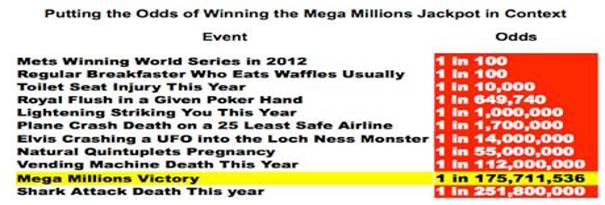
In many ways, it’s like the lottery, something that features often on television and about which people fantasize, but that rarely happens.
So, when you watch, along with my Pa, to see if your lucky number is drawn this evening, keep in mind three things: that your number almost certainly won’t come up; that you are still going to have fun; and that, finally, a lot of other things are more likely to happen—but getting eaten by a shark isn’t one of them.
小题1:It can be learned from the article that ________.
A.the Mega Millions jackpot is the last lottery to win in the world
B.a judge in that country can’t talk about lottery because it is illegal
C.the writer doesn’t buy lottery, for he never hopes to become rich
D.In spite of little possibility, a lot of people spend money on lottery
小题2:The function of the graph is to ________.
A.show chances that those things take place are fewer
B.support the writer’s arguments on the lottery tickets
C.indicate no one can win the Mega Millions jackpot
D.say shark attack death will seldom happen this year
小题3:Which of the following do you think the writer would probably agree with?
A.If one has mathematical odds, he can win the prize more easily.
B.Only those who have irrationality buy hundreds of lottery tickets.
C.The Mega Millions jackpot is very popular in the writer’s country.
D.Winning lottery is a shortcut to achieve the dream of being rich.
小题4:The underlined phrase “at play” in the 7th paragraph most probably means ________.
A.effectiveB.ridiculousC.contradictoryD.astonishing
小题5:What do you think is the best title?
A.The Popular Mega Millions JackpotB.Lottery is Merely a Trick
C.Mega Million is Like a Shark AttackD.Be rich, Buy Lottery Soon

查看答案和解析>>

科目:高中英语 来源:不详 题型:阅读理解


Quit while you're ahead
I am one of those people who are terrible at saying no.I take on too many projects at once, and spend too much of my time doing things I'd rather not be doing.I get work done, but it's not always the best I can do, or the best way I could spend my time.
That's why my newest goal, both as a professional and a person, is to be a quitter.
Being a quitter isn't being someone who gives up, who doesn't see important things through to the end.I aspire (渴望?) to be the opposite of that.The quitter I want to be is someone who gets out when there's no value in what he's doing, or when that value comes at the expense of something more important.
A friend of mine once told me, "I knew I was an adult when I could stop reading a book, even after getting 500 pages into it." Strange though it sounds, we all tend to do this.We get involved in something, realize we don't want to be a part of it, but keep on going.We say "Well, I've already invested so much time in this, I might as well stick it out."
I propose the opposite: quit as often as possible, regardless of project status or time invested.If you're reading a book, and don't like it, stop reading.Cut your losses, realize that the smartest thing to do is to stop before your losses grow even more, and quit.Instead of reading an entire book you hate, read half of a bad one and half of a good one.Isn't that a better use of your time?
Step back for a second.Let's learn how to say "no" at the beginning, or in the middle, and free up more of our time to do the things we'd like to be doing, and the things actually worth doing. Saying no is hard, and admitting a mistaken yes is even harder.If we do both, we'll start to make sure that we're spending our time creating value, rather than increasing our losses.Let's be quitters together.
小题1:The author wants to be a quitter, because he _____.
A.hopes to improve his personality
B.wishes to have more time for relaxation
C.expects to make more efficient use of his time
D.has found it hard to do several things at one time
小题2:In what circumstances does the author suggest quitting is a good idea?
A.When you feel tired and need a rest.
B.When you know a task cannot be finished.
C.When you meet with difficulties along the way in your life.
D.When you realize what you are doing is not worth the time.
小题3:If you stop reading a book you hate, the author might think that ______.
A.you are wise to cut your losses
B.it's a pity that you have wasted so much time
C.you should finish a book that you have started
D.you should regret choosing the wrong book
小题4:The message the author tries to convey is to ______.
A.learn to say no
B.live your life to the fullest
C.create more value
D.stop doing many things at once

查看答案和解析>>

科目:高中英语 来源:不详 题型:完形填空


A group of graduates got together to visit their old university professor.
The conversation soon turned into complaints about   1  in work and life. Offering his   2  coffee, the professor went to the kitchen and   3  with a large pot of coffee and a   4  of cups — porcelain, plastic, glass, crystal, some plain-looking, some expensive, some beautiful — telling them to   5  themselves to the coffee.
When all the students had a cup of coffee in hand, the professor said, “If you have   6 , all the nice-looking expensive cups have been   7 , leaving behind the plain and   8  ones. While it is normal for you to want only the best for yourselves,  that is the   9  of your problems and stress.”
“Be assured that the cup   10  adds no quality to the coffee.   11  it is just more expensive and in some cases   12  hides what we drink.”
  13  all of you really want is coffee, not the cup,   14  you consciously went for the best cups… And then you began   15  each other’s cups.”
“Now consider this:   16  is the coffee; the jobs, money and position in society are the cups.   17  are just tools to hold and contain life, and the type of cup we have does not define, nor change the   18  of life we live. Sometimes, by concentrating only on the cup, we   19  to enjoy the coffee. Value the coffee, not the cups! Don't let the cups   20  you… enjoy the coffee instead.”
小题1:
A.stressB.dreamC.sorrowD.truth
小题2:
A.friendsB.customersC.fellowsD.guests
小题3:
A.carriedB.returnedC.arrivedD.reached
小题4:
A.kindB.varietyC.sortD.number
小题5:
A.devoteB.exposeC.helpD.addicted
小题6:
A.searchedB.witnessedC.noticedD.discovered
小题7:
A.taken upB.brought inC.sold outD.cut down
小题8:
A.expensiveB.cheapC.beautifulD.usual
小题9:
A.pointB.answerC.sourceD.result
小题10:
A.by itselfB.on its ownC.for itselfD.itself
小题11:
A.At no timeB.At timesC.In no caseD.In most cases
小题12:
A.everB.evenC.neverD.hardly
小题13:
A.WhatB.ThatC.WhichD.Whether
小题14:
A.butB.soC.andD.for
小题15:
A.suspectingB.likingC.envyingD.eyeing
小题16:
A.LoveB.LifeC.FutureD.Failure
小题17:
A.TheyB.WeC.YouD.What
小题18:
A.quantityB.styleC.qualityD.standard
小题19:
A.haveB.hesitateC.forgetD.fail
小题20:
A.controlB.driveC.puzzleD.amaze

查看答案和解析>>

同步练习册答案

