
科目:高中英语 来源:2010年哈尔滨市第六中学高一下学期期末考试英语卷 题型:阅读理解
Whether you’re taking a trip alone or with your family, it’s easier to get sick when you’re in a new place because your body hasn’t had a chance to adjust to the food, water, and air in a new environment. Read the following tips on keeping your travel experience as healthy as possible.
Safe foods and drinks
What foods are safe to eat? Foods that have been boiled are generally safe, as well as fruits and vegetables that have to be peeled before eating. Avoid eating uncooked or undercooked meat.
Stay away from foods that require a lot of handling before serving.
Drink only bottled water when traveling. If you have to use the tap water, you should boil it first.
You can take it with you
When you’re packing, taking some painkiller and diarrhea medicine is a good idea. It’s also a good idea to pack some allergy (过敏) medicine even if you don’t take it at home, because people sometimes unexpectedly develop allergic reactions in a new environment.
Write it all down
Before you leave your sweet home, create a medical history form that includes the following information:
your name, address, and home phone number a s well as a parent’s daytime phone number
your blood typea list of any ongoing health problems, such as heart disease, diabetes, or AIDS a list of current medicines you are taking a list of allergies to medicine, food, insects, and animals the name, address, and phone number of a relative other th an your parent It also helps if you have some basic emergency medical knowledge, not only for yourself but also for helping others you may be traveling with. A great way to prepare for your trip is to take a first-
 aid or basic life support course before you go; if you’re traveling with a group, you should know where the first-aid kit is and what’s in it.
【小题1】 Which of the following word can replace the underlined word in Para.1?
| A.adapt | B.just | C.adopt | D.correct |
| A.Some travel tips | B.Danger of travel | C.Travel experience | D.First aid in travel |
| A.your own | B.one of your parents | C.one of your relatives | D.one of your friends |
| A.Taking a first-aid course. | B.Writing down your blood type. |
| C.Taking some necessary medicine. | D.Telling your parents’ your plan. |
查看答案和解析>>
科目:高中英语 来源:2010-2011黑龙江大庆中学高二下学期期中英语试卷 题型:阅读理解
Do you know how to prepare for and survive a major earthquake? According to Department of Conservation scientists, it is important to have the right answer to that question.
How to Be Prepared
Electricity, water, gas and telephones may not be working after an earthquake. The police and fire departments are likely to be tied up. You should be prepared to fend for yourself at least three days,preferably for a week. You’ll need food, water and so on. It’s also a good idea to decide ahead of time how and where your family will reunite if separated during a quake. You might choose an out-of-the-area friend or relative that family members can call to check on you.
________
If you’re indoors, stay there. Get under a desk or table. The kitchen is a particularly dangerous spot. If you’re in an office building, stay away from windows and outside walls and do not use the elevator. If you’re outside, get into the open. Stay clear of buildings, power lines or anything else that could fall on you. If you’re driving, move the car out of traffic and stop. Avoid parking under or on bridges or overpasses.
After an Earthquake
Check for fire. If you smell gas, shut off the main gas valve(阀). If there’s sign of damage to electricial wiring, shut off the power at the control box. If the phone is working, only use it in case of emergency(紧急情况). Avoid driving if possible to keep the streets clear for emergency vehicles. Be careful that things may fall out of cupboards when the door is opened, and also that chimneys can be weakened and fall with just a touch. Listen to the radio for important information and instructions. Remember that aftershocks, sometimes large enough to cause damage in their own right, generally follow large quakes. If you leave home, leave a message telling your friends and family your location.
【小题1】
The underlined phrase“tend for’’ in the second paragraph probably means“ ________’’
| A.look for | B.take care of | C.be proud of | D.think of |
| A.Before an Earthquake | B.After Making Preparations |
| C.While Staying at Home | D.During an Earthquake |
| A.You should stay away from the kitchen. |
| B.You should drive on a bridge. |
| C.You should turn off the power. |
| D.You should listen to the radio frequently. |
| A.The local people’s life will return to normal in a week. |
| B.There will be more earthquakes in a short time. |
| C.There won’t be any earthquakes in a short time. |
| D.The local people will stay at home waiting for help. |
查看答案和解析>>
科目:高中英语 来源:2012届福建省福州三中高三第五次月考英语试卷(带解析) 题型:阅读理解
“Write All About It”
Centerville High School Essay(论文)Contest
Rules
1. Students are asked to hand in essays of 500 to 700 words of their own work. Any essay containing material copied from another source will be disqualified.
2. Manuscripts should be typed double-spaced, with the student’s name, address, and grade level on a separate sheet of paper.
3. Essays must be turned in by 4:00 P.M. on November 30. They can be brought to Mrs. Elton in Room 104 or to Mr. Markham in the school library.
Essay-Writing Tips
1. Catch your reader’s interest—Your opening should immediately pull your reader into your essay. Asking a question or starting with a story, or surprising statement is some good ways to do this.
2. Create a picture—Use active words that show your reader what is happening. Instead of telling your reader that “the room was disordered,” paint a picture using active verbs and lively adjectives.
3. Have a purpose—Well-written essays do more than just describe an event or express a viewpoint; they also communicate a message.
4. Check for mistakes—Read your paper over to check for mistakes. Ask another student to read your paper. Another pair of eyes will often spot a mistake you have missed.
5. Format your essay—Neatly type your essay on white paper Choose an attractive cover for handing in. The computer lab will be open after school from 3:15 to 4:45P.M. each day this month so that students can use the computers.
Prizes
Winning essays will be published in the Centervile Times. Everyone who takes part in it will also receive a free pass to enter one school activity this year.
First Prize: $50 savings bond
Second Prize: Dictionary and reference book
Third Prize: Pen set and journal
【小题1】Which of the following rules is set for the essay contest?
| A.Students can write something exactly as it is written in other books. |
| B.Students’ personal information should be listed on another piece of paper. |
| C.Essays must be brought to Mr. Markham in the computer lab on November 30. |
| D.The students winning the second prize will be awarded a dictionary and a book. |
| A.Drawing a picture to go with the essay. |
| B.Trying to communicate an important idea to readers. |
| C.Asking a teacher to find the mistakes you haven’t found. |
| D.Making the essay short enough to hold the readers’ interest. |
| A.convince the students of the prizes available |
| B.explain how to write a good essay |
| C.inform the students of the essay contest |
| D.show how to organize an essay contest |
查看答案和解析>>
科目:高中英语 来源:安徽省灵璧一中2010届高三下学期第三次模拟考试英语试卷 题型:阅读理解
Rules
Students are asked to submit essays of 500 to 700 words of their own work. Any essay containing material plagiarized(剽窃) from another source will be disqualified.
Manuscripts should be typed double-spaced, with the student’s name, address, and grade level on a separate sheet of paper.
Essays must be turned in by 4:00 p.m. on November 30. They can be brought to Mrs. Elton in Room 104 or to Mr. Markham in the school library.
Essay-Writing Tips
Catch your readers’ interests--- Your opening should immediately pull your readers into your essay. Asking a question or starting with an anecdote, quotation, or surprising statement is a good way to do this.
Create a picture--- Use active words that show your readers what is happening. Instead of telling your readers vaguely that “the room was disordered”, paint a picture using active verbs and lively adjectives.
Have a purpose--- Well-written essays do more than just describe an incident or express a viewpoint, and they also communicate a message.
Check for mistakes--- Read your paper over to check for mistakes. Ask another student to read your paper and make suggestions. Another pair of eyes will often spot a mistake you’ve overlooked.
Format your essay--- Neatly type your essay on white paper. Choose an attractive cover for submission. The computer lab will be open after school from 3:15 to 4:45 p.m. each day this month so that students can use the computers.
Prizes
Winning essays will be published in the Centerville Times. Every contestant (选手) will also receive a free pass to enter one school activity or athletic game this year.
First Prize: $150
Second Prize: Dictionary and thesaurus
Third Prize: Pen set and journal
Special thanks to the Centerville Writers’ Association for the prizes to help encourage our aspiring authors. Good luck to all contestants.
1. The first writing tip given is mostly about________.
A. the use of quotations and anecdotes in an essay
B. using active verbs and lively adjectives
C. How a student should begin an essay
D. how to submit your essays
2. The prize section of the poster is included in order to _________.
A. show organizations how to donate prizes
B. inform teachers of the prizes available
C. persuade students to enter the essay contest
D. convince students to buy the local newspapers
3. Thanks are given to the Centerville Writers Association because it has_________.
A. offered to judge the contest B. prepared the essay-writing tips
C. organized the essay contest D. donated prizes for the contest
4. What do we know by inference from the passage?
A. The computer lab usually closes at 4:15 p.m. each day.
B. Winning essays will be published in the Centerville Times.
C. Every contestant will benefit from the essay contest.
D. The essay contest is held annually at Centerville High School.
查看答案和解析>>
科目:高中英语 来源:2011年湖南省高三年级下学期期中考试英语试卷 题型:填空题
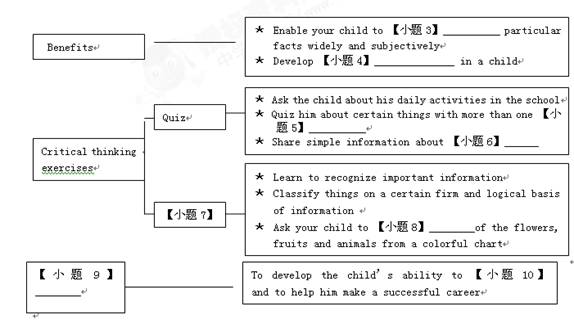
Critical thinking means thinking logically and developing an ability to ask questions or ask for evidence for a particular subject. Developing critical thinking skills in a child through the right critical thinking exercises is very important.
Critical thinking develops the ability of subjective analysis of a particular fact. Critical thinking is to evaluate the reason behind a particular fact. All possible viewpoints must be thought about before analyzing a fact, and this develops problem-solving skills in a child.
Here are some exercises you can use to encourage your child to think critically.
Quiz your child. Ask your child about daily activities that he does in the school. Quiz him about certain things that do not have a single correct answer. This will increase his ability to think about the things he’s just learned in class. Keep on telling your child simple information about nature, like the seasons when flowers bloom. You can either ask him questions or just explain to him in a casual way.
Recognize and classify. For critical thinking, your child must learn to recognize important information that is closely connected with the subject. Classification of things on a certain firm and logical basis of information is included in the critical thinking ability. Colorful toys or images can be included in teaching critical thinking. Ask your child to identify the names of the flowers, fruits and animals from a colorful chart.
Critical thinking exercises are not intended to make your child intelligent, but it is about making him successful in his decision-making ability and helping him make a successful career. Although thinking habits are cultivated(培养) in early childhood through exercises, they are indeed helpful for a lifetime.
Title: Critical Thinking Exercises for Children

查看答案和解析>>
湖北省互联网违法和不良信息举报平台 | 网上有害信息举报专区 | 电信诈骗举报专区 | 涉历史虚无主义有害信息举报专区 | 涉企侵权举报专区
违法和不良信息举报电话:027-86699610 举报邮箱:58377363@163.com
