
Can you escape from a sinking vehicle? The answer is obviously yes. “But you’ve got to be quick.” said Gordon Greisbeck, a professor from the University of Manitoba’s. Here he gives four rules of survival.
Rule 1. Don’t call 911 until you are out of the car. You should get out of that vehicle immediately after unbuckling. Think about calling 911 once you’ve made it out alive. ‘Time is very important,” Greisbeck says, “If you touch your cell phone, you’re probably going to die.”
Rule 2. Don’t open the door. Roll down or break the windows instead. Opening the door is very difficult against the water pressure and it also allows so much water into the vehicle that it will speed up the sinking process. Since most vehicles now have electronically controlled windows, it is probable that the circuits (电路) will short before you have a chance to roll them down. So you’ll need a tool like the Life Hammer to break the windows open. And make sure these tools are within reach at all times.
Rule 3. Children first. Everybody should get out of their own window if possible, but the kids are going to have a harder time fighting through the rush of water, so push them out if you have to. Greisbeck suggests starting with the oldest kids and taking the youngest out in your arms.
Rule 4. Get out. Swim through the broken windows as fast as possible. You can’t imagine what will happen in the next second. Any intention to take your belongings can be deadly.
If you’ve failed to get the windows rolled down or broken, you’ll still have the slightest of chances to escape. Once water fills the car, the pressure will be equalized and you will be able to open the door. But to do this, you will also have to be expert at holding your breath in an extremely stressful situation.
| How to 【小题1】___ a Sinking Vehicle | ||
| Rules | Details | 【小题2】___ |
| Don’t call Immediately. | Make a phone call once you’ve 【小题3】___ in escaping. | Time is of great importance. |
| Don’t Open The door. | Roll down the windows or use a Life Hammer to make the windows 【小题4】__. | ◆The water pressure can make opening the door 【小题5】___. ◆The vehicle will sink 【小题6】___ if you open the door. ◆Most cars have electronically controlled windows and the circuits will 【小题7】___ short. |
| Children first. | Push the oldest kids out first, and then go out with the youngest in your【小题8】___. | Kids have more difficulty 【小题9】___ through the rush of water. |
| Get out. | Swim through the broken windows as fast as possible. | What will happen is【小题10】___ your imagination. |
【小题1】Survive
【小题2】Reasons
【小题3】succeeded
【小题4】broken/open
【小题5】difficult/hard
【小题6】faster
【小题7】probably
【小题8】arms
【小题9】fighting/struggling
【小题10】beyond
解析试题分析:如果你驾驶的汽车不慎落入水中,能不能逃生呢?可以考虑一下Gordon Greisbeck教授所说的四原则:1.从车里逃出来再打电话911;2. 不要开门;3.儿童优先;4. 生命第一,要尽快逃离车子。
【小题1】根据Can you escape from a sinking vehicle? The answer is obviously yes.可知选Survive。本文主要讲了当机动车掉入水中时如何逃生。
【小题2】根据文章的结构可知,第一段引出主题。一位大学教授讲了生存四原则。接下来就分别讲述了做法和原因。故选Reasons。
【小题3】根据Don’t call 911 until you are out of the car.可知,应该先从车里逃出来在拨打电话,故选succeeded。
【小题4】根据Roll down or break the windows instead.可知,应该从打开或打破窗户,故选broken/open。
【小题5】根据Opening the door is very difficult against the water pressure可知,水压使打开车门很困难。故选difficult/hard。
【小题6】根据it also allows so much water into the vehicle that it will speed up the sinking process.可知,打开车门会有很多的水涌入车里以至于会加速车子的下沉,故选faster。
【小题7】根据Since most vehicles now have electronically controlled windows, it is probable that the circuits (电路) will short before you have a chance to roll them down.可知,大多数的车有电动控制车窗,所以很可能你还没来得及摇下车窗,线路就短路了,故选probably。
【小题8】根据Greisbeck suggests starting with the oldest kids and taking the youngest out in your arms. 可知,应该先让最大的孩子出去,然后抱着最小的,故选arms。
【小题9】根据the kids are going to have a harder time fighting through the rush of water, 可知,小孩子在湍急的水中更难,故选fighting/struggling。
【小题10】根据You can’t imagine what will happen in the next second.可知,应该尽快从车里逃离,什么事情都可能发生,令人难以想象,故选beyond。
考点:任务型阅读。

科目:高中英语 来源: 题型:单选题
----The clothes I received are not the same as shown online.
-----_________? But I promise we will see to it right away.
| A.Who says | B.How come | C.What for | D.Why worry |
查看答案和解析>>
科目:高中英语 来源: 题型:单选题
--- I think Tom’s team will lose tomorrow’s game.
--- Oh, really? _________
| A.Let’s make a decision. | B.What makes you think so? |
| C.I beg your pardon? | D.That’s my opinion. |
查看答案和解析>>
科目:高中英语 来源: 题型:阅读理解
阅读下面短文,根据所读内容在表格中的空白处填入恰当的单词。
注意:每个空格只填一个单词。
Traveling to all corners of the world gets easier and easier. We live in a global village, but this doesn’t mean that we all behave in the same way.
How should we behave when you meet someone for the first time? An American shakes your hand firmly while looking you straight in the eye. In many part of Asia, there is no physical contact (接触)at all. In Japan, you should bow, and the more respect you want to show, the deeper you should bow. In Thailand, people greet each other by pressing both hands together at the chest. In both countries, eye contact is avoided as a sign of respect.
Many countries have rules about what you should and shouldn’t wear. In Muslim countries, you shouldn’t reveal (显露)the body, especially women, who Should wear long blouses and skirts .In Korea, you should take off your shoes when entering a house. Remember to place then neatly together where you came in.
In Spain, lunch is often the biggest meal of the day, and can last two or three hours. For this reason many people eat a light breakfast and a late dinner. In Mexico, lunch is the time to relax, and many people prefer not to discuss business as they eat .In Britain, it’s not unusual to have a business meeting over breakfast.
In most countries, an exchange of business cards is necessary for all introductions. You should include your company name and your position. If you are going to a country where your language is not widely spoken, you can get the back side of your card printed in the local language. In China, you may present your card with the writing facing the person you are giving it to.
| Title :good【小题1】 | ||
| Aspect | Country | Custom |
| 【小题2】 | America Japan Thailand | Shaking hands firmly【小题3】_____to show respect Pressing both hands together at the chest |
| Dressing | 【小题4】________Countries Korea | Wearing long blouses and skirts Taking off your shoes at the 【小题5】_________ |
| Eating | Spain Mexico 【小题6】__________ | Having a light breakfast and a late dinner Relaxing while having 【小题7】_________ Holding a business meeting over breakfast |
| Doing business | Most countries China | Exchanging business cards when【小题8】_______yourself Presenting a card to a person 【小题9】________it’s front facing him |
| Conclusion: When traveling 【小题10】________, we should follow local customs. | ||
查看答案和解析>>
科目:高中英语 来源: 题型:阅读理解
认真阅读下列短文,并根据所读内容在文章后表格中的空格里填入一个最恰当的单词。
注意:每个空格只填1个单词。请将答案写在答题卡相应题号的横线上。
Gratitude means thankfulness, noticing simple pleasures, and acknowledging everything that you receive. It shifts your focus from what your life lacks to the abundance that is already present. Psychological research has shown the surprising life improvements gained from the practice of gratitude.
Two psychologists, Michael McCollough and Robert Emmons, conducted an experience on gratitude and its effect on well being. The results of the study indicated that daily gratitude exercises resulted in higher reported levels of enthusiasm, determination, optimism, and energy. In addition, those who practiced gratitude experienced less depression and stress, were more likely to help others, worked out problems more regularly, and made greater progress toward achieving personal goals.
Therefore, it's important to practice gratitude. Here are a few reminders.
A common method is to get yourself a cute little notebook and write down 3 - 5 things that you're grateful for at the end of each day. They can be small things, or bigger things.
You can also send a handwritten letter or make a phone call to a person for whom you are thankful, expressing the gratitude. It will surely brighten their day, and in turn, yours.
Besides, for some, it may be a good idea to express their gratitude in person. It doesn't need to be formal. Just a simple gesture of thanks is only needed to feel the benefits of this kind of gratitude.
Finally, there are certain times you can devote to gratitude. For example, at the beginning of your meals, or at bedtime, or when your parents get home from work. Committing to a specific time establishes a practice of gratitude.
Once you become accustomed to looking for things to be grateful for, you will find that you begin to appreciate simple pleasures, which can make a day and even change a life.
| Title | Gratitude |
| Introduction | Gratitude means being grateful and can help people 【小题1】.______ on what they receive instead of what they don't have. |
| 【小题2】.______ of gratitude exercises | ■Feeling more 【小题3】.______, optimistic, determined, and energetic. ■Becoming less depressed and stressed, but more willing to be 【小题4】.___. ■Working out problems more regularly. ■Achieving your 【小题5】.______ goals more easily. |
| 【小题6】.______ to practise gratitude | ■Putting down whatever you feel grateful for every day. ■Writing to or calling whoever you want to 【小题7】.______ gratitude to. ■Giving thanks personally in a 【小题8】.______ way. ■Devoting a proper 【小题9】.______ to gratitude. |
| Conclusion | ■【小题10】. can make you and others happy and even change your life |
查看答案和解析>>
科目:高中英语 来源: 题型:阅读理解
请认真阅读下列短文,并根据所读内容在文章后表格中的空格里填入一个最恰当的单词。注意:每个空格只填1个单词。
Guiding students through open-ended discussions can help students develop their understanding of the nature of science.
One useful practice in classroom discussions involves developing a discussion map. A discussion map is a graphic timeline created by the teacher on which a discussion is recorded --- who initially states the idea and who adds to or refuses the idea.
Discussion maps let teachers gain a deep understanding of students’ level of participation, the origins of ideas, and the claims that seem meaningful, useful, and/or reasonable to students. They also give the teacher an idea of students’ science thoughts of phenomena and ideas.
To make a discussion map, the teacher needs to do a couple of things. First, the teacher needs to keep informed of the ideas that are shared and who shared the idea. The teacher does this as the children talk, making quick notes of the ideas and thoughts. It can be helpful to record the discussion, but it isn’t required. Then, after the discussion is over, the teacher reflectively creates the discussion map to clarify the understanding of the ideas and connections that students were making in their talk.
Educators have identified discussions as consistent with reform recommendations in that they help children learn about the nature science and are useful in combining literacy and science. It is suggested that discussions can be useful for teachers in evaluating students’ ideas and building excitement as science. Discussions offer windows on students’ thinking, provide students who struggle in reading and writing with a chance to participate more actively in class, and create situations where students can express their ideas differently than in traditional schools tasks.
However, I suggest that there are additional reasons for having reasoned discussions in classrooms. First, discussions like this allow students to use their own vocabulary --- the words and terms that make sense to them and their classmates --- to drive the intellectual and academic work of understand phenomena. Many times learning science can become focused on learning terms but not necessarily understanding and explaining phenomena. Second, discussions allow students to think about their experiences and the things that they know and try to reconcile these with science ideas. This is challenging, but working together with classmates can help. Finally, reasoned discussions are fundamentally scientific because they offer an open forum that allows all students to be heard, and students’ ideas can be evaluated and connected to their experiences with scientific explanations of those phenomena. For example, during the children’s reasoned discussion about plants, the group came to the agreement that seeds grow into plants. The students understood that most seeds get buried in the ground, the seeds get wet, and then plants grow. This led to a question about whether the seed was still in the ground when the plant had grown into an adult plant. The students came up with several ideas about where the seeds were. During this conversation, the teacher took careful notes so that later investigations could respond to the questions that children were asking. Thus the students were working together using their ideas and understandings and realized something as a group that they didn’t understand as individuals.
| Discussion maps make sense! | |
| Passage outline | Supporting details |
| The 【小题1】_____ of a discussion map | A discussion map is a graphic timeline the teacher creates to record a discussion by initially 【小题2】______ the idea and adding to or refusing the idea. |
| The advantages of discussion maps | With discussion maps, teachers can get a deep understanding not only of how students 【小题3】______, who put forward the ideas, and the claims that seem meaningful, useful, and/or reasonable to the students, but also of what the students think of phenomena and ideas in scientific ways. |
| The procedure of making a discussion map | The teacher 【小题4】______ quick notes of the children’s ideas and thoughts as they talk. Afterwards, he or she reflectively【小题5】______ the map to clarify the understanding of the ideas and connections made by students in their talk. |
| Educators’ 【小题6】_____ for having reasoned discussions | Discussions are consistent with reform recommendations because they help children learn about the nature of science and 【小题7】______ literacy and science. Discussions can be useful for teachers in evaluating students’ ideas and building excitement at science. Discussions offer windows on students’ thinking, enable slow students to take a more 【小题8】_____ part in class, and allow students to express their ideas differently than in traditional school tasks. |
| The author’s reasons for having reasoned discussions | Reasoned discussions allow students to use their own 【小题9】_____ to drive the intellectual and academic work of understanding phenomena and reconcile their【小题10】_____ and knowledge with science ideas. They are also fundamentally scientific. |
查看答案和解析>>
科目:高中英语 来源: 题型:阅读理解
阅读下列短文,根据以下提示:1)汉语提示,2)首字母提示,3)语境提示,在每个空格内填入一个适当的英语单词,并将该词完整地写在右边相对应的横线上。所填单词要求意义准确,拼写正确。
I feel very happy to receive your letter and here I'd like to give you some a on how to learn English.Above all, don't lose your heart. Many students find it _______ to learn English,especially _______ write good English compositions.In my opinion, if you want to _______(改善)your writing, you should learn by heart as many English expressions and sentence p as possible.And at the same time try to use _______ in your compositions.I think just r grammar rules is no use. And only by reading and writing a lot_______ you be able to learn English well in an effective way.I definitely _______(相信) the most important thing is that you should _______ writing every day and never give up.
查看答案和解析>>
科目:高中英语 来源: 题型:阅读理解
Directions: Read the following passage. Fill in the numbered blanks by using the information from the passage.
Write NO MORE THAN THREE WORDS for each answer.
An apprenticeship is a form of on-the-job training that combines workplace experience and classroom learning. It can last anywhere from one to six years, but four years is typical for most. An apprentice spends the majority of the time in a workplace environment learning the practical skills of a career from a journeyman--someone who has done the job for many years. The rest of the apprentice's time is spent in a classroom environment learning the theoretical skills the career requires. Being an apprentice is a full-time undertaking.
One of the advantages of apprenticeship is that it does not cost apprentices anything. The companies that hire them pay for school. What's more, it offers apprentices an "earn while you learn" opportunity. They usually start out at half the pay of a journeyman, and the pay increases gradually as they move further along in the job and studies. Near the end of the apprenticeship, their wages are usually 90 percent of what a journeyman would receive. Apprenticeship also pays off for employers. It can offer employers a pool of well-trained workers to draw from.
Despite the advantages, apprentices are usually required to work during the day and attend classes at night, which leaves little time for anything else. Sometimes, they might be laid off(下岗) if business for the employers is slow.
Once they have completed the apprenticeship and become journeymen, they receive a nationally recognized and portable certification and their pay also increases again. Some journeymen continue employment with the companies they apprenticed with; others go onto different companies or become self-employed contractors.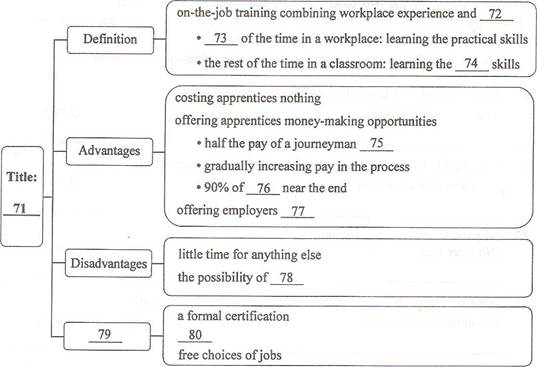
查看答案和解析>>
科目:高中英语 来源: 题型:填空题
【小题1】We are eager to get some a_________ of guilt from the cruel criminal.
【小题2】Everyone in my family is so willful(有主见) that it is difficult to reach a c_______.
【小题3】Things are c_________. We can’t predict what will happen next.
【小题4】It is a u___________ accepted theory: Practice makes perfect.
【小题5】 He s_____________ the aid of his best friend, but didn’t receive it.
【小题6】The sign at the gate of the park reads “No __________(吐痰)!”
【小题7】Martin Luther King, Jr. was a man who, throughout his lifetime, attempted to end racial
__________ (歧视) against African-Americans with success.
【小题8】Several _______(过路人) stopped and picked up the old man and then sent him to hospital.
【小题9】The hotel was booked full. So, instead, we found __________(住宿) in a dormitory.
【小题10】Distrusting women, he remained a ______________ (单身)all his life.
查看答案和解析>>
湖北省互联网违法和不良信息举报平台 | 网上有害信息举报专区 | 电信诈骗举报专区 | 涉历史虚无主义有害信息举报专区 | 涉企侵权举报专区
违法和不良信息举报电话:027-86699610 举报邮箱:58377363@163.com