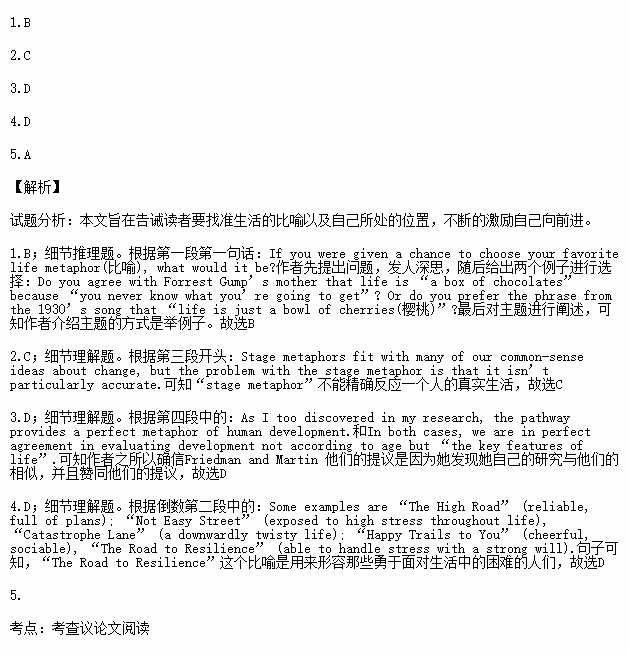
If you were given a chance to choose your favorite life metaphor(比喻), what would it be? Do you agree with Forrest Gump’s mother that life is “a box of chocolates” because “you never know what you’re going to get”? Or do you prefer the phrase from the 1930’s song that “life is just a bowl of cherries(樱桃)”? Though simply stated, each conveys a very different view. A “box” implies mystery, because we don’t know what is in a closed box. Meanwhile, a “bowl” of cherries is completely in view.
For many centuries, the metaphor of life that probably burst into most people’s mind was the one suggested by Shakespeare: “All of life is a stage…” On that stage, we take seven roles. More recently, psychologist Erik Erikson took up the idea of life as a stage. Erikson regarded development as a “powerful unfolding” in which we are driven from one stage to the next as our bodies, minds, and social roles develop.
Stage metaphors fit with many of our common-sense ideas about change, but the problem with the stage metaphor is that it isn’t particularly accurate. None of the studies that try to clarify the universality of adult life stages actually studied people as they developed over time. All of them were based on performances of their samples(样本) at one point in time. People’s actual lives don’t fit into these stage metaphors. They don’t automatically transform when people reach a certain age. Instead, people’s real lives are messy, unpredictable, and full of surprises.
Today, I’d like to focus on an even longer study, an 80-year study which is the subject of a recent book by Howard Friedman and Leslie Martin. Their final chapter summarizes the “many changes of healthy and unhealthy pathways” that their participants took over the course of their lives. As I too discovered in my research, the pathway provides a perfect metaphor of human development. We don’t all go down the same road marked with the same signposts based on age. People travel through diverse routes as they track the years of adulthood. Friedman and Martin use health and long life as their measure; I’ve used sense of achievement. In both cases, we are in perfect agreement in evaluating development not according to age but “the key features of life”.
The paths that Friedman and Martin describe seize the changes that characterize people as they age. Some examples are “The High Road” (reliable, full of plans); “Not Easy Street” (exposed to high stress throughout life), “Catastrophe Lane” (a downwardly twisty life); “Happy Trails to You” (cheerful, sociable), “The Road to Resilience” (able to handle stress with a strong will). Though I haven’t yet been able to follow my participants for 80 years, I too saw some of these pathways among my samples: “The Minding Way” , “The Downward Slope” , “The Straight and Narrow Path” , and “The Successful Trail”.
The pathway metaphor gives you hope for changing the direction of your life if you are unhappy with it so far. You can’t stop the clock from ticking the minutes between one birthday and the next, but you can adjust the road that you’re on by changing yourself, your situation, or both.
1.The author introduces the topic of the passage in the first paragraph by ______.
A. making comparisons B. giving examples
C. describing scenes D. providing explanations
2.According to the passage, the “stage metaphor” ______.
A. leads to misunderstandings
B. is used in memory of Shakespeare
C. doesn’t exactly reflect one’s real life
D. hasn’t enough stages to clarify life changes
3.The author is convinced of the life metaphor Friedman and Martin suggest because she ______.
A. spent less time on her research B. has found their book a bestseller
C. considers their measure more scientific D. got a similar finding to theirs
4.When a person is facing difficulties bravely, which metaphor can best describe him?
A. “Not Easy Street” B. “Happy Trails to You”
C. “Catastrophe Lane” D. “The Road to Resilience”
5.What does the passage focus on?
A. The pathway as a perfect life metaphor.
B. Various views on life metaphors.
C. The stage as a common life metaphor.
D. Different kinds of life metaphors.
科目:高中英语 来源:2014-2015学年浙江省六校高三3月联考英语试卷(解析版) 题型:单项填空
The shelter is expected to help the homeless live __________ the bitter winter.
A. across B. with C. through D. against
查看答案和解析>>
科目:高中英语 来源:2014-2015学年浙江宁波市十校高三3月联考英语试卷(解析版) 题型:单项填空
______ adequate water for all residents was, until only a few decades ago, a serious problem.
A. Providing B. Provided
C. Having provided D. Provide
查看答案和解析>>
科目:高中英语 来源:2014-2015学年四川遂宁市高三第二次诊断考试英语试卷(解析版) 题型:单项填空
The climate in Chengdu is warmer than______in Harbin.
A. it B. one C. this D. that
查看答案和解析>>
科目:高中英语 来源:2014-2015学年四川遂宁市高三第二次诊断考试英语试卷(解析版) 题型:单项填空
---Would you mind my sitting here?
--- ______. It’s for my girl friend.
A. Not at all. B. Never mind.
C. Better not. D. Of course not.
查看答案和解析>>
科目:高中英语 来源:2014-2015学年浙江省嘉兴市高三下学期教学测试(二)英语试卷(解析版) 题型:单项填空
According to the data from Robb’s studies, men produce slightly ______ speech. But no sex difference in the reading task was found.
A. clearest B. clear C. clearly D. clearer
查看答案和解析>>
科目:高中英语 来源:2014-2015学年浙江省嘉兴市高三下学期教学测试(二)英语试卷(解析版) 题型:单项填空
My mom held me and my brother tight, tears of happiness ______ her face, feeling proud of our final success.
A. to cover B. covered
C. having covered D. covering
查看答案和解析>>
科目:高中英语 来源:2014-2015学年山东枣庄市学业水平模拟考试英语试卷(解析版) 题型:单词拼写
根据下面每句句意、汉语提示或英语解释,写出空白处所缺单词的正确形式,每空一词。
1.Don’t be_______ (害羞) when you speak English to foreign friends.
2.September is the ______ (九) month of a year.
3.Hurry up, we only have a few _______ (分钟)left.
4.In my __________(a personal idea, view or impression), he is the best football player in the world today.
5.We are strongly against dropping litter ______ (here and there).
查看答案和解析>>
科目:高中英语 来源:2014-2015学年山东文登市高三第二次模拟考试英语试卷(解析版) 题型:书面表达
“美丽中国”是我国生态文明建设的宏伟目标。然而生活中一些不文明的现象时有发生,假如你是高三学生李华,请你围绕“美丽中国,美在行动”这一主题,用英语给全国的中学生写一封词数100左右的倡议书。
注意:
1. 倡议书的开头与结尾已给出,不计入总词数;
2. 倡议书中不能出现考生的真实姓名和学校名称。
A Letter to High School Students
Dear friends,
As we know, “ Beautiful China” is the goal of our Chinese Dream.
Yours,
LiHua
查看答案和解析>>
湖北省互联网违法和不良信息举报平台 | 网上有害信息举报专区 | 电信诈骗举报专区 | 涉历史虚无主义有害信息举报专区 | 涉企侵权举报专区
违法和不良信息举报电话:027-86699610 举报邮箱:58377363@163.com