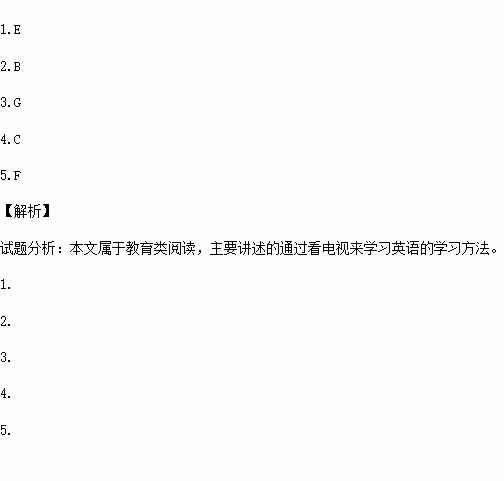
根据短文内容,从短文后的选项中选出能填入空白处的最佳选项。选项中有两项为多余选项。
Television is everywhere around us. Yet it is great for learning English. The pictures make it easier to understand than radio and because you can see who’s talking, and get a better idea of what people mean. Just watch their “body language”! Watch programs that you find enjoyable and entertaining. 1.
Here’s the english-at-home.com guide to learning as much as possible while watching English television:
2. Learning English should be fun –– not something that you have to force yourself to do. If you have a passion for football, watch matches or the sports news.
Keep a notebook near to your television. 3. This is especially useful. You can look for programs with sub-titles in your own language.
Try to watch English television regularly. Even if you can only watch 15 minutes a day, you’ll be amazed how much you learn.
Don’t worry if you don’t understand everything. English television is normally aimed at native English speakers. 4. If the programs that you’re watching are full of unknown words, just concentrate on understanding the general meaning.
Keep a note of television programs and presenters that you find easy to understand and try to watch them regularly. 5. Soon you will impress your friends with your English skills.
A. Don’t watch the programs too easy for you.
B. Better watch programs that you find interesting.
C. Programs often include many difficult words.
D. English learning has little to do with watching TV.
E. Whatever you watch will help you improve your English.
F. Doing this will increase your confidence in learning English.
G. You can take down any new words or expressions that you hear.
 心算口算巧算一课一练系列答案
科目:高中英语 来源:2015-2016学年福建师大附中高二下期中考试英语试卷(解析版) 题型:七选五
根据短文内容,从短文后的选项中选出能填入空白处的最佳选项,选项中有两项为多余选项。
Emotional eating is when people use food as a way to deal with feelings instead of satisfying hunger. 1. Have you ever finished a whole bag of chips out of boredom or downed cookie after cookie while preparing for a big test? But when done a lot — especially without realizing it — emotional eating can affect weight, health, and overall well-being.
Not many of us make the connection between eating and our feelings. 2. One of the biggest myths about emotional eating is that it’s caused by negative feelings. Yes, people often turn to food when they’re stressed out, lonely, sad, anxious, or bored. But emotional eating can be linked to positive feelings too, like the romance of sharing dessert on Valentine’s Day or the celebration of a holiday feast. Sometimes emotional eating is tied to major life events, like a death or a divorce. 3.
Emotional eating patterns can be learned: A child who is given candy after a big achievement may grow up using candy as a reward for a job well done. 4. It’s not easy to “unlearn(抛弃)” patterns of emotional eating. But it is possible. And it starts with an awareness of what’s going on.
We’re all emotional eaters to a degree. But for some people emotional eating can be a real problem, causing serious weight gain or other problems. The trouble with emotional eating is that once the pleasure of eating is gone, the feelings that cause it remain. 5. That’s why it helps to know the difference between physical hunger and emotional hunger.
Next time you reach for a snack, wait and think about which type of hunger is driving it.
A. Believe it or not, we’ve all been there.
B. If a crying boy gets some cookies, he may link cookies with comfort.
C. One study found that people who eat food like pizza become happy afterwards.
D. And you often may feel worse about eating the amount or type of food you like.
E. Understanding what drives emotional eating can help people take steps to change it.
F. Boys seem to prefer hot, homemade comfort meals, while girls go for chocolate and ice cream.
G. More often, though, it’s the countless little daily stresses that cause someone to seek comfort in food.
查看答案和解析>>
科目:高中英语 来源:2016届江西师大附中、鹰潭一中高三下第一次联考英语卷(解析版) 题型:语法填空
阅读下面材料,在空白处填入适当的内容(1个单词)或括号内单词的正确形式。
Facebook CEO Zuckerberg just had a baby girl named Max, and 1. (honor) the occasion, he's giving away the majority of his wealth. In the letter written by Zuckerberg and his wife, Priscilla Chan, to their new baby girl, he announced the birth of his first child and the ____2. (create) of the Chan Zuckerberg Fund, 3. will focus on personalized learning, curing disease, connecting people and 4. (build) strong communities.
“For your generation to live in 5. better world, there is so much more our generation can do,” Zuckerberg wrote. “Today your mother and I are committing to spend our lives doing our small part to help solve these challenges.” The couple 6. (donate) nearly all of their Facebook stock to the cause. “We will give 99% of our Facebook shares - __7. (current) about $45 billion - to advance this 8. (value) mission,” he wrote. “We know this is a small contribution compared 9. all the resources and talents already working on these issues. 10. we want to do what we can, working alongside many others.”
查看答案和解析>>
科目:高中英语 来源:2016届河南重点中学协作体高三第二次适应性考试英语卷(解析版) 题型:完形填空
短文改错
假定英语课上老师要求同桌之间交换修改作文,请你修改你同桌写的以下作文。文中共有10处错误,每句中最多有两处。错误涉及一个单词的增加、删除或修改。
增加:在缺词处加一个漏字符号(Λ),并在其下面写出该加的词。
删除:把多余的词用斜线(\)划掉。
修改:在错的词下划一横线,并在该词下面写出修改后的词。
注意:
1每处错误及其修改均仅限一词;
2只允许修改10处,多者(从第11处起)不计分。
In our life, we often regret what we did and which we couldn’t do. Actually, it doesn’t benefit us at all. As for most of us, we missed many chance to earn more money, to get a high position and to realize our dreams. We often regret that we don’t seize those opportunities, thus feel upset. Although we do know regretting the Past is no benefit, but we still can’t help doing it
To avoid the problem below, we need to pay more attention to what you are doing now, making us busier and having no time to recall the past. Moreover, we’d better set reasonably goals one by one. Only by doing so can we struggle for our future better.
查看答案和解析>>
科目:高中英语 来源:2016届河南重点中学协作体高三第二次适应性考试英语卷(解析版) 题型:阅读理解
This is a true story from Guyana.One day, a boy took a piece of paper from a box.He made a paper ball and pushed it into his nose.He couldn’t get it out.He ran crying to his mother.His mother couldn’t get the paper out, either.A week later, the paper was still in the boy’s nose.His nose began to have a bad smell.
So his mother took the boy to a hospital.The doctor looked up at the child’s nose, but she couldn’t get the paper out.She said she had to cut the boy’s nose to get the paper out.
The boy’s mother came home looking sad.She didn’t want her child to have his nose cut.The next day she took the b oy to her friend Sidney who lived in a house with an old lady called May.May wanted to see the child, so the child let her look up his nose.
“Yes, I can see it,” May said.“It will be out soon.”
As she spoke, she shook some black pepper (胡椒粉)on the child’s nose.The child gave a mighty sneeze and the paper flew out.His mother was surprised.May told his mother to take the boy to the seaside for a swim, for the salt water would go up his nose and stop the bad smell.So the lucky boy didn’t have to go to the hospital to have his nose cut.
1.After the boy pushed a paper ball into his nose, ____.
A.he took it out
B.his mother took it out
C.he tried to take it out but failed
D.he did nothing but cry
2.Which of the following is TRUE?
A.The doctor helped to take the paper ball out of the boy’s nose.
B.The boy had to have his nose cut at last.
C.The boy’s mother found some black pepper to solve the problem.
D.May succeeded in taking the paper out.
3.The boy should be taken to the seaside for a swim because ____.
A.he needed to learn to swim.
B.the sea water would wash out the paper ball.
C.the sea water would stop the bad smell of his nose.
D.he needed a rest.
查看答案和解析>>
科目:高中英语 来源:2016届广东佛山高三第二次模拟(4月)考试英语试卷(解析版) 题型:语法填空
书面表达
为了使我们的校园更美好,作为学生会主席的你,向全校学生倡议要养成环保意识,让同学们明白保护环境是我们中学生应尽的责任。请根据下面内容写一份倡议书,要点如下:
1.节电,节水,节粮食;
2.步行或骑车上学;
3.不乱扔纸,垃圾,拒绝使用一次性筷子及方便袋,支持“光盘行动”。
注意:1. 词数100左右
2. 可以适当增加细节,以使行文连贯;
3. 开头和结尾已经给出,不计入总词数。
参考词汇:一次性筷子 once-off chopsticks; 光盘行动 Clear Your Plate Campaign;
Dear Friends,
________________________________________________________________________________
________________________________________________________________________________
________________________________________________________________________________
________________________________________________________________________________
________________________________________________________________________________
________________________________________________________________________________
Thank you!
The Students Union
查看答案和解析>>
科目:高中英语 来源:2016届广东佛山高三第二次模拟(4月)考试英语试卷(解析版) 题型:阅读理解
Mr. Selfridge, the Wisconsin-born retailer (零售商) who left school at 14, rose to become a partner in Marshall Field's. Chicago. Founded in 1852, it was one of the first and most ambitious US department scores. Mr. Selfridge had done well with Marshall Field's. He liked to say, “The customer is always right,” which made the Chicago store popular. And he is believed to have invented the phrase “Only [so many] Shopping Days until Christmas”.
When he visited London on holiday in 1906 he was surprised to find most of the city's department stores were no match of their American and Parisian competitors. This led Selfridge to leave the US and establish Selfridges. a department store named after him. at the west end of London's Oxford Street. In Oxford Street, Selfridge's design team shaped an ambitious classical palacc building with a wall of plate glass windows.
Opened in 1909, Selfridges offered customers a hundred departments along with restaurants, a roof garden, reading and writing rooms, reception areas for foreign visitors, a first aid room and. most importantly, a small army of knowledgeable floor-walking assistants who served as guides as well as being thoroughly instructed in the art of making a sale.
Mr. Selfridge did much to make the department store a destination rather than just a big and comprehensively stocked city shop. It became a place to meet and for ladies to lunch. Mr. Selfridge later introduced the department store as a key element of the 20th Century culture, and Chaplin acknowledged the growing trend for shopping in the department store in his film The Floorwalker.
1.What can be learned about Mr. Selfridge from Paragraph I ?
A. lie was well-educated.
B. He was a gifted businessman.
C. He was a modest man.
D. He was dishonest.
2.What made Selfridge build a department store in London?
A. The large population in London.
B. His desire to own a department store.
C. His confidence in business success.
D. Affection for London architecture.
3.What was Selfridges' most impressive characteristic?
A. The number of departments.
B. The broad choice of goods.
C. The small group of guards.
D. The well-trained sales guides.
4.What is the main purpose of the article?
A. To introduce the history of Selfridge .
B. To compare different department stores.
C. To encourage readers to spend more.
D. To explain how to start a department store.
查看答案和解析>>
科目:高中英语 来源:2015-2016学年安徽师范大学附中高一下期中考试英语卷(解析版) 题型:听力第三部分
Owls(猫头鹰) are mysterious creatures. We often think of them as scary. They sometimes live in abandoned houses. They fly without a sound through backyards at night. In stories, they appear with ghosts. When we hear an owl's familiar “wh?ooo...whooo...”,it can make us feel very frightened. Owls fly silently, without even a whisper of wings moving through the air. It's as though they appear out of nowhere—like ghosts on wings. Owls fly and hunt on the darkest of nights. An owl's night habits make it unique. Do these creatures of the night possess strange powers?
Owls possess unusual powers of sight and hearing, but they are not supernatural powers. They are natural adaptations that let them live most efficiently(高效地) at night. There is no reason to fear owls. Their habits make them helpful to humans. By hunting mice and other rodents(啮齿目动物),owls help to keep a natural balance between plant and animal life. Without owls, there would be a large number of rodents in farmers' fields and storage barns.
More than 100 species of owls occupy a variety of habitats around the world. A few oceanic islands and the Antarctic have no owls. The world's owls come in different sizes. For example, the Eurasian eagle owl—one of the largest—has a body that is two to three feet long, with a wingspan(翼展) of up to five and one?half feet. The North American elf owl (the world's smallest owl) is five to six inches long and has a wingspan that measures slightly more than one foot.
Most male and female owls of the same species look alike, although females are usually larger. In some species, the female's colors are like those of the trees or grass where she makes her nest.
Baby owls, called chicks, stay with their parents until they are about three months old. They soon find their own hunting areas, where they may stay for the rest of their lives. Some owls can live 20 years or more.
1.Most people regard owls as________.
A.clever B.hard?working C.shy D.terrifying
2.Owls help humans in that they________.
A.frighten rodents away from humans
B.help preserve the balance of nature
C.have unusual powers
D.help guard backyards
3.What is special about owls?
A.They fly silently.
B.They are night hunters.
C.They possess supernatural powers.
D.They can be found around the world.
查看答案和解析>>
科目:高中英语 来源:2016年北京市朝阳区高三一模英语试卷(解析版) 题型:单项填空
The money will be used __________ the school with new computer equipment.
A.to provideB.providing
C.providedD.to be provided
查看答案和解析>>
湖北省互联网违法和不良信息举报平台 | 网上有害信息举报专区 | 电信诈骗举报专区 | 涉历史虚无主义有害信息举报专区 | 涉企侵权举报专区
违法和不良信息举报电话:027-86699610 举报邮箱:58377363@163.com