假定你是李华。你们学校和一所美国中学签署了教师交流协议,在过去的一年里,你们的英文老师是来自这所中学的Sue。不久前她返回美国任教。请你根据写作要点和要求给Sue写封电子邮件。
写作要点:
1. 对她表达感谢之意;
2. 介绍她离开后你自己及班里发生的事情;
3. 希望了解她的近况。
注意:
1. 词数100左右;
2. 邮件中不能体现本人真人信息;
3. 可以适当增加细节,以使行文连贯。
Dear Miss Sue,
I’m Li Hua, one of your students in China._______________________________________
_______________________________________________________________________________
_______________________________________________________________________________
_______________________________________________________________________________
_______________________________________________________________________________
_______________________________________________________________________________
_______________________________________________________________________________
_______________________________________________________________________________
_______________________________________________________________________________
All the best.
Li Hua
科目:高中英语 来源:2017届重庆一中高三上期开学摸底考试英语试卷(解析版) 题型:书面表达
书面表达
假定你是重庆第一中学校学生会主席李华,你校将举办一次英语演讲比赛,希望重庆大学外籍教师Brown女士来做评委。请参照以下比赛通知给她写一封信。
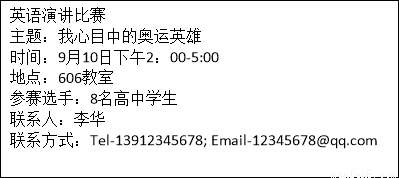
注意: 1. 可适当增加细节,使结构完整 2. 词数120左右
词汇:学生会主席 president of Students’ Union
查看答案和解析>>
科目:高中英语 来源:2016届东北师大附中高三第四次摸底考试英语卷(解析版) 题型:阅读理解
When you’re a junior in high school, three little letters quickly become larger than life: SAT.
At the start of my junior year, I realized that the environment was packed with competition. Surprisingly, this pressure didn’t come from adults. It came from the other students. Everyone in my grade had college on the brain. To get into the college of our choice, we all believed, we had to outcompete and outscore everyone else with less sleep, because time for sleeping was time you didn’t spend studying for the SAT.
I let myself get swept up in the pressure. My new motto was, if I wasn’t in every single honor level class, I wasn’t doing enough. I was bad-tempered and I couldn’t focus. I stopped talking to my friends and my mom, and I couldn’t figure out who I was. I didn’t have the confidence to know that my own passions and unique skills were what would make me stand out to colleges.
That’s when I realized: I am not my SAT score. Trying to stick to what I thought colleges wanted masked who I really am. I decided to rely on my strengths and get away from the crazy pressure I was putting on myself.
Instead of forcing myself into higher levels of math, I took on an extra history class. I learned how to love what I was doing and not what I thought I was supposed to do. I learned to shine as an individual, not a faceless member of the crowd. And I found that not only was this better for my happiness, but it also made me more effective and efficient when I studied.
To me, individuality means having the confidence to decide who I am and who I want to be, and a number on a page is never going to change that. I am more sure of myself, and more ready to apply for college, than ever.
1.At the start of the junior year, the author decided to study for the SAT ________.
A. to overcome the pressure from other high school students
B. to test how good she was at studying compared to others
C. because it was exciting to compete with others to get into college
D. because she was eager to get an advantage over others in the competition
2.When did the author realize she shouldn’t just compete for scores?
A. When she got in every single honor level class.
B. When everybody stopped talking to her.
C. When she found she was no longer her usual self.
D. When she forced herself to take advanced maths.
3.What can you infer from Paragraph 5?
A. She tried to live as who she was, not just a student focusing on grades.
B. She learned to team up with others and so gained efficiency.
C. She managed to do well in both maths and history classes.
D. She wanted to be number one and no one could change her mind.
4.Which statement best expresses the main idea of the passage?
A. Pressure brings out the best in you.
B. You will stand out by being your best self.
C. Things will happen whether you like it or not.
D. Life is just a matter of decisive times.
查看答案和解析>>
科目:高中英语 来源:2017届河北衡水中学高三上期小二调考试英语试卷(解析版) 题型:阅读理解
What's the most important thing in life?
People's answers vary greatly. For British scientist Robert Edwards, the answer is having a child. "Nothing is more special than a child," he told the BBC.
Edwards, the inventor of the In Vitro Fertilization (IVF) technology---more commonly known as "test-tube (试管) baby" technology---passed away on April 10, 2013 at the age of 87.
"Edwards changed the lives of millions of ordinary people who now rejoice (高兴) in the gift of their own child," said Peter Braude, a professor at King's College London. "He leaves the world a much better place."
Edwards started his experiments as early as the 1950s, when he had just finished his PhD in genetics. At that time, much of the public viewed test-tube babies as "scary", according to Mark Sauer, a professor at Columbia University, US.
Edwards and his colleague Patrick Steptoe faced opposition from churches, governments and media, not to mention attacks from many of their fellow scientists. "People said that we should not play God and we should not interfere with nature," Edwards once told Times. He said that he felt "quite alone" at the time.
"But Edwards was a fighter, and he believed in what he was doing," said Sauer. Without support from the government, the two struggled to raise funds to carry on. And in 1968 they finally developed a method to successfully fertilize human eggs outside the body.
The first test-tube baby was born on July 25, 1978. Her name was Is Louise Brown. Despite people's safety concerns, Brown was just as healthy as other children.
"IVF had moved from vision to reality and a new era in medicine had begun," BBC commented.
Ever since then, public opinion has evolved considerably. Couples who were unable to have babies began thronging (拥向) to Edwards' clinic. Nowadays, Reuters reports, some 4.3 million other "test-tube" children exist. Edwards received a Nobel Prize in 2010 and was knighted (封为爵士) by Queen Elizabeth n the following year.
Before his death, Edwards was still in touch with Louise. "He is like a granddad to me," she said in an interview with the Daily Mail.
He is a granddad to millions, in fact.
1.What’s the article mainly about?
A. The first test-tube baby.
B. A new era in medicine.
C. The inventor of IVF technology.
D. The changes IVF technology has brought.
2.The writer quoted Peter Braude to .
A. show how difficult it was for Edwards to do his work
B. describe what kind of person Edwards was
C. explain why he is loved by all children
D. comment on his achievement
3.The underlined word "opposition" in Paragraph 6 is closest in meaning to " "
A. attack B. support C. test D. influence
4. What is the correct order of events in Edwards' life?
a. He received a Nobel Prize.
b. He struggled to raise funds.
c. The first test-tube baby was born.
d. He was knighted by Queen Elizabeth II.
e. He succeeded in fertilizing human eggs outside body.
f. He started his experiments on IVF technology.
A. f-e-b-c-a- d B. f-b-e-c-d-a
C. f-b-e-c-a-d D. f-e-d-a-c-b
查看答案和解析>>
科目:高中英语 来源:2017届重庆市高三9月考英语试卷(解析版) 题型:七选五
根据短文内容,从短文后的选项中选出能填入空白处的最佳选项。选项中有两项为多余选项。
Some experts feel that cars are certain to fall into disuse. They see a day in the not-too-distant future when all cars will be deserted and made useless. 1. They hold that the car will remain a leading means of city travel in the foreseeable future.
The car will undoubtedly change greatly over the next 30 years. It should become smaller, safer, and more practical, and should not be powered by the gas engine. 2.
Unless changes take place in the power system, the car in the future will still be the main problem in city traffic jams. 3.
When the car enters the highway system, a small arm will drop from the car and connect with a rail, which is similar to hose(软管) powering subway trains electrically. Once joined to the rail, the car will become electrically powered from the system and control of the car will pass to a central computer. 4.
The driver will use the telephone to dial instructions about his position and the place he heads for into the system. The computer will find the best way and reserve space for the car all the way to the correct exit from the highway. ____5. It is believed that an automated highway will be able to deal with 10,000 cars per hour, compared with the 1,500 to 2,000 cars that can be carried by a present-day highway.
A. The driver will be free to relax and wait for the call that will warm him of his coming exit.
B. Other experts however think the car is here to stay.
C. The car of the future should be far more pollution-free than present types.
D. There will be plenty of policemen on the highway to control the traffic.
E. One suggested solution to this essential problem is the automated (自动的) system which seems to hold water.
F. The computer will then monitor all the car’s movements.
G. All of the experts don’t know what will happen in the future.
查看答案和解析>>
科目:高中英语 来源:2015-2016学年河北石家庄一中高二下期末考试英语卷(解析版) 题型:阅读理解
You use her as a shoulder to cry on. She texts you back with casual jokes. But she, Xiaoice, is only a virtual chatbot.
Xiaoice, Microsoft’s latest artificial intelligence robot, was briefly released in 2014, and returned to WeChat in 2015, where she became a big hit. Millions of young Chinese now exchange messages with her daily, The New York Times reported. On WeChat, Xiaoice is an official account. After following it, users can start text-based conversations with Xiaoice.
“Her incredible learning ability was why people loved to talk with Xiaoice,” Liu Jinchang, a researcher at High-tech Research and Development Center under the Ministry of Science and Technology, told China Daily. Apart from her ability to identify photos and send emojis(表情符号) in conversations, Xiaoice gains 45 percent of her knowledge from interacting with users, China Daily reported.
Chatbot programs first appeared in the mid-1960s in the US. Driven by top tech companies, they are becoming smarter and more common. For instance, IBM’s latest artificial intelligence program served as an academic consultant at Australia’s Deakin University, answering students’ questions about course schedules and financial aid. Apple’s Siri and Amazon’s Alexa have been used as voice assistants who can read news, play music and even make jokes for their users.
These programs are expected to move beyond smartphones, into televisions, cars and living rooms, The New York Times pointed out. However, it may take decades before scientists develop a “Samantha”, the advanced chatbot seen in the fiction film Her. In the film, Samantha sparks a romantic relationship with her user played by US actor Joaquin Phoenix. Many viewers were enthusiastic about this fantasy of virtual soul mates.
1.What does the underlined part in Paragraph Two mean?
A. She became a best seller.
B. She became very powerful.
C. She became a money maker.
D. She became very popular.
2.Which of the following can Xiaoice do?
A. Do housework.
B. Spread messages.
C. Identify various photos.
D. Read news to its users.
3.Which company’s chatbot program can act as an academic consultant?
A. Microsoft.B. IBM.C. Apple.D. Amazon.
4.What can be learned from the last paragraph?
A. Chatbots mainly run on smartphones now.
B. It’ll take decades to apply chatbots to cars.
C. Samantha is played by a US actor in the film.
D. The film Her doesn’t interest many audience.
查看答案和解析>>
科目:高中英语 来源:2015-2016学年河北石家庄一中高一下期末考试英语卷(解析版) 题型:完形填空
阅读下面短文,从短文后各题所给的四个选项(A、B、C和D)中选出可以填入空白处的最佳选项,并在答题卡上将该项涂黑。
Dad was not only my best friend, but my compass (指南针). While he was alive, he ________ me with his actions and advice. He taught me one important ________: “Believe in yourself. ” If there was one phrase my dad ________ liked to hear, it was “I can’t.” He never got to finish high school and ________ two jobs to support his large family, ________ he never complained. Through education and years of hard work, my dad became an excellent journalist.
When I was in high school, I had a ________ time with math. He tried to help me, but I ________ struggled. So my math teacher suggested I meet with him at 7:00 each morning before school for ________ help. I told Dad, “That’s ________! I’m tired! I can’t do that!” He replied, “You’re doing it. I’ll send you to school.” Every morning at 6:45, we’d leave the ________. Despite working 12 hours every day, Dad never once ________ driving me to school.
After months of ________, I was facing the final exam. I was so ________. On the day of the final, my dad hugged me and said, “Luke, ________yourself. You can do it. ” His words made me realize I needed to trust in my ________ and in the hours of work I’d ________. When I got my ________ proudly, the first person I called was my father. He cried, “Yes! You deserved it!”
Even now, whenever I ________ that a task is too much for me, I think back to that exam. No matter how ________ something is, if you’re willing to work, you can succeed. I’m forever ________ to Dad for that lesson.
1.A. understoodB. forgaveC. guidedD. impressed
2.A. historyB. lessonC. skillD. language
3.A. alwaysB. almostC. everD. never
4.A. tookB. lostC. leftD. finished
5.A. soB. orC. butD. and
6.A. goodB. freeC. terribleD. short
7.A. stillB. nearlyC. hardlyD. probably
8.A. realB. practicalC. immediateD. extra
9.A. wonderfulB. crazyC. expensiveD. necessary
10.A. houseB. schoolC. officeD. farm
11.A. suggestedB. riskedC. enjoyedD. missed
12.A. meetingB. testingC. learningD. interviewing
13.A. excitedB. nervousC. happyD. shocked
14.A. stand forB. hold backC. believe inD. look after
15.A. teacherB. luckC. timeD. ability
16.A. wastedB. ignoredC. picked upD. put in
17.A. answerB. gradeC. payD. gift
18.A. hopeB. forgetC. worryD. promise
19.A. differentB. importantC. hardD. interesting
20.A. gratefulB. sorryC. politeD. useful
查看答案和解析>>
科目:高中英语 来源:2016-2017学年山东淄博六中高二上第一周自主训练英语卷(解析版) 题型:完形填空
阅读下面短文,掌握其大意,然后从各题所给的四个选项中选出最佳选项。
(2016山东潍坊高二上期中)
I am from Indonesia. I was very happy when my sister Vera ________ helped me apply to a school in Provo, USA. Meanwhile, I felt ________, because it was my first time to go to another country which used a different language. However, I knew it was a good ________ to study in the U.S.
I left my hometown for Singapore on April 23, 2000 at 6:00 pm. It took me 20 minutes by taxi to Changi Airport. The taxi driver ________ me about the cost. I was supposed to pay him $12, but he charged me $22. I had already ________ that at that time, but I didn’t want to make any ________ because I was alone in another country.
Unfortunately, the Northwest Airlines counter (柜台) was ________. A security guard told me the counter would open at 4 o’clock in the morning, but my ________ time would be 6:00 am and what made me ________ was that I didn’t have a ticket in my hands. ________, my sister had already booked an online ticket, but I needed to get the ________ at the airline counter. ________, I could do nothing about that until the next day. Waiting at the airport was so ________. So I went into a cafeteria. I stayed up the whole night ________ the aircraft would be gone when I ________.
While waiting, I decided to take some pictures for ________. I met a new friend named AL Corpus there. He told me about his experience when he arrived in the U.S. for the first time. He ________ me what I would need to do to enter the United States. He was very ________ and friendly.
Finally, I arrived in Provo ________. Now whenever I think of the trip, I feel happy because I had many unforgettable ________ on my trip to Provo.
1.A.graduallyB.occasionallyC.successfullyD.usually
2.A.nervousB.sad
C.unhappyD.interested
3.A.adventureB.possibilityC.dreamD.choice
4.A.cheatedB.chargedC.supportedD.informed
5.A.forgottenB.realizedC.admittedD.forgiven
6.A.planB.mistakeC.troubleD.decision
7.A.stoppedB.damagedC.protectedD.closed
8.A.arrangementB.flightC.entranceD.meeting
9.A.anxiousB.relaxedC.cautiousD.delighted
10.A.SuddenlyB.EspeciallyC.FinallyD.Actually
11.A.changeB.admissionC.ticketD.notice
12.A.HoweverB.BesidesC.MeanwhileD.Therefore
13.A.thrillingB.interestingC.sillyD.boring
14.A.in order thatB.for fear thatC.as ifD.even if
15.A.expectedB.returnedC.understoodD.awoke
16.A.memoriesB.responsibilities
C.imaginationD.convenience
17.A.calledB.offeredC.taughtD.wished
18.A.carefulB.helpfulC.hopefulD.thankful
19.A.politelyB.hurriedlyC.simplyD.safely
20.A.experiencesB.difficultiesC.chancesD.advantages
查看答案和解析>>
科目:高中英语 来源:2017届内蒙古高三上期第一次月考英语卷(解析版) 题型:听力第三部分
A story of a man who made the brave journey of love, cycling from India to Sweden to see his sweetheart, has gained the hearts of thousands online. A Facebook post, that has been linked more than 113,000 times, shares the tale of how Dr. Pradyumna Kumar Mahanandia crossed eight countries to be reunited with his wife Charlotte Von Schedvin in her native country.
The story began in 1975 when wealthy 19-year-old Charlotte Von Schedvin, who was a student in London at the time, traveled to India in 1975 to meet the poor but famous artist Mahanandia. The Indian was born in 1949 into a poor family in Odisha, Dhenkanal and was considered an untouchable in the society.
Although his family couldn’t afford his education, he managed to gain a place at the College of Art in New Delhi where word of his talent quickly spread.
In events that wouldn’t be out of place in a romantic movie, when young Charlotte Von Sledvin met with the painter, the two fell in love with one another. He was greatly impressed by her beauty and she, with his pure simplicity. Despite their contrasting backgrounds, the pair shortly married.
In 1978, the time came for Charlotte to return to her native country, and she requested her husband join her back in Europe. However, Mahanandia was in the middle of his studies and said he would join her after these were completed. The couple stayed in touch through letters and despite Charlotte’s offers to send flight tickets, Mahanandia was determined to meet her in his own way.
Selling his belongings, he managed to get enough money to buy a second-hand bike and set out on the intrepid journey to be reunited. From New Delhi the love-struck adventurer entered Afghanistan, Iran, Turkey, Bulgaria, Yugoslavia, Germany, Austria and Denmark. It wasn’t all easy sailing. His bike broke down a lot of times along the way and he had to go on without food for days.
In total the trip took four months and three weeks before he finally reached Gothenburg, Sweden. Upon arrival, he was questioned by immigration officers, who were said to be amazed at his story of devotion after he shared photographs of his marriage.
Her parents welcomed him with open arms and 40 years later, the pair are still happily married. Dr PK Mahanandia serves as the Odiya Cultural Ambassador of India to Sweden and lives with his wife and two children in Sweden. He has become well-known in Sweden as an artist and as an adviser of Art and Culture, under the Swedish Government too.
1.How did Mahanandia and Charlotte meet for the first time?
A. Charlotte travelled to India to meet Mahanandia.
B. Mahanandia went to study in the same school with Charlotte.
C. Mahanandia cycled to Sweden.
D. Their families arranged the meeting.
2.The underlined word “intrepid” in Paragraph 6 means _______.
A. longB. excitingC. braveD. poor
3.What’s the best title for this passage?
A. A Romantic StoryB. Meet across Boarder.
C. Mahanandia and Charlotte.D. Journey of Love.
查看答案和解析>>
湖北省互联网违法和不良信息举报平台 | 网上有害信息举报专区 | 电信诈骗举报专区 | 涉历史虚无主义有害信息举报专区 | 涉企侵权举报专区
违法和不良信息举报电话:027-86699610 举报邮箱:58377363@163.com