
The manager was satisfied to see many new products ______ after great effort.
A. having developed B. to develop C. developed D. develop
 天天向上一本好卷系列答案
 小学生10分钟应用题系列答案
科目:高中英语 来源:2014年全国普通高等学校招生统一考试英语(山东卷解析版) 题型:单项填空
A company ______profits from home markets are declining may seek opportunities abroad.
A. which B. whose C. who D. why
查看答案和解析>>
科目:高中英语 来源:2014年全国普通高等学校招生统一考试英语(天津卷解析版) 题型:单项填空
I think _______ impresses me about his painting is the colours he uses.
A. what B. that C. which D. who
查看答案和解析>>
科目:高中英语 来源:2014年全国普通高等学校招生统一考试英语(四川卷解析版) 题型:其他题
补全对话
Mary: Mike, how do I look in these blue jeans?
Mike: 1. They really suit you, Mary!
Mary: Thanks, you know, these kinds of jeans are in style now.
Mike: 2.
Mary: I mean...they are very popular these days; everyone is wearing them!
Mike: You are great at keeping up with fashions.
Mary: Well, 3.
Mike: Perhaps you can help me pick out a pair of jeans now, since you are an expert.
Mary: 4. I would be happy to help you with your fashion change!
Mike: 5.
A. Wow, great!
B. No problem!
C. See you then.
D. Any suggestions?
E. I am a girl after all.
F. What do you mean?
G. Thank you so much!
查看答案和解析>>
科目:高中英语 来源:2014年全国普通高等学校招生统一考试英语(四川卷解析版) 题型:单项填空
— How about dinner tonight? It's on me.
— ______ .
A. You are welcome B. Oh, I'd like to C. Well, I'm afraid so D. That's all right
查看答案和解析>>
科目:高中英语 来源:2014年全国普通高等学校招生统一考试英语(北京卷解析版) 题型:书面表达
假设你是红星中学高三(1)班的学生李华,请根据以下四幅图的先后顺序,用校刊“英语园地”写一篇短文,记述你和同学们向学校提建议,解决自行车存放问题的过程。
注意:1. 词数不少于 60.
2. 短文的开头已给出,不计入总词数。
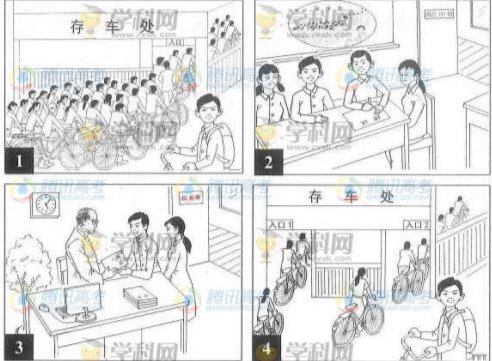
There was a problem with the parking place for bikes in our school.
查看答案和解析>>
科目:高中英语 来源:2014年全国普通高等学校招生统一考试英语(北京卷解析版) 题型:完型填空
The Fitting-in of Suzy Khan
The first time I saw Suzy Khan, I knew I had to help her. She was really small for her age of 12. The boy in my class often about her and laughed their heads off. She would open a book, pretending to read, with tears dropping on the open page.
All I knew was that she was an orphan (孤儿) from Africa. She had just been adopted by a family in town who that the best way for her to learn American ways of life was to be with american kids. I looked down at this girl and promised myself that somehow I would help her.
But how could I help her in with us? There had to be a .
One day, when I went into the classroom, I saw that Suzy had her geography book to a picture of a train, and in her notebook, she had made a(n) copy.
I was surprised and thought that she could do something in the coming show. So, I took her to see the art teacher, Miss Parker, and showed her what Suzy had . “why, it’s wonderful,” said Miss Parker, who then showed us a poster she had painted the talent show. “I need more of these, but I just don’t have enough . Could you help me, Suzy?”
On the day of the talent show, Suzy’s were everywhere ---- all over the hall and all over the school, each one different.
“And finally,” said Mr Brown, the schoolmaster, at the end of the show, “we have a (n) award. I’m sure you’ve all noticed the wonderful posters.” Everyone nodded. “One of our own students them.”
I could hear everyone whispering. “Who in our school could draw well?”
Mr. Brown waited a while before saying, “ this student worked so hard on the posters, she deserves a ,too. Our mystery(神秘) artist is our new student ---- Suzy Khan!”
Mr. Brown thanked her for all the wonderful posters and gave her a professional artist’s set. “Thank you,” she cried.
I , at that time when I was looking at her excited face, she’d probably never anything in her whole life.
Everyone started to their hands. Suzy Khan gave them a shy smile and the applause was defening. I knew then Suzy was going to ne all right.
1.A. jokedB. caredC. trainsD. worried
2.A. reportedB. decidedC. complainedD. questioned
3.A. richB. proudC. tinyD. popular
4.A. comeB fallC. fitD. tie
5.A. mannerB. patternC. choiceD. way
6.A. readB. takenC. openedD. put
7.A. freeB. perfect C. finalD. extra
8.A.areB.talkC.quizD. talent
9.A. coloredB. writtenC. carvedD. drawn
10.A. atB. afterC. forD. around
11.A. roomB. timeC. paperD. interest
12.A. giftsB. booksC. photosD. posters
13.A. specialB. academicC. nationalD. rayal
14.A. paintedB. foundC. printedD. collected
15.A. veryB. thatC. quiteD. too
16.A. IfB. ThoughC. UnlessD. Since
17.A. prizeB. rankC. restD. place
18.A. repliedB. realizedC.rememberedD. regretted
19.A. offeredB. valuedC. ownedD. controlled
20.A. clapB. waveC. raiseD. shake
查看答案和解析>>
科目:高中英语 来源:2014年全国普通高等学校招生统一考试英语(上海卷解析版) 题型:其他题
Directions: Translate the following sentences into English, using the words given in the brackets.
1.我习惯睡前听点轻音乐。(accustomed)
2.将来过怎样的生活取决于你自己。(be up to)
3.没有什么比获准参加太空旅行项目更令人兴奋的了。(than)
4.家长嘱咐孩子别在河边嬉戏,以免遭遇不测。(for fear)
5.虽然现代社会物资丰富,给予消费者更多的选择,但也使不少人变成购物狂。(turn)
查看答案和解析>>
科目:高中英语 来源:2013-2014学年吉林省长春市高三下学期第三次模拟考试英语试卷(解析版) 题型:完型填空
阅读下面短文,从短文后各题所给的四个选项(A、B、C和D)中,选出可以填入空白处的最佳选项,并在答题卡上将该项涂黑。
There are two types of people in the world. Although they have equal degrees of health and wealth and the other comforts of life, one becomes happy, becomes unhappy. This from the different ways in which they consider things, persons, and events, and the resulting effects upon their minds.
The people who are to be happy their attention to the conveniences of things, the pleasant parts of conversation, the well-prepared dishes, the goodness of the wines, and the fine weather. They enjoy all the cheerful things. Those who are to be unhappy think and speak only of the things. They are, , continually unsatisfied. By their words, they complain about the pleasure of society, offend many people, and themselves disagreeable (不受欢迎的) everywhere. If this turn of mind were founded in nature, such unhappy persons would be more to be pitied. The intention of criticizing and being disliked is perhaps taken up by imitation (模仿). It grows into a habit, unknown its possessors. The habit may be strong, but it may be cured when those who have it are its bad effects on their interests and tastes. I hope this little warning may be  of service to them, and them change this habit.
Although in fact it is chiefly an act of imagination, it has serious in life, since it causes deep sorrow and bad luck. Those people offend many others, nobody loves them, and no one treats them with more than the most politeness and respect. This puts them in bad temper and draws them into arguments. If they aim at obtaining advantages in social position or fortune, nobody wishes them success. Nor will anyone start a step speak a word to favor their hopes. If they cause themselves public objections (反对), no one will or excuse them, and many join to criticize their wrongdoings. These people should change this bad habit and be pleased with what is pleasing, worrying needlessly about themselves and others. If they do not, will be good for others to avoid any contact with them. Otherwise, it can be disagreeable and sometimes very inconvenient, when one becomes mixed up in their quarrels.
1.A. other B. another C. the other D. one another
2.A. comes B. rises C. raises D. becomes
3.A. draw B. focus C. attract D. pay
4.A. same B. contrary C. happy D. funny
5.A. however B. furthermore C. otherwise D. therefore
6.A. let B. force C. make D. have
7.A. originally B. finally C. normally D. gradually
8.A. as B. to C. for D. at
9.A. convinced for B. convincing for C. convinced of D. convincing of
10.A. agree B. enjoy C. praise D. help
11.A. consequences B. reasons C. causes D. phenomena
12.A. usual B. common C. average D. normal
13.A. hardly B. luckily C. seriously D. frequently
14.A. any B. other C. few D. no
15.A. and B. but C. so D. or
16.A. defend B. offend C. intend D. attend
17.A. shall B. must C. can D. will
18.A. with B. without C. but for D. in case of
19.A. one B. they C. it D. that
20.A. specially B. only C. mainly D. especially
查看答案和解析>>
湖北省互联网违法和不良信息举报平台 | 网上有害信息举报专区 | 电信诈骗举报专区 | 涉历史虚无主义有害信息举报专区 | 涉企侵权举报专区
违法和不良信息举报电话:027-86699610 举报邮箱:58377363@163.com
