
科目: 来源: 题型:
第一部分 英语知识运用(共三节,满分50分)
第一节 从A、B、C、D四个选项中,找出其划线部分与所给单词的划线部分读音相同的选项,并在答题卡上将该项涂黑。(满分5分)
1. stop A. lose B. woman C. shock D. rose
2. theirs A. strength B. health C. thank D. then
3. double A. found B. through C. country D. though
4.news A. research B. newspaper C. Christmas D. Thursday
5.parent A. glare B. paper C. carrot D. Gather
查看答案和解析>>
科目: 来源: 题型:
23. ------ Ian gave up playing the piano eventually.
-------It’s just_____of him to spend all that money on the equipment and then lose interest halfway through the course.
A. normal B. ordinary C. common D. Typical
查看答案和解析>>
科目: 来源: 题型:
26.— Why are you still here? Everybody has gone to attend the lecture by the president.
— Oh, I__________about it!
A.wasn’t informed B. hadn’t been informed C. haven’t informed D. didn’t inform
查看答案和解析>>
科目: 来源: 题型:
29. Realizing ______ I had been able to accomplish, my fears of failure grew rapidly.
A. so little B. such little C. how little D. what little
查看答案和解析>>
科目: 来源: 题型:
31. I have no dreams ________ to have a happy life.
A. rather than B. more than C. other than D. less than
查看答案和解析>>
科目: 来源: 题型:
34. ---You have given us a wonderful Chinese dinner, Mrs. Wang.
---_________________.
A. Oh, I’m afraid I didn’t cook very well B. I’m glad you enjoyed it
C. Come again when you are free D. It’s not necessary for you to say so
查看答案和解析>>
科目: 来源: 题型:阅读理解
第二部分 阅读理解(共20小题,每小题2分,满分40分)
A
Too often we accuse others of not listening, pretending that we ourselves are faultless, yet in our hearts we know that many of the mistakes we make come about because we haven’t listened carefully enough. We get things wrong because we haven’t listened carefully enough. We get things wrong because we haven’t quite understood what someone meant when they were talking to us. Anyone who has ever taken the minutes of a long meeting will know how hard it is to remember-- despite the benefit of notes-- exactly what everyone said. But success depends on getting things right--and that means listening.
Listening is not the same thing as hearing; it is not an effort actively. It demands attention and concentration. It may mean quizzing the speaker for additional information or for clarification------ it is always better to ask than to continue regardless and get things wrong. However, if you allow your mind to wander onto something else, even for a few minutes, you’ll miss what the speaker is saying------ probably at the very moment when he or she is saying something critical. And not having heard, you won’t know you’ve missed anything until it’s too late.
The most common bad habit we have is to start thinking of what we are going to say about the subject long before the other speaker has finished. We then stop listening. Even worse, this often adds rudeness to inattentiveness, as once you have decided what to say there is a fair chance you will interrupt to say it. Good listeners don’t interrupt. In fact it is often worth explaining the main idea of what you have just been told before going on to make your own points. Nobody is offended by this and it shows that you have listened well.
Above all be patient and accept that many people are not very good communicators. It’s helpful to remember that the ways people move and position themselves while they are speaking can reveal a great deal about what they are saying. Equally important you should put yourself in the other person’s place, both intellectually and emotionally; it will help you to understand what they are getting at and form a response. But don’t be too clever. Faced with a know-all, many people keep quiet because they see no point in continuing.
56. Which is the best title for this passage?
A. Don’t be too clever B. Be a good listener.
C. Don’t miss anything critical D. Think of the speaker
57. In the last paragraph, “…… what they are getting at ……” means________ .
A. what they imply B. what they like
C. what they attack D. what they achieve
58. What is the writer’s opinion?
A. If you want to be a good listener, you should be very clever and emotional.
B. Speakers won’t continue talking when their listeners explain what they’ve heard.
C. If you don’t want to get things wrong, it’s important to be a good listener,
D. It’s hard to be a good listener because listening tests you on your intelligence.
59. What is the lesson we can learn from this passage?
A. Don’t accuse others of not listening while talking with them.
B. Don’t get anything wrong if you miss what the speaker is saying.
C. Listening inattentively may cost you the loss of your success.
D. Think carefully of what you’re going to say before the speaker finishes.
查看答案和解析>>
科目: 来源: 题型:阅读理解
D
Children start out as natural scientists, eager to look into the world around them. Helping them enjoy science can be easy; there’s no need for a lot of scientific terms or expensive lab equipment. You only have to share your children’s curiosity. Firstly, listen to their questions. I once visited a classroom of seven-year-olds to talk about science as a job. The children asked me “textbook questions” about schooling, salary and whether I liked my job. When I finished answering, we sat facing one another in silence. Finally I said, “Now that we’ve finished with your lists, do you have questions of your own about science?”
After a long pause, a boy raised his hand, “Have you ever seen what a grassshopper(蚱蜢)eats? When I try eating leaves like that, I get a stomachache. Why?”
This began a set of questions that lasted nearly two hours.
Secondly, give them time to think. Studies over the past 30 years have shown that, after asking a question, adults typically wait only one second or less for an answer, no time for a child to think. When adults increase their “wait time” to three seconds or more, children give more logical, complete and creative answers.
Thirdly, watch your language. Once you have a child involved in a science discussion, don’t jump in with “That’s right” or “Very good.” These words work well when it comes to encouraging good behavior. But in talking about science, quick going by saying “That’s interesting” or “I’d never thought of it that way before,” or coming up with more questions or ideas.
Never push a child to “think”. It doesn’t make sense, children are always thinking, without your telling him what to do. What’s more, this can turn a conversation into a performance. The child will try to find the answer you want, in as few words as possible, so that he will be a smaller target for your disagreement.
Lastly, show, don’t tell. Real-life impressions of nature are far more impressive than any lessons children can learn from a book or a television program. Let children look at their fingertips through a magnifying glass(放大镜), and they’ll understand why you want them to wash before dinner. Rather than saying that water evaporates(蒸发), set a pot of water to boil and let them watch the water level drop.
68.According to the passage, children are natural scientists, and to raise their interest, the most important thing for adults to do is ___________.
A.to let them see the world around
B.to share the children’s curiosity
C.to explain difficult phrases about science
D.to supply the children with lab equipment
69.Children can answer questions in a more logical, complete and creative way if adults _______.
A.ask them to answer quickly
B.wait for one or two seconds after a question
C.tell them to answer the next day
D.wait at least three seconds after a question
70.The author mentioned all of the following techniques for adults to share with their children’s curiosity EXCEPT that adults should _______________.
A.tell their children stories instead of reciting facts
B.offer their children chances to see things for themselves
C.be patient enough when their children answer questions
D.encourage their children to ask questions of their own
查看答案和解析>>
科目: 来源: 题型:
第二节:书面表达(本题有1小题,满分15分)
假设你叫李华,是学校英语报“Share with You”栏目的编辑。你收到一封读者来信。请仔细阅读此信,并根据所给信息,结合自己的学习经验,写一封回信。
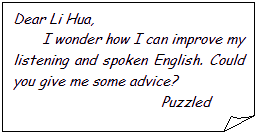 Tips
Tips
be active in English classes
watch English programs
read English texts aloud
listen to English tapes
…
注意:(1)回信可参考上述要点,并适当增加细节,以使行文连贯。
(2)词数:100左右。信的开头和结尾已给出,不计入总词数。
April 10th, 2010
Dear Puzzled,
Thank you for your letter. You asked me about how to improve your listening and spoken English. Here are some tips for you.
________________________________________________________________________________
Best wishes!
Yours,
查看答案和解析>>
科目: 来源: 题型:
17. We have every reason to believe that ________ 2010 Shanghai World Expo will be ________ success.
A. a; a B. the; / C. the; a D. /; a
查看答案和解析>>
湖北省互联网违法和不良信息举报平台 | 网上有害信息举报专区 | 电信诈骗举报专区 | 涉历史虚无主义有害信息举报专区 | 涉企侵权举报专区
违法和不良信息举报电话:027-86699610 举报邮箱:58377363@163.com