
2006-2007学年度潍坊市诸城九年级下学期
单元过关考试(四)
第I卷(共75分)
一、听力测试(20分)
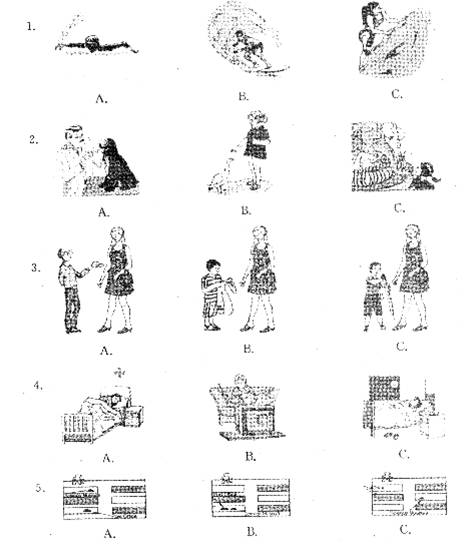
II.听下列五段对话和对话后的问题,选择正确答案。(每小题1分,共5分)
6. A. By bike. B. By bus. C. On foot.
7. A. The bank. B. The restaurant. C. the supermarket.
8. A. The hospital, B. The factory. C. The school.
9. A. Lucy. B. Tom. C. Lily.
10. A. He has gone to the shop. B. He has gone to the cinema.
C. He has gone to the museum,
III.听下列一段对话和对话后的问题,选择正确答案。(每小题1分,共5分)
11. A. No. they aren't. B. I'm not sure. C. Yes. they are.
12. A. This evening, B. Tomorrow evening, C. Tomorrow morning.
13. A. On foot. B. By air. C. By boat.
14. A. Near the post office. B. Next to the post office.
C. In front of the post office.
15. A. The second floor. B. The fifth floor. C. The third floor.
Ⅳ.听下列一封短信,填上所缺的单词或短语。(每小题1分,共5分)
Dear Linda.
Thanks for you letter. I'm glad to hear you can come on Sunday. When you 16 over to my house, it's easy to 17 , It's a little difficult after that, so here are some instructions:
Drive past the station. You can't 18 into Garden Road, so go across the traffic lights into New Street. There's a football ground on your left 19 ahead, pass the bank, and turn left into Green Road. Turn left again into the High Street. River Street is the first on the right. My house is on the right 20 the school.
See you on Sunday!
Love,
Ann
16. 17. 18. 19. 20.
从每小题A、B、C、D中选出能填入空白处的最佳选项。
二、单项选择(每小题1分,共15分)
21. useful the information he gave us is!
A. What an B. How an C. What D. How
22. --Must I finish the project now?
--No, you .You do it this evening.
A. mustn't; can B. needn't; may C. can't; must D. needn't; must
23. The little boy ate a big meal he said he wasn't hungry.
A. if B. though C. because D. as
24. --Did he live in Germany?
--Yes, but now he living in China.
A. use to, is used to B. used to, used to
C. use to, used to D. used to, is used to
25. --Your present is so nice. I like it very much.
--
A. That's a good idea! B. It doesn't matter.
C. Thank you to say so. D. I don't think so.
26. -- I wonder
--Tigers.
A. what do they call these animals B. how they call these animals
C. what they call these animals D. how do they call these animals
27. --Do you know whether Mary will go there?
--I'm not sure. She says she will stay at home unless she to the party.
A. is inviting B. invites C. was invited D. is invited
28. --Hello, may I speak to Mr. Smith?
--I'm sorry, he is out.
A. but B. and C. or D. so
29. --Where do you think the box?
--Anywhere you like.
A. can I put B. to put C. I can put D. putting
30. Simon walking jogging after super every day.
A. prefers; than B. would rather; than
C. prefers; to D. would rather; to
31. more accidents, we should slow down the driving, speed.
A. To prevent B. Prevented C. Stop D. Stopping
32. I don't know I should with my broken computer.
A. how, do B. what, do C. how, to deal D. which, deal
33. China is the east of Asia and the west of Japan.
A. in, on B. in, to C. to, on D. on, to
34. --What would you like to drink, coffee or orange juice?
-- .Please give me a cup of tea.
A. Neither B. Both C. All D. None
35. --Can I use your dictionary, please'?
--Sorry. My dictionary . I have looked for it everywhere but still it.
A. has lost; don't find B. is missing; don't find
C. has lost; haven't found D. is missing; haven't found
36. My father on business for two weeks. He'll return in 3 days.
A. left B. has left
C. has gone D. has been away
从每小题A、B、C、D中选中选出能填入空白处的最佳答案。
Some years ago, Chinese high school students would show their new schoolbags, new clothes or new pens to their classmates when the new term started. Today, however, all have 37 If you still come back to school 38 only these things, you are falling out-of-date (过时的). Students in big cities like to bring the latest high-tech things to school, and feel happy and 39 to show off (炫耀) these things to 40 Mobile. phones, MP3 players, CD players, electronic dictionaries, the list is endless.
Young people think
that, living in the 21st century, they must keep up with the 41 They don't want to fall 42
Besides, they think 43
they need to keep in touch with their classmates, so they need
mobile phones. They also like to 44 the pop music, so they need CD
players. They explain that 45 like electronic dictionaries, these can
be
Foreign students will also bring some latest high-tech things when they 49 to school at the beginning of a new term 50 , they often use the money which they made by themselves during the holiday to 51 these high-tech things that they want.
三、完形填空(每小题1分,共15分)
37. A. changed B. come C. joined D. stopped
38. A. to B. from C. of D. with
39. A. right B. lucky C. nice D. pleased
40. A. other B. the other C. others D. the others
41. A. times B. days C. years D. date
42. A. down B. off C. behind D. back
43. A. that B. how C. if D. which
44. A. hear B. listen to C. read D. play
45. A. look B. just C. feel D. something
46. A. new B. modern C. latest D. useful
47. A. also B. too C, either D. then
48. A. where B. which C. what D. why
49. A. return B. return back C. reach D. arrive
50. A. But B. However C. So D. Still
51. A. borrow B. buy C. lend D. take
A
One of the things to be learnt in a foreign language is guessing all the time what kind of thing to come when listening to someone talking. People do this all the time in their own language, so it is necessary (必要的) to do this in a foreign language, too. Here are some examples.
四、阅读理解(每小题1.5分,共24分)
湖北省互联网违法和不良信息举报平台 | 网上有害信息举报专区 | 电信诈骗举报专区 | 涉历史虚无主义有害信息举报专区 | 涉企侵权举报专区
违法和不良信息举报电话:027-86699610 举报邮箱:58377363@163.com