科目:czyy 来源:2011年河南省中考英语压轴试卷(四) 题型:阅读理解
Today there are 6.4 billion people on the earth. By the year 2050 there may be 12.5 billion . There are a lot of people to feed. We need more and more food.
One way to produce more food is growing stronger plants. For thousands of years, farmers have made plants better. Every season, they pick the best plants for the next season. It works very slowly. Since 1983, scientists have been able to change plants more quickly by changing their genetic(遗传的) material. Foods from plants grown in this way are called genetically modified(改变的) foods, or GM foods.
By changing the genetic material of a plant, it is possible to make new plants. They make plants which are strong against plant diseases. They can also help in our diseases; a kind of rice is being prepared , for example , which stops people becoming blind.
Rich countries produce GM foods because they are easy to grow and bring in more money. Poor countries are interested in them because they help produce more food.
GM plants are not natural. No one knows how good or bad they are,. Making GM foods is only one way of feeding people in 2050. There are strong feelings against them, because they are unnatural. They may feed people , then hurt them or their children later. But both rich and poor countries are interested in their use, and they are not going to go away. In 2050, we may think differently about them.
【小题1】GM foods are made by
A. farmers B. workers C. scientists D plants
【小题2】What are the good things about GM foods ?
A. They make plants strong against diseases. B. They are unnatural.
C. They can help in human diseases. D Both A and C.
【小题3】GM foods .
A. are a quick way to produce food B. grow in the wild
C. are safe D are grown only in rich countries
【小题4】Why do some people not like GM foods?
A. They are not useful. B. They are not helpful.
C. They are not natural. D They are not cheap.
【小题5】From the passage we know that .
| A.GM foods will disappear one day in the future |
| B.GM foods will not disappear in the future |
| C.People will not be interested in GM foods. |
| D.People will have to stop using GM foods |
科目:czyy 来源:2015届云南省八年级上学期期末考试英语卷(解析版) 题型:单项填空
We need to do this work with money and people than before.
A. little, few B. fewer, less C. less, fewer D. more, few
科目:czyy 来源:2013届江苏扬州扬中教育集团树人学校初三中考第三次模拟考试英语卷(带解析) 题型:阅读理解
It’s interesting that the arrival of snow has a different effect on people in different countries. For some countries it is an important happening to celebrate each year, while for others it is a catastrophe (灾难) or even a wonder.
There are countries between these two extremes (极端) that normally expect snow some time over the winter months, but never receive snow regularly or in the same quantities(数量) every year. Britain is one such country, for which the arrival of snow quite simply creates problems. Within hours of the first snowfall, however light, roads are blocked, trains and buses stop in the middle of traffic. Normal communications are affected as well, telephone calls become difficult and the post immediately takes more time than usual. Almost within hours, there are also shortages(不足) -- bread, vegetables and other things -- not because all these things can no longer be produced or sent to shops, but mainly because people are frightened, and go out to store up these commodities (日用品), “just for fear that something bad should happen.”
Why then does snow have this effect? After all, the Swiss, Austrians and Canadians don’t have such problems. It is simply because there is not enough planning and preparation. We need money to buy equipment to deal with snow and ice. To keep the roads clear, for example, requires snow ploughs and machines to spread salt. The reason why a country like Britain does not buy some ploughs is that they are only used for a few days in any one year, and the money could be more useful in other things such as hospitals, education or helping the old.
【小题1】According to the writer, Britain is a country____.
| A.which has regular snow | B.which is not well prepared for snow |
| C.for which snow is not a problem | D.for which snow is a wonder |
| A.traffic | B.communication | C.food supplies | D.service quality |
| A.shops have closed down | B.people buy as much as they can |
| C.farmers can’t produce any more | D.people eat more vegetables in winter |
| A.spreading salt is good enough | B.old people need more money |
| C.snow ploughs are not used often | D.the hospital is more important |
科目:czyy 来源:2012-2013学年江苏扬州扬中教育集团树人学校初三中考第三次模拟考试英语卷(解析版) 题型:阅读理解
It’s interesting that the arrival of snow has a different effect on people in different countries. For some countries it is an important happening to celebrate each year, while for others it is a catastrophe (灾难) or even a wonder.
There are countries between these two extremes (极端) that normally expect snow some time over the winter months, but never receive snow regularly or in the same quantities(数量) every year. Britain is one such country, for which the arrival of snow quite simply creates problems. Within hours of the first snowfall, however light, roads are blocked, trains and buses stop in the middle of traffic. Normal communications are affected as well, telephone calls become difficult and the post immediately takes more time than usual. Almost within hours, there are also shortages(不足) -- bread, vegetables and other things -- not because all these things can no longer be produced or sent to shops, but mainly because people are frightened, and go out to store up these commodities (日用品), “just for fear that something bad should happen.”
Why then does snow have this effect? After all, the Swiss, Austrians and Canadians don’t have such problems. It is simply because there is not enough planning and preparation. We need money to buy equipment to deal with snow and ice. To keep the roads clear, for example, requires snow ploughs and machines to spread salt. The reason why a country like Britain does not buy some ploughs is that they are only used for a few days in any one year, and the money could be more useful in other things such as hospitals, education or helping the old.
1.According to the writer, Britain is a country____.
A.which has regular snow B.which is not well prepared for snow
C.for which snow is not a problem D.for which snow is a wonder
2.The arrival of snow in Britain affects all of the following except____
A.traffic B.communication C.food supplies D.service quality
3.After a few hours’ snowing there are often shortages of food because______
A.shops have closed down B.people buy as much as they can
C.farmers can’t produce any more D.people eat more vegetables in winter
4.The first reason that the British don’t buy snow ploughs is that______
A.spreading salt is good enough B.old people need more money
C.snow ploughs are not used often D.the hospital is more important
科目:czyy 来源:2011年河南省中考英语压轴试卷(四) 题型:阅读理解
Today there are 6.4 billion people on the earth. By the year 2050 there may be 12.5 billion . There are a lot of people to feed. We need more and more food.
One way to produce more food is growing stronger plants. For thousands of years, farmers have made plants better. Every season, they pick the best plants for the next season. It works very slowly. Since 1983, scientists have been able to change plants more quickly by changing their genetic(遗传的) material. Foods from plants grown in this way are called genetically modified(改变的) foods, or GM foods.
By changing the genetic material of a plant, it is possible to make new plants. They make plants which are strong against plant diseases. They can also help in our diseases; a kind of rice is being prepared , for example , which stops people becoming blind.
Rich countries produce GM foods because they are easy to grow and bring in more money. Poor countries are interested in them because they help produce more food.
GM plants are not natural. No one knows how good or bad they are,. Making GM foods is only one way of feeding people in 2050. There are strong feelings against them, because they are unnatural. They may feed people , then hurt them or their children later. But both rich and poor countries are interested in their use, and they are not going to go away. In 2050, we may think differently about them.
1.GM foods are made by
A. farmers B. workers C. scientists D plants
2.What are the good things about GM foods ?
A. They make plants strong against diseases. B. They are unnatural.
C. They can help in human diseases. D Both A and C.
3.GM foods .
A. are a quick way to produce food B. grow in the wild
C. are safe D are grown only in rich countries
4.Why do some people not like GM foods?
A. They are not useful. B. They are not helpful.
C. They are not natural. D They are not cheap.
5.From the passage we know that .
A. GM foods will disappear one day in the future
B. GM foods will not disappear in the future
C. People will not be interested in GM foods.
D. People will have to stop using GM foods
科目:czyy 来源: 题型:阅读理解
| A.GM foods will disappear one day in the future |
| B.GM foods will not disappear in the future |
| C.People will not be interested in GM foods. |
| D.People will have to stop using GM foods |
科目:czyy 来源:湖北省荆门市2010年初中毕业生学业考试英语试卷 题型:050
| |||||||||||||||||||||||||||||||||||||||||||||||||||||||||||||||||||||||||
科目:czyy 来源: 题型:
Money can’t buy everything, but we need money in our life. If I have a lot of money, I will do a lot of things.
First, I want to build a nice house for my parents. Now I just live with my grandparents. My parents can’t afford to build one beautiful house, because the money my parents make is only used to pay for my study and everyday life. I feel sorry for them. So I will give a lot of money to my parents if I am very rich.
Second, I will give money to the poor children, then they can go to school and they can get knowledge(知识). When they grow up, they can work for the country. Now in the 21st century, knowledge is the most important thing. Can we say “Knowledge is money”? I think so. So I am sure we can have a nice future and a much stronger motherland.
At last I will go to the best medical college in the world, and also I will make a lot of medicine for different diseases of cancer(癌症), and then I can help more people.
There are many things we will do if we have a lot of money, but now we have to work hard. So let’s work hard for money, and for our country!
根据短文内容判断正(T)误(F)。
1.The writer tells us she has a lot of money.
2.There are three people in the writer’s family.
3.If the writer has a lot of money, she will help the poor children.
4.In the 21st century, money is the most important thing.
5.The writer thinks knowledge is money.
科目:czyy 来源:期末题 题型:阅读理解
科目:czyy 来源: 题型:阅读理解
科目:czyy 来源: 题型:
We need some more money and people to ________ with our study of science.
A. put on B. turn on C. try on D. carry on
科目:czyy 来源: 题型:阅读理解
科目:czyy 来源:湖北省中考真题 题型:阅读理解
| 阅读理解。 | |||||
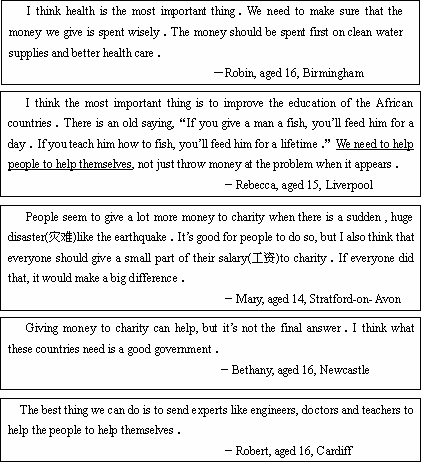
| Below are some suggestions given by the English children posted on the website about how to help Africa. Which one do you think is the best?
| |||||
| 1. Which two children share the similar opinion? | |||||
| A. Mary and Rebecca. B. Bethany and Mary. C. Rebecca and Bethany. D. Rebecca and Robert. | |||||
| 2. Who pays more attention to Africans' health care? | |||||
| A. Mary. B. Robin. C. Rebecca. D. Robert. | |||||
| 3. What does Rebecca mean by saying "We need to help people to help themselves"? | |||||
| A. We should help the teachers in Africa to improve their teaching ways. B. We should help people in Africa how to build a good government. C. We should help the African people develop skills to make a living. D. We should help the African people build more schools. | |||||
| 4. What is Mary's opinion? | |||||
| A. Everyone should do what we can to help the African people. B. It is not good for people to give so much money to the African people. C. It is very important to have a good government. D. We can send more teachers there to help the African people. | |||||
| 5. Where are these suggestions posted? | |||||
| A. In the textbook. B. On the website. C. In the guidebook. D. In the magazine. |
科目:czyy 来源: 题型:单选题
科目:czyy 来源:2012-2013学年江西省九年级第一次段考英语试卷(解析版) 题型:单项填空
—Can we finish the work with ______ money and ______ people?
—I'm afraid it's impossible.
A.less; fewer
B.few; less
C.less; less
D.fewer; fewer
科目:czyy 来源:2015届江苏无锡华仕中学初二上学期第一次阶段性检测英语卷(解析版) 题型:单项填空
I am sure that we can do our job better with______ money and _________ people.
A. less; less B. fewer; fewer C. less; fewer D. fewer; less
科目:czyy 来源: 题型:单选题
科目:czyy 来源:2013-2014学年福建省教研片九年级上学期期中考试英语试卷(解析版) 题型:阅读理解
Today we can see that many people are cutting down the trees in the forests. A lot of lands have become deserts. If we read newspapers, we’ll learn that the forests on the earth are getting smaller . We are cutting down large numbers of trees we need wood and farmland. Some scientists say that there will not be any great forests 20 or 30 years.
What will happen if the forests disappear? A lot of plants will die and the animals will
their homes. In many places the new farmland will soon look the old desert. Crops will not grow there. There won’t be enough , and the weather will get hot and dry. If the climate of the earth changes, life will be for everyone. Our living environment will become . More and more rich farmland will disappear. We will suffer a lot from both droughts (干旱) and floods.
It’s our duty the forests well. Everyone should try his best to make a contribution (贡献) to taking care of the forests. Stop cutting down the trees and make the world greener!
1.A. rich B. low C. lonely
2.A. on time B. all the time C. in time
3.A. or B. so C. because
4.A. at B. on C. in
5.A. find B. build C. lose
6.A. up B. like C. at
7.A. snow B. rain C. wind
8.A. easy B. happy C. hard
9.A. better and better B. worse and worse C. bigger and bigger
10.A. to protect B. do C. to do
科目:czyy 来源:2013届江西省吉安朝宗实验学校九年级第一次段考英语试卷(带解析) 题型:单选题
—Can we finish the work with ______ money and ______ people?
—I'm afraid it's impossible.
| A.less; fewer |
| B.few; less |
| C.less; less |
| D.fewer; fewer |
科目:czyy 来源:2012-2013学年江苏省南通市八一中学八年级上学期期中考试英语试卷(带解析) 题型:单选题
We can do the work better with ______ money and ______ people.
| A.little, few | B.few, little | C.less, fewer | D.fewer, less |