
精英家教网 > 试题搜索列表 >It's our hope that we will

It's our hope that we will答案解析

科目:gzls 来源: 题型:阅读理解

Vicious(剧烈的)and Dangerous Sports Should be Banned by Law
When you think of the tremendous technological progress we have made, it’s amazing how little we have developed in other respects. We may speak contemptuously of the poor old Romans because they relished the orgies of slaughter that went on in their arenas. We may despise them because they mistook these goings on for entertainment. We may forgive them condescendingly because they lived 2000 years ago and obviously knew no better. But are our feelings of superiority really justified? Are we any less blood-thirsty? Why do boxing matches, for instance, attract such universal interest? Don’t the spectators who attend them hope they will see some violence? Human beings remains as bloodthirsty as ever they were. The only difference between ourselves and the Romans is that while they were honest enough to admit that they enjoyed watching hungry lions tearing people apart and eating them alive, we find all sorts of sophisticated arguments to defend sports which should have been banned long age; sports which are quite as barbarous as, say, public hangings or bearbaiting.
It really is incredible that in this day and age we should still allow hunting or bull-fighting, that we should be prepared to sit back and watch two men batter each other to pulp in a boxing ring, that we should be relatively unmoved by the sight of one or a number of racing cars crashing and bursting into flames. Let us not deceive ourselves. Any talk of ‘the sporting spirit’ is sheer hypocrisy. People take part in violent sports because of the high rewards they bring. Spectators are willing to pay vast sums of money to see violence. A world heavyweight championship match, for instance, is front page news. Millions of people are disappointed if a big fight is over in two rounds instead of fifteen. They feel disappointment because they have been deprived of the exquisite pleasure of witnessing prolonged torture and violence.
Why should we ban violent sports if people enjoy them so much? You may well ask. The answer is simple: they are uncivilized. For centuries man has been trying to improve himself spiritually and emotionally – admittedly with little success. But at least we no longer tolerate the sight madmen cooped up in cages, or public floggings of any of the countless other barbaric practices which were common in the past. Prisons are no longer the grim forbidding places they used to be. Social welfare systems are in operation in many parts of the world. Big efforts are being made to distribute wealth fairly. These changes have come about not because human beings have suddenly and unaccountably improved, but because positive steps were taken to change the law. The law is the biggest instrument of social change that we have and it may exert great civilizing influence. If we banned dangerous and violent sports, we would be moving one step further to improving mankind. We would recognize that violence is degrading and unworthy of human beings.

  1. 1.

    It can be inferred from the passage that the author’s opinion of nowadays’ human beings is

    1. A.
      not very high.        
    2. B.
        high. 
    3. C.
        contemptuous.     
    4. D.
        critical.
  2. 2.

    The main idea of this passage is

    1. A.
      vicious and dangerous sports should be banned by law.
    2. B.
      people are willing to pay vast sums money to see violence.
    3. C.
      to compare two different attitudes towards dangerous sports.
    4. D.
      people are bloodthirsty in sports.
  3. 3.

    That the author mentions the old Romans is

    1. A.
      To compare the old Romans with today’s people. 
    2. B.
      to give an example.
    3. C.
      to show human beings in the past know nothing better.
    4. D.
      to indicate human beings are used to bloodthirsty.
  4. 4.

    How many dangerous sports does the author mention in this passage?

    1. A.
        Three.    
    2. B.
        Five.   
    3. C.
        Six.   
    4. D.
        Seven.
  5. 5.

    The purpose of the author in writing this passage is

    1. A.
      that, by banning the violent sports, we human beings can improve ourselves.
    2. B.
      that, by banning the dangerous sports, we can improve the law.
    3. C.
      that we must take positive steps to improve social welfare system.
    4. D.
      to show law is the main instrument of social change.

查看答案和解析>>

科目:gzls 来源: 题型:

Victor Hugo Condemning theBurning of Winter Palace(1861)(8分)

    Since you ask,I will answer as follows:in a comer of the world there existed a man——made miracle(人间奇迹)—the Winter Palace.

    Now,the miracle is no more!One day,two pirates(海盗)broke(毁坏)into it. One of them  went plundering(掠夺);the other set every building and everything in it all blaze(燃烧)! Standing before the tribunal of history is one brigand(强盗)named France and the  other named Great Britain.

    I can only hope that there will come one day when France will disburden(摆脱负担) herself of the heavy load on her conscience(良心)and cleanse herself of the crime(罪行)by returning to China all the spoils taken from the Winter Palace.

    请回答:

    (1)Victor Hugo所说a man—made miracle—the Winter Palace是指什么地方?(2分)

    (2)写出在历史法庭前的这两个强盗的名字。(2分)

    (3)当时的France正处于哪一历史时期?(2分)

(4)Victor Hugo写这封谴责信,说I can only hope that there will come one day when    France wiIl disburden herself 0f the heavy load 0n her conscience and cleanse herseIf of the crime by returning to China all the spoils taken from the Winter Palace,    表现了怎样的内心情感?(2分)

查看答案和解析>>

科目:gzls 来源: 题型:阅读理解

Is war unavoidable? Can war be prevented?
History tells that there were wars, great or small, in every century, in every decade. Throughout the ages, from the Stone age to the Atomic Age, men have been fighting, first with swords and shields(盾), then with guns and cannons, and now, hydrogen bombs and missiles are used for military purpose. But, in spite of all these, it is still my belief that war can be prevented and peace can be won, but it requires the effort of every one of us.
I am sure that we would not like to experience another world war. If it ever happens, two-thirds of the world and much of the civilization which men have gained through time, patience and effort will be destroyed. Will then the remaining one-third of the world be able to survive on its own?
Our task now is not to blame the past, but to plan for the future.
If there is peace in the world, men can use their rockets to explore the mystery of space, their submarines to explore the depth of the sea, their missiles to deliver mails and their fine equipment to penetrate(穿透) the jungles of Africa, instead of using them military.
Governments can use their money to build more schools, so that more children can be educated to be useful citizens. Scientists can use atomic energy to propel (推动) steamships and planes. They can also design new machines to increase the production of goods and thus improve the way of living of the people.
How can a peaceful world be achieved? It requires, in my opinion, the understanding and friendship between all people from all nations. Let no one suffer discrimination by reason of color, race, religion, or national origin. Let the rich support the poor and the strong help the weak.
We know that neither peace nor such a dream world can come true in a day or a month. It may even take decades or centuries. But let us plan and begin now.

  1. 1.

    The best title for this passage is _________.

    1. A.
      The Past and the Future
    2. B.
      To Die or To Survive
    3. C.
      War and Peace
    4. D.
      Understanding and Friendship
  2. 2.

    In the writer’s opinion, __________.

    1. A.
      it is too difficult to achieve peace
    2. B.
      peace can be won through the efforts of all human beings
    3. C.
      another world war is inevitable
    4. D.
      wars will always exist in the world
  3. 3.

    We can infer from the passage that __________.

    1. A.
      wars were not expensive in the past
    2. B.
      wars can promote the development of weapons
    3. C.
      things for military use can be transformed to peaceful use
    4. D.
      as long as there are wars, people’s way of living cannot be improved
  4. 4.

    What should we do to achieve peace?

    1. A.
      Spend more money educating children.
    2. B.
      Stop military exploration
    3. C.
      Call on people to help each other
    4. D.
      Act from right now on.
  5. 5.

    Which word can best describe the writer’s picture of the future of the world?

    1. A.
      Optimistic
    2. B.
      Pessimistic
    3. C.
      Imaginative
    4. D.
      Disappointing

查看答案和解析>>

科目:gzls 来源: 题型:阅读理解

The journey to the moon had been the first step toward future exploration(探险) in space. The distance between the Moon and Earth is very short indeed when compared with the distances between Earth and the other planets. Mars, the nearest planet to Earth is millions of miles away. Traveling to the planets will be man’s next aim. Such travels will be more challenging than the trip to the moon and certainly more adventurous.
Recently, two American spaceships, Vikings 1 and 2, landed on Mars trying to discover whether that planet has any life on it. So far the signs of life on Mars has neither confirmed(确认) nor ruled out. Russians have discovered that the surface of Venus(金星) is so hot that it is almost certain that there is no life there. Also the atmosphere of Venus is extremely dense(稠) and the pressure is nearly a hundred times greater than that of the Earth’s atmosphere.
Scientists believe man may find planets which have the same conditions as those we have on Earth , but man should realize Earth will be his only home for a long time and begin to love and care for it.

  1. 1.

    According to the passage, traveling to the planets will be ________.

    1. A.
      much easier and even more interesting
    2. B.
      far more exciting and dangerous
    3. C.
      man’s final aim
    4. D.
      man’s first step
  2. 2.

    Which of the following is Not true?

    1. A.
      Mars is nearer to the earth than the moon.
    2. B.
      The moon is much nearer to the earth than Mars.
    3. C.
      Of all the planets, Mars is the nearest to the earth.
    4. D.
      All the planets are much farther to the earth.
  3. 3.

    From the passage, we can guess______________.

    1. A.
      there is life on Mars
    2. B.
      there is no life on Mars
    3. C.
      the atmosphere of Mars is not so dense as that of Venus
    4. D.
      scientists will have little hope to find the answers
  4. 4.

    Man can live on under the conditions of ______________.

    1. A.
      much too hot surface
    2. B.
      the same pressure as we get on earth
    3. C.
      normal atmosphere as we have on earth
    4. D.
      both B and C

查看答案和解析>>

科目:gzls 来源: 题型:阅读理解

For thousands of years, the most important two buildings in any British village have been the church and the pub.Traditionally, the church and the pub are at the heart of any village or town, where the people gather together to socialize and exchange news.
As a result, British pubs are often old and well preserved.Many of them have become historic sites.The most famous example is the pub in the city of Nottingham called " Ye Olde Trip to Jerusalem" , which dates back to the year 1189 AD and is probably the oldest pub in England.
However, British pubs are not just for kings and queens; they welcome people from all classes and parts of society.On a cold night, the pub's landlord or landlady can always find a warm place for you by the fire.There is always honest and hearty food and plenty of drinks available at an affordable price.
That's how things used to be.Things are beginning to change.It is said that the credit crunch (信贷紧缩) is causing 39 British pubs in a week to go out of business.People do not have enough spare money to spend on beer.Recently, the UK government banned smoking in all pubs, and that may also have affected the number of customers going to pubs.
This decline is happening despite the fact that in 2005 the UK government started to allow pubs to stay open after 11 p.m..Previously, with 11 p.m.as closing time, customers would have to drink quite quickly, meaning they sometimes got more drunk than they would if allowed to drink slowly.The British habit of drinking a lot very quickly is known as "binge drinking" , and it causes long-term health problems for people and problems with violent crime for communities.
In order to save their businesses, pubs are trying to change with the market.British pubs now offer something for everyone.A lot of pubs used to be "Working Men's Clubs" , meaning that women could not usually enter.Today, however, women can freely enter 99% of pubs without experiencing any problems.Perhaps things are changing for the better after all.

  1. 1.

    British people have the habit of gathering in the pubs to _____.

    1. A.
      have the hearty food
    2. B.
      enjoy the historic sites
    3. C.
      make themselves known
    4. D.
      communicate with each other
  2. 2.

    The British pubs are allowed to stay open after 11p.m.to ______.

    1. A.
      urge customers to drink quickly
    2. B.
      affect the number of customers
    3. C.
      help reduce social problems
    4. D.
      give pub owners better income
  3. 3.

    We can learn from the last paragraph that the author _____.

    1. A.
      is against the admission of too many women to the pubs
    2. B.
      holds an optimistic attitude towards the future of the British pubs
    3. C.
      thinks that women in the pubs will cause less social problems
    4. D.
      holds the view that British pubs should offer everything you need
  4. 4.

    The passage mainly tells us ______.

    1. A.
      the long history of British pubs
    2. B.
      the present situation of British pubs
    3. C.
      the reason why British people go to pubs
    4. D.
      the disadvantages of running pubs in Britain

查看答案和解析>>

科目:gzls 来源: 题型:阅读理解

Coffee has a history dating back to at least the 9th century and has been a catalyst for social interaction across cultures and eras. Originally discovered in Ethiopia, coffee beans were brought into the Middle East by Arab traders, spreading to Egypt, Yemen, Persia, Turkey, and North Africa by the 15th century. Muslim merchants eventually brought the beans to the thriving port city of Venice, where they sold them to wealthy Italian buyers. Soon, the Dutch began importing and growing coffee in places like Java and Ceylon (largely through slave labor), and the British East India Trading Company was popularizing the beverage in England. Coffee spread across Europe and even reached America.
Where there has been coffee, there has been the coffeehouse. From the 15th century Middle Eastern establishments where men gathered to listen to music, play chess, and hear recitations from works of literature, to Paris' Cafe le Procope where luminaries of the French Enlightenment such as Voltaire, Rousseau, and Diderot came to enjoy a hot cup of joe, coffeehouses have traditionally served as centers of social interaction, places where people can come to relax, chat, and exchange ideas.
The modern coffee shop is modeled on the espresso and pastry-centered Italian coffeehouses that arose with the establishment of Italian-American immigrant communities in major US cities such as New York City's Little Italy and Greenwich Village, Boston's North End, and San Francisco's North Beach. New York coffee shops were often frequented by the Beats in the 1950's. It wasn't long before Seattle and other parts of the Pacific Northwest were developing coffee shops as part of a thriving counterculture scene. The Seattle-based Starbucks took this model and brought it into mainstream culture.
Although coffeehouses today continue to serve their traditional purpose as lively social hubs in many communities, they have noticeably adapted to the times. Rediscovering their purpose as centers of information exchange and communication, many coffee shops now provide their customers with internet access and newspapers. It has become extremely common to see someone sitting at a Starbucks listening to music or surfing the web on his or her laptop. Coffee stores today also maintain a fairly identifiable, yet unique aesthetic: wooden furniture and plush couches, paintings and murals drawn on walls, and soft-lighting combine to give coffee shops the cozy feeling of a home away from home.
Today, big business retail coffee shops are expanding quickly all over the world. Starbucks alone has stores in over 40 countries and plans to add more. Despite its popularity, Starbucks has been criticized and labeled by many as a blood-sucking corporate machine, driving smaller coffee shops out of business through unfair practices. This has even spawned an anti-corporate coffee counterculture, with those subscribing to this culture boycotting big business coffee chains. Increasingly popular coffee stores such as The Coffee Bean and Tea Leaf are also giving Starbucks some stiff competition. In any case, it seems pretty clear that coffee has weaved itself into the fabric of our consumer-oriented culture.

  1. 1.

    Which of the following is the correct order of coffee spreading in history?
    ①Egypt         ②America   ③the Middle East   ④Netherlands   ⑤Venice

    1. A.
      ①③④②⑤
    2. B.
      ③①⑤④②
    3. C.
      ①⑤④③②
    4. D.
      ③②⑤④①
  2. 2.

    We can infer from the passage ________.

    1. A.
      Starbucks has beaten all the competitors
    2. B.
      there are no changes in the development of coffee culture
    3. C.
      the taste of coffee has changed a lot
    4. D.
      Starbucks has some effect on the development of coffee culture
  3. 3.

    The famous coffeehouse “Starbucks” originally come from _______.

    1. A.
      Seattle
    2. B.
      Ethiopia
    3. C.
      Java
    4. D.
      France
  4. 4.

    Nowadays, if you come to a coffeehouse, you can _______.

    1. A.
      play chess with other customers
    2. B.
      enjoy delicious dishes from South America
    3. C.
      surf the internet
    4. D.
      watch a TV play

查看答案和解析>>

科目:gzls 来源: 题型:阅读理解

For the first time in Hong Kong’s history, an entertainer has been written into middle school textbooks. He is considered one of the best actors in Hong Kong. Yes, he is Chow Yun-fat.
The example of his long hard struggle for success has been used in a chapter in a Hong Kong middle school textbook. Using his experience, students can learn to make the most of their time and to grab every opportunity to succeed.
On hearing about this, Chow said happily, “I really hope that my experiences can make young people understand that one should not be afraid of difficulties and setbacks (挫折), for they are the only way to success.”
Indeed, Chow has travelled a long and difficult path to reach his success. In 1955, he was born into a poor family in Hong Kong. When he was 17, he had to leave school. He worked in a number of jobs—as a postman, camera salesman and taxi driver. These experiences paved (铺路) the way for him to play all kinds of roles later in life.
Chow broke into the film industry in the late 1970s. He was one of the hardest working actors and starred in a number of popular TV dramas and films including “Shanghai Bund”(《上海滩》) and “A Better Tomorrow”. Since 1985, he has won many awards including Taiwan's Golden Horse Awards and Hong Kong Film Awards.
In 1995, he went to Hollywood. Although he was already over 40, he had to learn English. He even put chopsticks in his mouth to practise pronouncing certain sounds. His film, “Crouching Tiger, Hidden Dragon”, began to gain him more fame and recognition around the world. In 1998, the mayor of Chicago set aside January 12 as “Chow Yun-fat Day”.

  1. 1.

    Chow Yun-fat has been written into middle school textbooks mainly because ________.

    1. A.
      he plays best in Hong Kong
    2. B.
      he keeps on struggling for success
    3. C.
      his experiences are very special
    4. D.
      he is well thought of
  2. 2.

    Chow felt ________ when he learned that he had been written into middle school textbooks.

    1. A.
      surprised
    2. B.
      shy
    3. C.
      sad
    4. D.
      happy
  3. 3.

    What can we infer from the passage?

    1. A.
      Chow Yun-fat is proud of his success.
    2. B.
      Chow Yun-fat prefers to make a living by selling cameras rather than by performing.
    3. C.
      Chow Yun-fat has won more awards than other actors.
    4. D.
      Chow Yun-fat is popular both at home and abroad.
  4. 4.

    The underlined sentence (in paragraph 6) suggests ________.

    1. A.
      chopsticks is of great help to practise English pronunciation
    2. B.
      Chow Yun-fat is willing to struggle with difficulties
    3. C.
      Chow Yun-fat has suffered a lot before he went to Hollywood
    4. D.
      it is hard for a person who is over 40 years old to learn spoken English
  5. 5.

    The author wrote this passage to ________.

    1. A.
      introduce Chow’s films
    2. B.
      praise Chow for his excellent performance
    3. C.
      call on people to learn from Chow
    4. D.
      show why Chow is popular

查看答案和解析>>

科目:gzls 来源: 题型:阅读理解

You may have heard the term "the American Dream". In 1848, James W. Marshall found gold in California and people began having golden dreams. That 19th century "American Dream" motivated (激发起) the Gold Rush and gave California its nickname of the "Golden State".
The American Dream drove not only 1800s gold-rush prospectors but also waves of immigrants throughout that century and the next. People from Europe, and a large number of Chinese, arrived in the US in the 19th century hoping that in America they would find gold in the streets. But most, instead, worked as railroad labourers. They created the oldest Chinatown, in San Francisco, and gave the city a Chinese name "the old gold hill".
In the 20th century, some critics said that it was no longer possible to become prosperous through determination and hard work. Unfair education for students from poor families and racial discrimination almost made the American Dream a nightmare.
Then, in the 1990s, California saw a new wave of dreamers in Silicon Valley. People poured their energy into the Internet. This new chapter of the American Dream attracted many business people and young talents from China and India to form start-ups and seek fortunes in America.
Better pay, a nice house, and a rising standard of living will always be attractive. However, the new American Dream is no longer just about money. It encourages Americans to consume wisely to protect the environment, improve the quality of life, and promote social justice.
The Governor of California, Arnold Schwarzenegger, has become the model of the new American Dream. After years of hard work, he grew from a poor young man from Austria into a movie superstar and then governor. Many people hope his story can save the American Dream and give California a brighter future.  

  1. 1.

    It can be inferred that _____.

    1. A.
      America’s golden dream could never be realized
    2. B.
      America’s golden dream had bought great fortunes to Chinese immigrants
    3. C.
      each period of time has its own taste of the American dream
    4. D.
      determination and hard work are the best way to realize the American dream
  2. 2.

    Why did most of the early immigrants work as railroad laborers?

    1. A.
      Because they could earn more money as railroad laborers.
    2. B.
      Because they had to make a living by working as railroad laborers.
    3. C.
      Because they thought railroad was the first step to find gold.
    4. D.
      Because railroad laborers were greatly honored at that time.
  3. 3.

    The underlined sentence “his story can save the American Dream” (in the last paragraph) indicates that _____.

    1. A.
      the dream of seeking fortunate in America is easy to realize
    2. B.
      most of the immigrants to America don’t reach their previous goal
    3. C.
      the success of Arnold Schwarzenegger is among the common examples of the immigrants
    4. D.
      the immigrants have made great contributions to California
  4. 4.

    What’s the best title of the passage?

    1. A.
      Wave of Immigrants to America
    2. B.
      Make Fortunes Abroad
    3. C.
      Hard Work Leads to Success
    4. D.
      Changes of America’s Golden Dream

查看答案和解析>>

科目:gzls 来源: 题型:阅读理解

It’s not the first movie to show the end of the world. But in the latest box office hit 2012 it is neither aliens nor a killer disease that threaten the human race, but climate change.
Some say the film lacks good dialogue and its science is questionable, others believe German director Roland Emmerich makes up for these flaws in special effects. An earthquake destroys the White House and Yellow stone  National Park ends up in flames.
Emmerich borrows from the old Mayan(玛雅人的) story which says, that the world will end in 2012.He is being criticized for fuelling Internet rumors(传闻) about doomsday(世界末日)
“There is no factual basis for these claims,’’ NASA said on its website. “Credible(可信赖的) scientists worldwide know of no threat connected with 2012,’’ it insisted. “After all, our planet has been getting along just fine for more than 4 billion years, ” they added.
According to the UK’s Daily Telegraph, it was first thought that the disaster would happen in May 2003. When the world continued, supporters picked the last day of the Mayan calendar.
“Every culture has a myth(传说) of destruction(毁灭), just as they have a myth of creation. These myths |of destruction tend to surface(重新出现) during times of crisis(危机), ” Michael A. Ryan, an assistant profess of history,speaking to Purdue University News. Ryan studies apocalyptic(像世界末日的) themes from the Middle Ages at the US university. “Today’s current economic climate is a state of crisis for many people who are worried whether they can afford to feed themselves,”he added.

  1. 1.

    What led to the end of the world according to the film 2012?

    1. A.
      Aliens.
    2. B.
      The human race.
    3. C.
      Climate change.
    4. D.
      A killer disease.
  2. 2.

    What does the underlined word “fuelling’’ in the third paragraph refer to?

    1. A.
      Making sth. stronger..
    2. B.
      Putting gas into a car.
    3. C.
      Producing power or heat.
    4. D.
      Burning
  3. 3.

    Which of the following statements about the film 2012 is TRUE according to the text?

    1. A.
      A big fire destroys Yellow-stone National Park.
    2. B.
      All scientists in the world know of no threat connected with 2012.
    3. C.
      The old Mayan story says that the world will end in
    4. D.
      Every culture has a myth of destruction rather than creation
  4. 4.

    Why do the rumors about doomsday come about now and then?

    1. A.
      Because during times of crisis, people tend to worry about their future.
    2. B.
      Because aliens often threaten the human race.
    3. C.
      Because killer diseases happen at times.
    4. D.
      Because the old Mayan story says that the world will

查看答案和解析>>

科目:gzls 来源: 题型:阅读理解

For hundreds of years, Japan has been hit, from time to time, by tsunamis(海啸), which are caused by earthquakes or underwater volcanoes. The story of the boy Yuuki is the story of such a disaster.
Yuuki lived with his family in a seaside village, below a small mountain. One day, as he played on top of the mountain, Yuuki felt a small earthquake but it was not strong enough to frighten anybody. Soon after, however, Yuuki noticed the sea darken and begin running away from the shore very fast, leaving behind wide areas of beach that had never been seen before.
Yuuki remembered reading that just before a terrible tsunami, the sea suddenly and quickly rolls backward. He ran to the beach, warning the villagers who had gathered to admire the new beach land.
But no one listened. They laughed at him and continued playing in the new sand.
Desperate, Yuuki could think of only one thing to do. He lit a tree branch, raced to the rice fields and began burning the harvested rice. Then he called out, “Fire! Fire! Everyone run to the mountain! Now!”
When everyone reached the mountain top, a villager cried out, “Yuuki is mad! I saw him set the fire.” Yuuki hung his head in shame, but said nothing as the villagers screamed at him.
Just then, someone shouted, “Look!”
In the distance a huge dark wave of water was speeding towards the shore. When it hit the shore, it destroyed everything.
On the mountain everyone stared at the village ruins in terror.
“I'm sorry I burned the fields,” said Yuuki, his voice trembling.
“Yuuki,” the village chief answered. “You saved us all.”
The villagers cheered and raised Yuuki into the air. “We were going to celebrate our rice harvest tonight,” said one, “but now we’ll celebrate that we’re all still alive!”

  1. 1.

     Where was Yuuki when the earthquake struck?

    1. A.
      On the beach.
    2. B.
      On the mountain.
    3. C.
      In the rice fields.
    4. D.
      At home.
  2. 2.

    In what order did the following events take place?
    a.Yuuki ran to the rice fields.
    b.The villagers paid no attention to Yuuki’s word.
    c.Yuuki went to warn the villagers.
    d.The village was in ruins.
    e.The people were screaming at Yuuki.

    1. A.
      c, b, d, a, e
    2. B.
      a, c, d, b, e
    3. C.
      c, b, a, e, d
    4. D.
      a, c, d, e, b
  3. 3.

    How did Yuuki save the villagers from the disaster?

    1. A.
      He told them about the earthquake.
    2. B.
      He explained why the sea was flowing out.
    3. C.
      He told the village chief to warn the people.
    4. D.
      He set fire to the rice field.
  4. 4.

    What were the people planning to do before the tsunami struck their village?

    1. A.
      Burn the rice crop.
    2. B.
      Play on the beach.
    3. C.
      Climb the mountain.
    4. D.
      Celebrate the rice harvest.

查看答案和解析>>

科目:gzls 来源: 题型:阅读理解

If English means endless new words, difficult grammar and sometimes strange pronunciation, you are wrong. Haven’t you noticed that you have become smarter since you started to learn a language?
According to a new study by a British university, learning a second language can lead to an increase in your brain power. Researchers found that learning other languages changes grey matter. This is the area of the brain which processes information. It is similar to the way that exercise builds muscles. The study also found the effect is greater the younger people learn a second language.
A team led by Dr Andrea Mechelli, from University College London, took a group of Britons who only spoke English. They were compared with a group of “early bilinguals” who had learnt a second language before the age of five, as well as a number of later learners.
Scans showed that grey matter density(密度)in the brain was greater in bilinguals than in people without a second language. But the longer a person waited before mastering a new language, the smaller the difference.
Our findings suggest that the structure of the brain is changed by the experience of learning a second language,”said the scientists.
It means that the change itself increases the ability to learn.
Professor Dylan Vaughan Jones of the University of Wales, has researched the link between bilingualism and math skills. “Having two languages gives you two windows on the world and makes the brain more flexible(灵活的),” he said. “You are actually going beyond language and have a better understanding of different ideas.”
The findings were matched in a study of native Italian speakers who had learned English as a second language between the ages of two and 34. Reading, writing, and comprehension were all tested. The results showed that the younger they started to learn, the better. “Studying a language means you get an entrance to another world,” explained the scientists.

  1. 1.

    Which part will change more when a person studies a second language?

    1. A.
      grey matter density
    2. B.
      the brain
    3. C.
      mental system
    4. D.
      musles
  2. 2.

    Who can study a second language easier? 

    1. A.
      The adults
    2. B.
      The teenagers
    3. C.
      The children
    4. D.
      The old
  3. 3.

    The underlined word “bilingual” probably means      .

    1. A.
      a researcher on language learning
    2. B.
      a second language learner
    3. C.
      a person who can speak two languages
    4. D.
      an active language learner
  4. 4.

      How do you understand the underlined sentence ( in paragraph 4 ) in the passage?

    1. A.
      It means that we can practise our brain by studying a second language
    2. B.
      It means that the change itself increases the ability to learn
    3. C.
      It means that learning a second language makes you more flexable
    4. D.
      It means that learners will better understand the difficult ideas.

查看答案和解析>>

科目:gzls 来源: 题型:阅读理解

Besides entertainment and beautiful lanterns, another important part of the Lantern Festival, or Yuanxiao Festival is eating small dumpling balls made of glutinous rice flour. We call these balls Yuanxiao or Tangyuan. Obviously, they get the name from the festival itself. It is said that the custom of eating Yuanxiao originated during the Eastern Jin Dynasty in the fourth century, then became popular during the Tang and Song periods.
The fillings inside the dumplings or Yuansiao are either sweet or salty. Sweet fillings are made of sugar, Walnuts, sesame(芝麻), osmanthus flowers(桂花), rose petals, sweetened tangerine(橘子)peel, bean paste, or jujube paste(枣子酱). A single ingredient or any combination can be used as the filling . The salty variety is filled with minced meat(肉末儿), vegetables or a mixture.
The way to make Yuanxiao also varies between northern and southern China. The usual method followed in southern provinces is to shape the dough of rice flour into balls, make a hole, insert the filling, then close the hole and smooth out the dumpling by rolling it between your hands. In North China, sweet or nutmeat stuffing is the usual ingredient. The fillings are pressed into hardened cores, dipped lightly in water and rolled in a flat basket containing dry glutinous rice flour. A layer of the flour sticks to the filling, which is then again dipped in water and rolled a second time in the rice flour. And so it goes, like rolling a snowball, until the dumpling is the desired size.
The custom of eating Yuanxiao dumplings remains. This tradition encourages both old and new stores to promote their Yuanxiao products. They all try their best to improve the taste and quality of the dumplings to attract more customers.

  1. 1.

    Which of the following is NOT true?

    1. A.
      The custom of eating Yuanxiao dates back to the fourth century.
    2. B.
      Sugar, rose petals and minced meat are all fillings of Yuanxiao.
    3. C.
      Sweet Yuanxiao are usually made in southern China.
    4. D.
      People in northern China usually make Yuanxiao by rolling like a snowball.
  2. 2.

    Which country does the Lantern Festival come from?

    1. A.
      China
    2. B.
      South Korea
    3. C.
      Jin Dynasty
    4. D.
      Tang and Song periods.
  3. 3.

    Choose the right order of making Tangyuan in southern provinces.
    ① make a hole and insert the filling 
    ② roll the dough between your hands 
    ③ shape the dough of rice flour into balls  
    ④ close the hole  
    ⑤ prepare some rice flour

    1. A.
      ⑤③②①④
    2. B.
      ③⑤①②④
    3. C.
      ③①④②⑤
    4. D.
      ⑤③①④②
  4. 4.

    What is the best title of this passage?

    1. A.
      The Lantern Festival
    2. B.
      The ingredients of Yuanxiao
    3. C.
      The difference between Yuanxiao and Tangyuan.
    4. D.
      China’s traditional food—Yuanxiao.
  5. 5.

    Why do we eat Yuanxiao today?

    1. A.
      Because it’s a tradition.
    2. B.
      Because it’s a tasty food.
    3. C.
      Because we love our country.
    4. D.
      Because this food can make money.

查看答案和解析>>

科目:gzls 来源: 题型:阅读理解

The idea about the phoenix goes back to Ancient Egypt, where we find the phoenix described as a handsome, eagle-like bird, with part-golden, part-red plumage, that spent most of its life in the Arabian deserts. It was rarely seen and according to one version of the story, only appeared in Egypt once every five hundred years, when it flew to Heliopolis, “city of the sun”, and deliberately burnt itself to ashes by settling on the altar (祭坛) flame there! However, it seems it did not really die because from those same ashes a young, fully formed phoenix was born and flew away, apparently back to Arabia.
It is pretty obvious that no one has ever seen or will see a living phoenix. The interesting thing is that we can find certain clues which may explain one aspect of the Egyptians’ idea. It may sound unbelievable, but some birds are apparently quite charmed by flames and small fires, especially members of the crow family. One zoologist actually proved this by setting fire to some straw near to a tame(驯养的)rook, a large black bird like a crow. Far from becoming nervous and backing away, the bird deliberately stood over the flames, with raised and vibrating wings. It didn’t get burnt, but the image it presented by its strange behavior was almost exactly like that shown in illustrations of the mythical phoenix!
Why birds should occasionally behave in this strange way is not clear. One idea is that they carefully use the heat of the flames to relieve the annoyance caused by their feather mites (虱) which all birds have. Whatever the reason, it is quite possible that the Ancient Egyptians saw birds behaving in this way, from time to time, and used it as the basis of their phoenix myth, adding fanciful details which closely linked it to their worship of the sun and their belief in resurrection.
Nowadays, the phoenix is much less important to us than it was to the Egyptians. But the logo of modern fire insurance companies, which employ the phoenix as one of their symbols, refers that in one sense the idea of it remains.  

  1. 1.

    According to the passage, the phoenix _________ .

    1. A.
      is a handsome and eagle-like bird living in Arab
    2. B.
      used to be seen when the Egyptians held religious activities
    3. C.
      has never really existed in the world
    4. D.
      is the king of all kinds of birds
  2. 2.

    The reason why birds stand above flames is probably that _________ .

    1. A.
      the phoenix used to do so
    2. B.
      they may get rid of the mites
    3. C.
      they want to burn their feather
    4. D.
      they can heat themselves
  3. 3.

    Which of the following statements is NOT correct?

    1. A.
      The ancient Egyptians worshiped the phoenix.
    2. B.
      The scientists have discovered why birds are attracted by fire.
    3. C.
      The modern people still favor the idea of the phoenix.
    4. D.
      The mythical tales about the phoenix were based on facts.
  4. 4.

    Which of the following is closest to the underlined word “resurrection” in the 3rd paragraph?

    1. A.
      living forever
    2. B.
      offering warmth
    3. C.
      coming back to life
    4. D.
      staying healthy
  5. 5.

    What does the phoenix probably mean in the logo of a fire insurance company?

    1. A.
      Our company can protect you from being harmed by fire.
    2. B.
      If your property is destroyed by fire, we will help you build it up again.
    3. C.
      Our company will always be energetic and wealthy.
    4. D.
      If needed, we will save you at the risk of losing lives.

查看答案和解析>>

科目:gzls 来源: 题型:阅读理解

Death Valley is one of the most famous deserts in the United States, covering a wide area with its alkali sand. Almost 20 percent of this area is well below sea level, and Badwater, a salt water pool, is about 280 feet below sea level and the lowest point in the United States.     
Long ago, the Panamint Indians called this place “Tomesha”— the land of fire. Death Valley’s present name dates back to 1849, when a group of miners coming across from Nevada became lost in its unpleasantness and hugeness and their adventure turned out to be a sad story. Today Death Valley has been declared a National Monument(纪念碑) and is crossed by several well-marked roads where good services can be found easily. Luckily the change created by human settlement has hardly ruined the special beauty of this place.
Here nature created a lot of surprising, almost like the sights on the moon, ever-changing as the frequent wind moves the sand about, showing the most unusual colors. One of the most astonishing and variable parts of Death Valley is the Devil’ s Golf Course, where it seems hard for one to tell reality from terrible dreams. Sand sculptures(沙雕) stand on a frightening ground, as evening shadows move and lengthen.

  1. 1.

    _______ is the lowest place in the desert.

    1. A.
      Tomesha
    2. B.
      Death Valley
    3. C.
      Nevada
    4. D.
      Badwater
  2. 2.

    The name of the valley comes from _______.

    1. A.
      an Indian name
    2. B.
      the death of the miners
    3. C.
      the local people
    4. D.
      a National Movement
  3. 3.

    From the passage we can learn that _______.

    1. A.
      no one had ever known the desert before the miners
    2. B.
      it’s still not easy to travel across the desert
    3. C.
      people can find gas-stations, cafes and hotels in the desert
    4. D.
      people have changed the natural sight of the desert
  4. 4.

    Devil Golf Course is famous for _______.

    1. A.
      the frequent wind
    2. B.
      the colors of the sand
    3. C.
      dream-like sights
    4. D.
      the sand sculptures
  5. 5.

    From the passage we can see that the writer _______ the Death Valley.

    1. A.
      appreciates
    2. B.
      is fearful of
    3. C.
      dislikes
    4. D.
      is tired of

查看答案和解析>>

科目:gzls 来源:福建省福州八县(市)一中2011-2012学年高二上学期期中联考历史理科试题 题型:066

美是人类永恒的追求,中外历史上的文化艺术异彩纷呈、绚丽多姿,不同地域、不同民族的文化艺术在延续本身的传统、呈示多元化和多样性特点的同时,推动着全人类文化艺术的共同进步。阅读下列材料并结合所学知识,回答问题:

  材料一:味摩诘(王维)之诗,诗中有画;观摩诘之画,画中有诗。
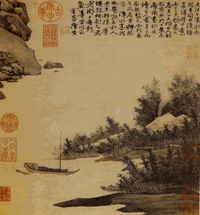
——(宋)苏轼

  材料二:这种音乐所特有的战斗性,令人想起产生它的时代。……在他生命晚期最熟知他的申德勒说:“他主张无限制的自由与民族的独立……他渴望法国实现普选……。”……于是他接连写下《英雄交响曲》……

——(法)罗曼·罗兰

  材料三:We are the world, we are the children; we are the ones who make a brighter day, so let's start giving.There's a choice we're making; We are saving our own lives; It's true we'll make a better day, Just you and me.

——《四海一家》歌词

请回答:

(1)上图属于“士大夫画”,“士大夫画”又被称为什么画?根据材料一并结合所学知识指出:这种画有哪些特点?

(2)材料二中的“他”指谁?结合材料三分析指出其作品《英雄交响曲》蕴涵的时代精神。

(3)材料三这首歌曲属于当代哪一流行音乐形式?这种音乐形式的产生并风靡全球体现了世界文化怎样的现象?

查看答案和解析>>

科目:gzls 来源: 题型:阅读理解

People believe that climbing can do good to health. Where can you learn the skill of climbing then? If you think that you have to go to the mountains to learn how to climb, you are wrong. Many Americans are learning to climb in city gyms(体育馆). Here, people are learning on special climbing walls. The climbing wall goes straight up and small holding places for hands and feet.

    How do people climb the wall? To climb, you need special shoes and a harness(保护带) around your chest to hold you. There are ropes tied to your harness. The ropes hold you in place so that you don’t fall. A beginner’s wall is usually about 15 feet high, and you climb straight up. There are small pieces of metal that stick out for you to stand on and hold on to. Sometimes it’s easy to see the next piece of metal. Sometimes, it’s not. The most difficult part is to control your fear. It’s normal for humans to be afraid of falling, so it’s difficult not to feel fear. But when you move away from the wall, the harness and the ropes hold you, and you begin to feel safe. You move slowly until you reach the top.

    Climbing attracts people because it’s good exercise for almost everyone. You use your whole body, especially your arms and legs. This sport gives your body a complete workout. When you climb your mind and your body can become stronger.

  1. What can we infer from the passage?

A. People are fairly interested in climbing nowadays.

B. It is impossible to build up one’s body by climbing.

C. People can only learn the skill of climbing outdoors.

D. It is always easy to see holding places in climbing.

2. The most difficult thing to do in wall climbing is _________.

A. to tie ropes to your harness        B. to control your fear

C. to move away from the wall       D. to climb straight up

3. The word “workout” underlined in the last paragraph most probably means _______.

A. settlement      B. exercise      C. excitement     D. tiredness

4. Why does the author write this passage?

A. To tell people where to find gyms.     B. To prove the basic need for climbing.

C. To encourage people to climb mountains.  D. To introduce the sport of wall climbing.


查看答案和解析>>

科目:gzls 来源: 题型:阅读理解

It was a simple letter asking for a place to study at Scotland’s oldest university which helped start a revolution in higher education. A 140-year-old letter written by a lady calling for her to be allowed to study medicine at St Andrews University has been discovered by researchers. Written by Sophia Jex-Blake in 1873, the seven-page document, which urged the university to allow women to study medicine at the institution, was released yesterday on International Women’s Day.
The document was discovered buried in the university archives (档案) by part-time history student Lis Smith, who is completing her PhD at St Andrews Institute of Scottish Historical Research. She said: “We knew that Sophia Jex-Blake and her supporters, in their effort to open up university medical education for women, had written to the Senatus Academicus (校评议委员会) at St Andrews in an attempt to gain permission to attend classes there, but we didn’t know documentary evidence existed. While searching the archives for information about the university’s higher certificate for women, I was astonished to come across what must be the very letter Jex-Blake wrote.”
In the letter, Sophia and her supporters offered to hire teachers or build suitable buildings for a medical school and to arrange for lectures to be delivered in the subjects not already covered at St Andrews. Although her letter was not successful, it eventually led to the establishment of the Ladies Literate in Arts at St Andrews, a distance-learning degree for women. The qualification, which ran from 1877 until the 1930s, gave women access to university education in the days before they were admitted as students. It was so popular that it survived long after women were admitted as full students to St Andrews in 1892.
Ms Jex-Blake went on to help establish the London School of Medicine for Women in 1874. She was accepted by the University of Berne, where she was awarded a medical degree in January 1877. Eventually, she moved back to Edinburgh and opened her own practice.

  1. 1.

    Sophia wrote a letter to St Andrews University because she wanted _______.

    1. A.
      to carry out a research project there
    2. B.
      to set up a medical institute there
    3. C.
      to study medicine there
    4. D.
      to deliver lectures there
  2. 2.

    Lis Smith found Sophia’s letter to St Andrews University _______.

    1. A.
      by pure chance
    2. B.
      in the school office
    3. C.
      with her supporters’ help
    4. D.
      while reading history books
  3. 3.

    Sophia’s letter resulted in the establishment of _______.

    1. A.
      the London School of Medicine for Women
    2. B.
      a degree programme for women
    3. C.
      a system of medical education
    4. D.
      the University of Berne
  4. 4.

    When did St Andrews University begin to take full-time women students?

    1. A.
      In 1873.
    2. B.
      In 1874.
    3. C.
      In 1877.
    4. D.
      In 1892.

查看答案和解析>>

科目:gzls 来源: 题型:阅读理解

The Erie Canal was the first important national waterway built in the US. It crossed New York from Buffalo on Lake Erie Troy to Albany on the Hudson River. It joined the Great Lakes with the Atlantic Ocean. The canal served as a route over which industrial goods could flow into the west, and materials could pour into the east. The Erie Canal helped New York develop into the nation’s largest city.
The building of the canal was paid for entirely by the state of New York. It cost $ 7 143 789, but it soon gained its price many times over. Between 1825, when the canal was opened, and 1882, when toll charges(过运河费) were stopped, the state collected $121 461 891.
For a hundred years before the Erie was built, people had been talking about a canal which could join the Great Lakes and the Atlantic Ocean. The man who planned the Erie Canal and carried the plan through was De Witt Clinton. Those who were against the canal laughingly called it “Clinton’s Ditch(沟)”. Clinton talked and wrote about the canal and drew up plans for it. He and Governor Morris went to Washington in 1812 to ask for help for the canal, but they were unsuccessful.
Clinton became governor of New York in 1817, and shortly afterwards, on July 4, 1817, broke ground for the canal in Rome, N.Y. The first part of the canal was completed in 1820. As the canal grew, towns along its course developed fast. The length of the canal is 363 miles.

  1. 1.

    We can see that the Erie Canal ________.

    1. A.
      joined the Great Lakes together
    2. B.
      crossed New York from north to south
    3. C.
      played an important part in developing New York City
    4. D.
      was the first waterway built in the US
  2. 2.

    It can be inferred that ________ into the Atlantic Ocean.

    1. A.
      the Great Lakes flow
    2. B.
      the Hudson River flows
    3. C.
      Lake Erie flows
    4. D.
      the Erie Canal flows
  3. 3.

    Which of the following is true according to the passage?

    1. A.
      The Erie Canal brought profits of over $114, 000, 000.
    2. B.
      It’s 363 miles from the Great Lakes to the Atlantic Ocean.
    3. C.
      The West was more advanced than the East when the canal was built.
    4. D.
      Many other states helped New York built the canal.
  4. 4.

    Which of the following is true according to the passage?

    1. A.
      Clinton broke ground for the canal at both ends.
    2. B.
      Clinton started building the canal before he became governor.
    3. C.
      All parts of the canal were completed at the same time.
    4. D.
      Construction of the canal took eight years.

查看答案和解析>>

科目:gzls 来源: 题型:阅读理解

Before Nicholas Clapp got there, he had half hoped that he might run into some of Ubar’s ruins sticking(凸出) out of the sand. But finding the city wasn’t that easy. During the summer, he and his 40 helpers dug at 35 different spots. The only things they found were ground spiders, giant ticks, and deadly snakes.
Just before Thanksgiving says Clapp, “We were within a whisker of total failure.”
But then Clapp’s team looked at the high-tech maps again and saw something surprising. Many of the caravan routes(沙漠商队路线)on the high-tech maps came together on the same spot marked “Omani Marketplace” on Ptolomy’s map. Two maps, made almost 2000 years apart, pointed the team toward the same area!
In December 1991, Clapp arrived at the spot where, according to the maps, the caravans met. Clapp had a handheld instrument that could detect(探测) objects below the ground. It showed ruins under the sand! He and his team started digging. And then they found it! A tower buried in the sand. They slowly unearthed a giant, eight-sided fortress(堡垒). It had nine towers and many rooms. People had lived in this fortress 2000 years ago. Outside its walls, they had found buried remains of nearly 40 campsites. They seemed to be camping areas for traders(商人). 
More digging found shards, or pieces of pottery(陶瓷) from ancient Rome, Greece, China, Egypt, and Syria. Diggers and scientists agree that people were here for about 5000 years. Clapp and his team were excited as they continued to discover more pieces of the past that seemed to prove that it was the lost city of Ubar.
“We started with this hopeless myth(神秘),” says Clapp, “and then finally found the truth behind the myth.” But is this unearthed site really the once-great Ubar? Experts aren’t totally persuaded.
Donald Whitcomb is an archeologist(考古学家) at the University of Chicago. He doubts that Clapp really discovered Ubar. “There’s probably some truth to this myth,” he says. “But Ubar is described as a place with walls all made of gold, and the rubies and emeralds(宝石).” No gold or precious stones have been found by Clapp.
“I’m not sure whether they discovered Ubar because I’m not sure if Ubar really existed,” Whitcomb says.

  1. 1.

    The following statements are true according to the reading EXCEPT_____.

    1. A.
      Clapp made this discovery with the help of caravan routes on the maps
    2. B.
      Clapp made this discovery with the help of some high technology
    3. C.
      Clapp was not sure that he had found Ubar
    4. D.
      Donald Whitcomb was not sure if Clapp had found Ubar
  2. 2.

    Which of the following is closest in meaning to the underlined part?

    1. A.
      We were ready for any failure
    2. B.
      We were on the point of giving up hopes
    3. C.
      We would never stop digging though there was difficulty.
    4. D.
      We decided that we had failed to find Ubar.
  3. 3.

    It can be inferred from the reading that Nicholas Clapp is _____

    1. A.
      a person of courage
    2. B.
      a person of determination
    3. C.
      a very young person
    4. D.
      a person who is good for nothing

查看答案和解析>>