
题目列表(包括答案和解析)
The number of speakers of English in Shakespeare’s time is estimated(估计) to have been about five million. Today it is estimated that some 260 million people speak it as a native language, mainly in the United States, Canada, Great Britain, Ireland, South Africa, Australia and New Zealand. In addition to the standard varieties of English found in these areas, there are a great many regional and social varieties of the language as well as various levels of usage that are employed both in its spoken and written forms.
In fact, it is impossible to estimate the number of people in the world who have acquired an adequate(足够的) working knowledge of English in addition to their own languages. The purpose for English learning and the situations in which such learning takes place are so varied that it is difficult to explain and still more difficult to judge what forms an adequate working knowledge for each situation.
The main reason for the widespread demand for English is its present-day importance as a world language. Besides serving the indefinite needs of its native speakers, English is a language in which some of important works in science, technology, and other fields are being produced, and not always by native speakers. It is widely used for such purposes as meteorological and airport communications, international conferences, and the spread of information over the radio and television networks of many nations. It is a language of wider communication for a number of developing countries, especially former British colonies. Many of these countries have multilingual populations and need a language for internal communication in such matters as government, commerce, industry, law and education as well as for international communication and for entrance to the scientific and technological developments in the West.
1.What would be the best title for this passage?
|
A.The Difficulties of Learning English |
B.International Communications |
|
C.The Standard Varieties of English |
D.English as a World Language |
2.Which of the following statements is NOT true?
|
A.Some 260 million people in the world have an adequate working knowledge of English. |
|
B.There are some 260 million native speakers of English in the world. |
|
C.It is almost impossible to estimate the number of people with an adequate working knowledge of English. |
|
D.People learn English for a variety of reasons. |
3.According to the passage, what is the main reason for the widespread use of English?
|
A.It was popular during Shakespeare’s time. |
B.It is used in former British colonies. |
|
C.It serves the needs of its native speakers. |
|
|
D.It is a world language that is used for international communication. |
4.What forms an adequate working knowledge of English?
|
A.The ability to read a newspaper. |
|
|
B.It is difficult to judge because it differs for each situation. |
|
|
C.Being able to speak several languages. |
D.Being a native speaker. |
5.What type of developing countries would be most likely to use English?
|
A.Those geographically close to the United States. |
|
B.Those interested in the culture of the United States. |
|
C.Former colonies of Great Britain. |
|
D.Countries where international conferences are held. |
6.C。细节题。根据文章最后一段倒数第2句可推知此题
There seems never to have been a civilization(文明) without toys, but when and how they developed is unknown. They probably came about just to give children something to do.
In the ancient world, as is today, most boys play with some kinds of toys and most girls with another. In societies where social roles are strictly determined, boys pattern their play after the activities of their fathers and girls after the tasks of their mothers. This is true because boys and girls are being prepared, even in play, to step into the roles and responsibilities of the adult world.
What is remarkable about the history of toys is not so much how they changed over the centuries but how much they have remained the same. It is the universality of toys about their development in all parts of the world and their continuing to the present that is amazing. In Egypt, the Americas, China, Japan and among the Arctic peoples, generally the same kinds of toys appeared. Nearly every civilization had dolls, little weapons, toy soldiers, tiny animals and vehicles.
Because toys can be generally regarded as a kind of art form, they have not been subject to (服从于) technological progress that characterizes inventions for adult use. The progress from the wheel to the oxcart to the automobile is a direct line of advancement. The progress from a rattle (拨浪鼓) used by a baby in 3,000 BC to one used by an infant today, however, is not characterized by inventiveness. Each rattle is the product of the artistic tastes of the times and subject to the limitations of materials then ready for use. (words: 285 ; time : 5ms)
1. The reason why the toys most boys play with are different from those that girls play with is that ________ .
A. their social roles are strictly determined
B. most boys would like to follow their fathers' jobs
C. boys like to play with their fathers while girls with their mothers
D. they like challenging activities.
2. "The universality of toys" lies in the fact that ________ .
A. technological advances have greatly improved the making of toys
B. the improvement of techniques in making toys depends on the efforts of universities
C. the exploration of the universe has led to the creation of new kinds of toys
D. the basic characteristics of toys are the same all over the world
3. Regarded as a kind of art form, toys ________.
A. follow a direct line of development
B. also greatly interest adults
C. are not characterized by progress in technology
D. show the pace of social progress
(C)篇
1. A。由原文第二段第二句可知。
2. D。根据文章第三段第一句和第三句可知,玩具的基本的特征变化不大。
3. C。由文章最后一段第一句可知,玩具作为一种艺术形式,不因科技变化而变化。
第一节:听独白或对话(共5小题;每小题1.5分,满分22.5分)
听下面5段对话或独白。每段对话或独白后有几个小题,从题中所给的A、B、C三个选项中选出最佳选项,并标在试卷的相应位置,听每段对话或独白前,你将有时间阅读各个小题,每小题5秒钟;听完后,各小题将给出5秒钟的作答时间。每段对话或独白读两遍。
听第1段对话,回答第1-3题。
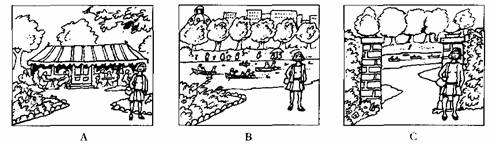
1.Where does Jane ask Tom to meet her at first?
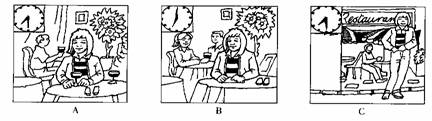
2.When and where do they agree to meet finally?
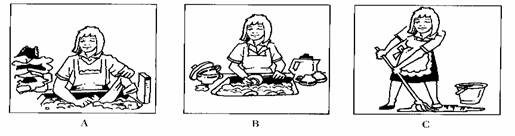
3.What does Jane have to do before going out to meet Tom?
听第2段对话,回答第4-6题。
4.According to Peter, what is the problem with the building?
A. The air-conditioning is too strong.
B. The air-conditioning is out of order.
C. The air-conditioning stops working sometimes.
5.Why did Peter miss the breakfast yesterday morning?
A. He overslept.
B. He couldn't fall asleep the night before.
C. He talked with his roommates late into the night.
6.How many students will be staying in this room?
A. Two. B. Three. C. Four.
听第3段对话,回答第7-9题。
7.Which subject (s) does David find particularly difficult?
A. Math. B. English. C. The sciences.
8.What does David do to help his uncle with the cows?
A. He milks the cows on Sundays and cleans the cowshed sometimes.
B. He drives the tractor on Sundays and does the milking sometimes.
C. He cleans the cowshed on Sundays and drives the tractor sometimes.
9.What is David going to do now?
A. He is going to work on his own farm.
B. He is preparing to attend an agricultural college.
C. He is going to study hard to pass the exams.
听第4段对话,回答第10-12题。
10.What is the probable relation between the man and woman?
A. A research student and a stranger.
B. A social worker and a businessman.
C. A businessman and a research student.
11.What made the woman begin to smoke at the age of 17?
A. Her boyfriend offered her a cigarette.
B. She often went to parties with her friends.
C. She wanted to follow her friends’ example.
12.What was the result of the woman's first attempt to stop smoking?
A. She stopped smoking for a while.
B. She managed to give up smoking completely.
C. She began to smoke fewer cigarettes than before.
听第5段对话,回答第13-15题。
13.What do the students come to the school for?
A. Visiting the school.
B. Attending summer courses.
C. A sightseeing tour of the area.
14.How long has the school been open?
A. Twenty years. B. Five years. C. Twenty-five years.
15.What could the students do in the study center if they were out late the night before?
A. Talk to the teachers. B. Use the equipment. C. Do the homework.
第二节:听取信息(共5小题;每小题1.5分,满分7.5分)
听下面1段对话。请根据题目要求,从所听到的内容中获取必要的信息,填入答题卡 标号为16—20的空格中。听录音前,你将有10秒钟的阅题时间,录音读两遍。你有80秒钟的作答时间。
|
Caller information |
|
|
Name of caller |
John Smith |
|
Where to go |
London |
|
When to go |
(16.) |
|
What to do there |
(17.) |
|
How long to stay |
A week or so |
|
Ticket information |
||||
|
Class |
Airline |
Price |
When to leave |
When to arrive |
|
Economy |
(18.) |
RMB 5600 |
7:40 a.m. |
In the morning |
|
Pacific Airline |
(19.) |
11:40 a.m. |
(20.) |
That year , in the local school, there was a new math teacher, as well as some new pupils. One of the new kids was the stupidest child anyone had ever seen. It made no difference how quickly or how slowly they tried explaining numbers to him; he would always end up saying something enormously stupid. Like two plus two was five, seven times three was twenty-seven, or a triangle had thirty corners……
Before this boy arrived, math lessons had been the most boring of all. Now they were great fun. Encouraged by the new teacher, the children would listen to the pieces of nonsense spouted by the new kid, and they would have to correct his mistakes.
Whenever the new teacher asked questions, the stupid kid would stand up but made the wrong answers, the other students all wanted to be the first to find his mistakes, and then think up the most original ways to explain them. To do this they used all kinds of stuff : sweets, playing cards, oranges, paper planes, etc. It didn’t seem like any of this bothered the new kid.
However, Little Lewis was sure that it was bound to make him feel sad inside. Lewis was sure he would see him crying. So, one day, he decided to follow the new kid home after school. On leaving school, the new kid walked a few minutes to a local park, and there he waited for a while, until someone came along to meet him……
It was the new teacher!
The teacher gave the new kid a hug, and off they went, hand in hand. Following from a distance, Lewis could hear they were talking about math.
【小题1】根据短文第二三段描述,可知这位新老师的工作很有创造性,故选A。
【小题2】根据短文最后一段Following from a distance, Lewis could hear they were talking about math.描述,可知选B,这个所谓的最蠢的学生其实比其它学生知道的多。
【小题3】根据Lewis was sure he would see him crying. So, one day, he decided to follow the new kid home after school.描述,可知选B。
【小题4】联系上文To do this they used all kinds of stuff :可知选C。
【小题5】The math lessons became interesting again because of the new teacher’s ___________.
| A.creativity | B.imagination | C.responsibility | D.curiosity |
| A.was in great need of math teacher’s help after class |
| B.knew much more about math than other classmates |
| C.had no much gift for math and was slow to learn it |
| D.disliked both the new math teacher and his lessons |
| A.learn about where he lived | B.find out if he felt upset |
| C.say something to comfort him | D.make friends with him |
| A.To find the stupidest kid’s mistakes. |
| B.To think up the most original ways to explain. |
| C.To use all kinds of stuff. |
| D.To follow him home after school. |
第一节(共5小题,每小题1分,满分5分)
听下面5段对话,每段对话后有一个小题,从题中所给的A、B、C三个选项中选出最佳选项,并标在试卷的相应位置。听完每段对话后,你都有10秒钟的时间来回答有关小题和阅读下一小题。每段对话仅读一遍。
1.What does Alice’s father want to buy for her?
A. A watch. B. A sweater. C. A red bike.
2.What do we learn from the conversation?
A. The train will not arrive.
B. The train may arrive at 9:15.
C. The train may arrive at 9:50.
3.What are the speakers talking about?
A. Something robbed B. Something repaired. C. Something misplaced.
4.What does the woman think the man should do?
A. Tell his neighbors about it. B. Report it to the police. C. Keep it quiet.
5.How will the man be paid?
A. By the hour. B. By the week. C. By the month.
第二节(共15小题,每小题1分,共15分)
听下面5段对话或独白,每段对话或独白后有几个小题,从题中所给的A、B、C三个选项中选出最佳选项,并标在试卷的相应位置。听每段对话或独白前,你将有时间阅读各个小题,每小题5秒钟,听完后,各小题将给出5秒钟的作答时间。每段对话或独白读两遍。
听第6段对话,回答第6、7题。
6.What is the man doing here?
A. Checking in. B. Doing shopping. C. Checking out.
7.What’s the clerk’s suggestion?
A. To come again.
B. To have a good trip.
C. To make a reservation for next time.
听第7段对话,回答第8至10题。
8.Where did the car come according to the man at the beginning of the conversation?
A. He lent it. B. He won it. C. He bought it.
9.What color is the car?
A. Blue. B. Black. C. Yellow.
10.What’s the date today?
A. 1st, March. B. 1st, April. C. 1st , May.
听第8段对话,回答第11至13题。
11.What does Tom want to become in the future?
A. A pilot. B. A college teacher. C. A computer expert.
12.Why is Mary studying English?
A. She wants to be a translator.
B. She wants to make English friends.
C. She will move to the US.
13.What is the best way to learn English according to Mary?
A. Using the Internet.
B. Listening to the radio.
C. Talking with the native speakers.
听第9段对话,回答第14至17题。
14.What are the speakers doing?
A. One is interviewing the other.
B. They are having a friendly chat.
C. They are talking about each other’s family.
15.How many subjects did the woman take?
A. Two. B. Three. C. Four.
16.Why was the woman’s father disappointed at first?
A. She did her first job badly.
B. She didn’t do well in the Art College.
C. She gave up her job as an accountant.
17.Which of the following is not the woman’s hobby?
A. Acting. B. Fishing C. Reading.
听第10段对话,回答第18至20题。
18.What is the monologue mainly talking about?
A. An influenza B. The seasonal flu. C. A kind of cancer.
19.Why was the medical expert team sent to Guangdong?
A. To discuss further control steps.
B. To attend a medical conference.
C. To offer technical assistance.
20.How many people were dead in the mainland according to the monologue?
A. Nobody. B. One. C. Two.
湖北省互联网违法和不良信息举报平台 | 网上有害信息举报专区 | 电信诈骗举报专区 | 涉历史虚无主义有害信息举报专区 | 涉企侵权举报专区
违法和不良信息举报电话:027-86699610 举报邮箱:58377363@163.com