
题目列表(包括答案和解析)
I don’t ever want to talk about being a woman scientist again. There was a time in my life when people asked constantly for stories about what it’s like to work in a field dominated by men. I was never very good at telling those stories because truthfully I never found them interesting. What I do find interesting is the origin of the universe, the shape of space-lime and the nature of black holes.
At 19, when I began studying astrophysics, it didn’t bother me in the least to be the only woman in the classroom. But while earning my Ph.D. at MIT and then as a post-doctor doing space research, the issue started to bother me. My every achievement-jobs, research papers, awards-was viewed through the lens of gender(性别) politics. So were my failures. Sometimes, when I was pushed into an argument on left brain versus right brain, or nature versus nurture(培育), I would instantly fight fiercely on my behalf and all womankind.
Today I research and teach at Barnard, a women’s college in New York City. Recently, someone asked me how many of the 45 students in my class were women. You cannot imagine my satisfaction at being able to answer, 45. I know some of my students worry how they will manage their scientific research and a desire for children. And I don’t dismiss those concerns. Still, I don’t tell them “war” stories. Instead, I have given them this: the visual of their physics professor heavily pregnant doing physics experiments. And in turn they have given me the image of 45 women driven by a love of science. And that’s a sight worth talking about.
1. Why doesn’t the author want to talk about being a woman scientist again?
A. She feels unhappy working in male-dominated fields.
B. She is fed up with the issue of gender discrimination
C. She is not good at telling stories of the kind
D. She finds space research more important
2. Form Para 3, we can infer that people would attribute (归结于) the author’s failures to___
A. the very fact that she is a woman
B. her involvement in gender politics
C. her over-confidence as a female astrophysicist
D. the burden she bears in a male-dominated society
3. How does the author feel when talking about her class?
A. worried B. satisfied C. excited D. concerned
4. What does the image the author presents to her students suggest?
A. Women students needn’t have the concerns of the generation
B. women have more barriers on their way to academic success
C. Women can balance a career in science and having a family
D. Women now have fewer problems in pursuing a science career
Grown-ups know that people and objects are solid. At the movies, we know that if we reach out to touch Tom Cruise, all we will feel is air. But does a baby have this understanding?
To see whether babies know objects are solid, T. Bower designed a method for projecting an optical illusion of a hanging ball. His plan was to first give babies a real ball, one they could reach out and touch, and then to show them the illusion. If they knew that objects are solid and they reached out for the illusion and found empty air, they could be expected to show surprise in their faces and movements. All the 16- to 24-week-old babies tested were surprised when they reached for the illusion and found that the ball was not there.
Grown-ups also have a sense of object permanence, We know that if we put a box in a room and lock the door, the box will still be there when we come back. But does a baby realize that a ball that rolls under a chair does not disappear and go to never-never land?
Experiments done by Bower suggest that babies develop a sense of object permanence when they are about 18 weeks old. In his experiments, Bower used a toy train that went behind a screen. When 16-week-old and 22-week-old babies watched the toy train disappear behind the left side of the screen, they looked to the right, expecting it to reappear. If the experimenter took the train off the table and lifted the screen, all the babies seemed surprised not to see the train. This seems to show that all the babies had a sense of object permanence. But the second part of the experiment showed that this was not really the case. The researcher substituted a ball for the train when it went behind the screen. The 22-week-old babies seemed surprised and looked back to the left side for the train. But the 16-week-old babies did not seem to notice the switch. Thus, the 16-week-old babies seem to have a sense of “something permanence,” while the 22-week-old babies had a sense of object permanence related to a particular object.
1. The passage is mainly about .
|
A.babies’ understanding of objects |
B.effects of experiments on babies |
|
C.babies’ sense of sight |
D.different tests on babies’ feelings |
2. In Paragraph 3, “object permanence” means that when out of sight, an object .
|
A.still exists |
B.keeps its shape |
C.still stays solid |
D.is beyond reach |
3.. What did Bower use in his experiments?
|
A.A chair. |
B.A screen. |
C.A film. |
D.A box. |
4.. Which of the following statements is true?
|
A.The babies didn’t have a sense of direction. |
|
B.The older babies preferred toy trains to balls. |
|
C.The younger babies liked looking for missing objects. |
|
D.The babies couldn’t tell a ball from its optical illusion. |
Grown-ups know that people and objects are solid. At the movies, we know that if we reach out to touch Tom Cruise, all we will feel is air. But does a baby have this understanding?
To see whether babies know objects are solid, T. Bower designed a method for projecting an optical illusion(视觉影像) of a hanging ball. His plan was to first give babies a real ball, one they could reach out and touch, and then to show them the illusion. If they knew that objects are solid and they reached out for the illusion and found empty air, they could be expected to show surprise in their faces and movements. All the 16-to 24- week -old babies tested were surprised when they reached for the illusion and found that the ball was not there.
Grown-ups also have a sense of object permanence. We know that if we put a box in a room and lock the door, the box will still be there when we come back. But does a baby realize that a ball that rolls under a chair does not disappear and go to never-never land?
Experiments done by Bower suggest that babies develop a sense of object permanence when they are about 18 weeks old. In his experiments, Bower used a toy train that went behind a screen. When 16-week-old and 22-week-old babies watched the toy train disappear behind the left side of the screen, they looked to the right, expecting it to reappear. If the experimenter took the train off the table and lifted the screen, all the babies seemed surprised not to see the train. This seems to show that all the babies had a sense of object permanence. But the second part of the experiment showed that this was not really the case. The researcher substituted a ball for the train when it went behind the screen. The 22-week-old babies seemed surprised and looked back to the left side for the train. But the 16-week -old babies did not seem to notice the switch. Thus, the 16-week-old babies seemed to have a sense of “something permanence,” while the 22-week-old babies had a sense of object permanence related to a particular object.
1.The passage is mainly about _____.
|
A.babies' sense of sight |
B.effects of experiments on babies |
|
C.babies' understanding of objects |
D.different tests on babies' feelings |
2.In Paragraph 3, “object permanence” means that when out of sight, an object _____.
|
A.still exists |
B.keeps its shape |
C.still stays solid |
D.is beyond reach |
3.What did Bower use in his experiments?
|
A.A chair. |
B.A screen. |
C.A film. |
D.A box. |
4.Which of the following statements is true?
|
A.The babies didn't have a sense of direction. |
|
B.The older babies preferred toy trains to balls. |
|
C.The younger babies liked looking for missing objects. |
|
D.The babies couldn't tell a ball from its optical illusion. |
(You may read the questions first)
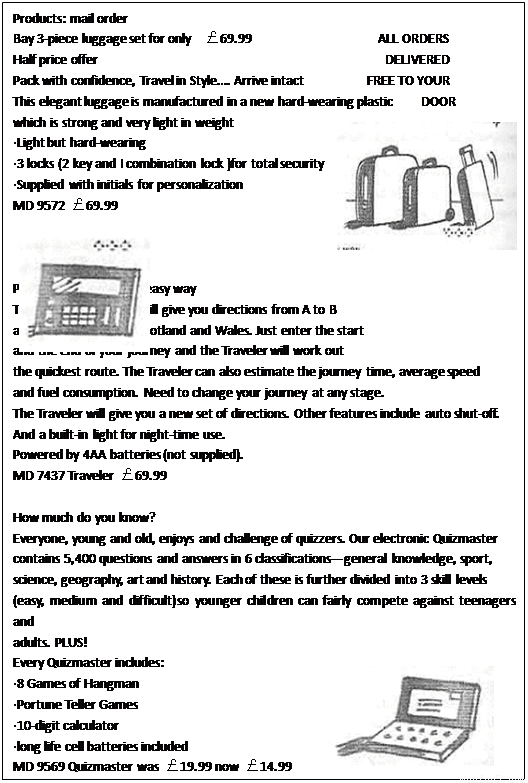
1.In advertisement 2, the Traveler enables us to learn__________.
A. the road conditions from London to Oxfords
B. all the garages along the chosen route
C. the time and speed of the journey in Britain
D. the directions from London to Paris.
2.In advertisement 3, the Quizmaster_________.
A. contains nothing but 5400 questions
B. can only answer challenging questions
C. can be bought in many shops
D. can be used by people of all
3.All these advertisements are aimed at those_________.
A. who like to order goods at home
B. who are going to travel abroad
C. who do market researches
D. who are interested in intelligence tests
In ancient Japan, if you saved someone’s life, they would make it their duty to spend the rest of their life serving you. Nowadays, if you rescue someone’s story, he or she will feel the same kind of gratitude(感激).
It happens all the time. Someone in a group is telling a story and, just before their big point, BOOM! There’s an interruption. Someone new joins the group, a waiter with a plate of biscuits comes over, or a baby starts crying. Suddenly everyone’s attention turns to the new arrival, the food on the plate, or the “charming” little child. Nobody is aware of the interruption — except the speaker. They forget all about the fact that the speaker hasn’t made his or her point.
Or you’re all sitting around the living room and someone is telling a joke. Suddenly, just before his big punch line(妙语), little Johnny drops a dish or the phone rings. After the crash, everyone talks about little Johnny’s carelessness. After the call, the subject turns to the upcoming marriage or medical operation of the caller. Nobody remembers the great punch line got unfinished — except the joke teller. When it’s you entertaining everyone at a restaurant, have you ever noticed how you can almost set your clock by the waiter coming to take everyone’s order just before your funny punch line?
Most joke and story tellers are too shy to say, after the interruption, “Now, as I was saying…” Instead, they’ll spend the rest of the evening feeling bad they didn’t get to finish. Here’s where you come in. Rescue them with the technique I call “Lend a Helping Tongue.”
Watch the gratitude in the storyteller’s eyes as he stabilizes where his story sunk and he sails off again toward the center of attention. His expression and the appreciation of your consideration by the rest of the group are often reward enough. You are even more fortunate if you can rescue the story of someone who can hire you, promote you, buy from you, or otherwise lift your life. Big winners have excellent memories. When you do them subtle favors like Lend a Helping Tongue, they find a way to pay you back.
1.
Very often, a storyteller cannot make his point because ______.
A. people are more interested in food than his story
B. many guests bring their babies to the party
C. his story is easily forgotten by the listeners
D. he is interrupted by something unexpected
2.
From Paragraph 3, we know that when someone is telling a joke, ______.
A. something bad will surely happen just before their punch line
B. the only person really interested in the joke is the joke teller
C. listeners’ attention is often drawn to something else
D. the waiter knows when to take everyone’s order
3.
How can we “Lend a Helping Tongue” to the story tellers, according to the writer?
A. Comfort them to make them happy.
B. Give them a chance to finish.
C. Go on telling the story for them.
D. Teach them some useful techniques.
4.
What is the text mainly about?
A. People should learn how to take turns in a conversation.
B. Telling jokes will make you the center of attention.
C. We can win someone’s heart by getting him back to his story.
D. It is impolite to cut in on someone’s talk.
湖北省互联网违法和不良信息举报平台 | 网上有害信息举报专区 | 电信诈骗举报专区 | 涉历史虚无主义有害信息举报专区 | 涉企侵权举报专区
违法和不良信息举报电话:027-86699610 举报邮箱:58377363@163.com