
题目列表(包括答案和解析)
听力测试
听下面5段材料。每段材料后有几个小题,从题中所给的A、B、C三个选项中选出最佳选项。听每段材料前,你将有时间阅读各个小题,每小题5秒钟;听完后,各个小题将给出5秒钟的作答时间。每段材料读两遍。
听第1段材料,回答第1~3题。
W:Don’t you have any good news?
M:No.Yesterday, I had to stay after school, because I was talking during my biology teacher’s class.
W:You’d better keep quiet during class.
M:Sometimes I do.The day before yesterday, I was very quiet during my history teacher’s class and I still had to stay after class.
W:I don’t understand.
M:Because I fell asleep during his class, but it wasn’t my fault.The lesson was very dull.
W:I advise you to take school more seriously.If you don’t pass your exam, you’ll have to go out and work as a result.
M:I don’t see that it makes much difference.If I have a job, I have to do dull work every day, but if I’m in school I must listen to dull teachers every day.
1.What is the possible relationship between the man and woman?
A.Good friends.
B.Mother and son.
C.Teacher and student.
2.What did the boy often do at school?
A.He was often late for school.
B.He often fell asleep in class.
C.He often stayed after class.
3.Which of the following statements is true?
A.The boy prefers to go out and work.
B.The boy has neither interest in school nor in work.
C.The boy is discouraged because he hasn’t passed the exam.
听第2段材料,回答第4~6题。
M:How long have you been studying English?
W:For about six years.I started when I was ten.My teacher was from America.He was a very good teacher.I enjoyed studying English with him.
M:Are you still studying English?
W:Yes, I go to an evening school now.
M:How often do you have classes?
W:Twice a week usually.
M:Do you find English difficult?
W:Yes, it’s rather difficult, I think.Do I make many mistakes?
M:No, your English is very good.Do you often listen to the radio?
W:Yes, I listen to the radio every night.
M:Do you enjoy reading English books?
W:Yes, I read a lot of English books.But I prefer conversation.I like talking to foreigners.
4.How old is the girl?
A.Fifteen.
B.Sixteen.
C.Seventeen.
5.What does the woman think of the study of English?
A.Interesting.
B.Easy.
C.Hard.
6.What did the woman enjoy most?
A.Listening.
B.Writing.
C.Talking.
听第3段材料,回答第7~9题。
M:You look worried.Is anything the matter?
W:It’s my son.He hasn’t come home yet.I can’t understand him being so late.
M:Where’s he gone?
W:To visit a friend.I didn’t want him to go.I don’t like him going out at night.
M:Well, it isn’t very late.
W:It’s nine o’clock.I expected him to be back about eight.And it’s already dark.
M:Well…
W:I can just imagine him losing his way.Or falling off his bicycle.
M:Er…how old is your son?
W:Thirty-five.
7.Why does the woman look worried?
A.Her son has lost his way.
B.Her son hasn’t come back yet.
C.Her son has gone out at night.
8.Where has her son gone?
A.To school.
B.For a ride.
C.To visit a friend.
9.What do you think has happened to the woman’s son?
A.He has got lost.
B.He has fallen off his bicycle.
C.We don’t know.
听第4段材料,回答第10~12题。
W:We’re thinking about putting on a show this spring.
M:Do you think you’ll be able to make some money?
W:Oh, no, we just want to do it for the fun of it.You know there are a lot of us who like to get up a stage and perform.
M:What kind of show?
W:A musical play.
M:Have you decided who to do it?
W:We have three in mind, and of course we’ve been thinking about you.
M:Me? Why me?
W:You sing, don’t you? Everyone says you have a wonderful voice.
M:Well, I have sung a little, but I’ve never really appeared on a stage.
W:I thought you sang in church every Sunday.
M:That’s different.There are so many others singing too.
W:Then here’s your chance to find out how good you are.And not just to sing but to act and dance too.
M:Oh, it might be exciting.
10.What will they put on a show for?
A.For money.
B.For fun.
C.For others.
11.What can we conclude from the dialogue?
A.They want to put on three shows in all.
B.Three people will appear in the play.
C.They will sing three songs in the play.
12.What can we learn about the man?
A.He’ll sing and dance in the show.
B.He often gets up a stage.
C.He sings pop songs for money.
听第5段材料,回答第13~15题。
Now back to the news.
Ten people died yesterday morning when a boat sank off the Gold Sand Coast.Eight were able to swim to the shore and were saved by the coast guard.The boat was on its way to Beill Island.
Police are looking for a man and a woman in their early twenties who broke into a bank in the early hours this morning.This was reported by people working in the shop opposite who heard the breaking of glass.Two people were seen running away.The man is said to be very well-built, with dark hair which is very long.The woman with him is said to be small with short hair cut very close to her head.She was wearing blue trousers and a brown jacket.Anyone who has any information please gives further details to the police.
13.What were the eight people doing after the boat sank?
A.Saving the others.
B.Swimming to the shore.
C.Helping the captain.
14.When did the robbers break into the bank?
A.In the afternoon.
B.At midnight.
C.Early in the morning.
15.What was said about the man?
A.Tall and strong.
B.Strong with long hair.
C.Fat and well built.
听力测试(共20小题;每小题1.5分,满分30分)
第一节?
听下面5段对话。每段对话后有一个小题,从题中所给的A、B、C三个选项中选出最佳选项。听完每段对话后,你都有10秒钟的时间来回答有关小题和阅读下一小题。每段对话仅读一遍。
W:Could you tell me the way to the hospital?
M:I’m sorry I’m a stranger here myself.You can ask the policeman over there.
1.Why doesn’t the man tell the woman the way to the hospital?
A.Because he is a stranger to the city.
B.Because he doesn’t want to tell her the way.
C.Because he doesn’t feel like talking with her.
W:Where is the post office?
M:Just walk down this street.It’s only ten minutes’ walk from here.You will find it on your right.
2.Where are the two speakers?
A.They are in an office.
B.They are in the street.
C.They are at home.
W:Would you mind if I borrowed your dictionary?
M:I’m sorry, but I’m using it now.
3.Why doesn’t the man lend his dictionary to the woman?
A.Because he is using it.
B.Because he hasn’t brought it with him.
C.Because he doesn’t want to lend it to the woman.
W:Do you mind if I use your rubber?
M:Of course not.Go ahead, please!
4.What does the woman want to borrow from the man?
A.A dictionary.
B.A pen.
C.A rubber.
W:Would you like me to carry this box for you?
M:No, thanks.I can manage it myself.
5.What does the woman offer to do?
A.To wash some clothes for the man.
B.To carry the box for the man.
C.To look after the child for the man.
第二节?
听下面5段对话或独白。每段对话或独白后有几个小题,从题中所给的A、B、C三个选项中选出最佳选项。听每段对话或独白前,你将有时间阅读各个小题,每小题5秒钟;听完后,各小题将给出5秒钟的作答时间。每段对话或独白读两遍。
听第6段材料,回答第6~7题。
W:What’s the matter, Peter? You don’t look very happy.
M:I’m not.I’m worried about my English.
W:What’s the problem?
M:I’m not practicing enough.
W:Why not?
M:Well, it’s difficult to meet English people.
W:You should go out more.
M:Where should I go?
W:You should go to bars.You should join a club.
M:But English people never speak to me.
W:Ah! You should speak first.
M:What can I talk about?
W:The weather! English people are always interested in the weather.
6.What are the two speakers talking about?
A.English.
B.Hobby.
C.Weather.
7.What is Peter worried about?
A.English people.
B.His English.
C.Going out.
听第7段材料,回答第8~10题。
M:Today is the twelfth of August.In another four days it will be my sister Mary’s birthday.We will have a party.Would you please come and join us, Jean?
W:What time will the party begin?
M:At twenty to two.
W:My sister is coming to see me from Shanghai at 1∶20 that afternoon.I’ve got to meet her at the station, so I’m afraid I’ll be late for the party.
M:That’s all right.Do come please.
W:Sure.
8.When is Mary’s birthday?
A.On August 15th.
B.On August 16th.
C.On August 12th.
9.What time will the party begin?
A.At 2∶00 p. m.
B.At 2∶20 p. m.
C.At 1∶40 p. m.
10.Will Jean come to the party?
A.No, she won’t, because she’ll meet her sister at the station.
B.Yes, she will, but she will be late for the party.
C.Not sure.Perhaps she won’t be able to come.
听第8段材料,回答第11~13题。
M:Madam, come and look at this china.It’s beautiful, isn’t it?
W:Yes, it is.I haven’t seen anything like this for years.
M:Ladies always like the china more than the weapons.
W:Tell me something about it, please.
M:Well, you see, all these pieces of china belong to the same set.A king gave it to the Duke in 1819, and pictures on the china tell the story of the Duke’s life.
W:You know a lot about the things in the museum, don’t you? Have you worked here long?
M:Oh yes, I’ve worked here for a long time.I’ve been here since the opening of the museum.I’ve been here for ten years.
11.Where are the speakers?
A.At a museum.
B.In a shop.
C.In a school.
12.What are they talking about?
A.A country.
B.A china.
C.A gun.
13.How long has the man worked here?
A.Two years.
B.Five years.
C.Ten years.
听第9段材料,回答第14~16题。
W:I’m sorry you had to wait so long.
M:That’s all right.Was the boy hurt badly?
W:No.After I cleaned his head, he felt much better.So did his mother.The blood had frightened her.
M:She probably thought it was much worse than it really was.
W:Yes, mothers are always worried about their children.Now, what’s the matter with you?
M:I’ve just got a headache.I feel weak.I really feel terrible.
W:I’m sorry to hear that.Let me examine you.
14.What’s the relationship between the two speakers?
A.Mother and son.
B.Teacher and parent.
C.Doctor and patient.
15.Who probably thought it was much worse than it really was?
A.The child.
B.The mother of the boy.
C.Everyone there.
16.What’s the matter with the man?
A.He has a headache and feels bad.
B.He is frightened at the blood.
C.He hurt himself on the head.
听第10段材料,回答第17~20题。
A young father was visiting an old neighbor.They were standing in the old man’s garden and talking about children.The young man asked, “How strict should parents be with their children?” The old man pointed to a string between a big, strong tree and a thin, young one.“Please untie that string, ” he said.The young man untied it, and the young tree bent over to one side.“Now tie it again, please, ” said the old man.“But first pull the string tight so that the young tree is straight again.” The young man did so.Then the old man said, “There, it is the same with children.You must be strict with them, but sometimes you must untie the string to
see how they are getting on.If they are not yet able to stand alone, you must tie the string tight again.But when you find that they are ready to stand alone, you can take the string away.”
17.What was the young father doing?
A.He was looking after his child.
B.He was paying a visit to an old neighbor.
C.He was working with an old neighbor.
18.What were they talking about?
A.Children.
B.Their houses.
C.Their trees.
19.Why did the young tree bend over to one side?
A.Because it was pulled by a string.
B.Because it was dying.
C.Because it was too thin to stand straight alone.
20.What did the young father learn from the old man?
A.He needn’t be strict with children.
B.He learned how strict parents should be with their children.
C.He learned how to plant a tree.
“Can I see my baby?” asked the happy new mother. The bundle was placed in her arms and when she moved the fold of cloth to look upon his tiny face, she gasped-the baby had been born without ears. Time, however, proved that the baby’s hearing was perfect except his appearance.
One day when he rushed home from school and threw himself into his mother’s arms,he cried out bitterly,“A boy, a big boy…called me-a f—…freak.”She sighed, knowing that his life was to be endless of heartbreaks.
He grew up,handsome for his misfortune.A favorite with his fellow students, he might have been class president, but for that.He developed a gift for literature and music.
The boy’s father had a talk with the family doctor.Could nothing be done? “I believe we could graft on a pair of outer ears,if they could be donated,”the doctor decided.So the search began for a person who would make such a sacrifice for a young man.Two years went by.Then, “You’re going to the hospital,son.Mother and I have someone who will donate the ears you need.But it’s a secret,” said the father.
The operation was a brilliant success.His talents blossomed into genius.School and college became a series of successes.Later he married and entered the diplomatic service.“But I must know!” he urged his father.“Who gave so much for me? I could never do enough for him.”
“I do not believe you could,” said the father,“but the agreement was that you are not to know…not yet.”The years kept the secret, but the day did come …one of the darkest days that ever passed through a son.w ww.ks 5u.co mHe stood with his father over his mother’s casket(棺材).Slowly and tenderly,the father stretched forth a hand and raised the thick,reddish-brown hair to let out the secret.
56.When the mother unfolded the cloth and looked upon the tiny face we know that the mother________.
A.suddenly decided to make a sacrifice for the baby
B.kept the baby’s situation unknown to others
C.felt shocked and disappointed to see her new baby
D.complained of her bad luck and regretted having a disabled child
57.Give the closest meaning to the underlined word “freak” in Paragraph 2.
A.slow—acting person B.ugly—looking child
C.badly—behaved student D.strangely—shaped creature
58.At last, we may infer from the passage that_________.
A.The agreement was between the donator and the family
B.Finally the boy came to know the donator was a stranger
C.The mother may never let her hair be cut to keep her ears from being seen
D.The mother donated her ears to her son after she died
59.What moral lesson can we draw from this reading?
A.Real love lies in what is done unknown rather than what is done known.
B.It is up to parents to help their children heart and soul.
C.True beauty lies only in the heart not in appearance.
D.It is a virtue for young generations to learn to be grateful.
Tess still stood hesitating like a swimmer about to make his dive,hardly knowing whether to return or move forward,when a figure came out from the dark door of the tent.It was a tall young man,smoking
He had an almost black face,though red and smooth.His moustache was black with curled points,though he could not be more than twenty, three or—four.There was an unusual force in his face,and in his daring rolling eyes.w.w.w.k.s.5.u.c.o.
Well,my beauty, what can I do for you?’said he,coming forward.And seeing that she was quite m a loss:'Never mind me. I am Mr.d’Urberville,.Have you come to see me or my mother?’
This differed greatly from what Tess had expected.She had dreamed of an aged and dignified face.She tried to keep calm and answered —I came to see your mother, sir.
I am afraid you cannot see her—she is ill in bed, replied the representative of the house;for this was Mr.Alee, the only son of the noble family.’What is the business you wish to see her about?’ w.w.w.k.s.5.u.c.o.
“It isn't business—it is—I can hardly say what!”
“Pleasure?”
“Oh no.Why, sir if tell you, it will seem—”
Tess's sense of a certain ridicule was now so strong that, despite her general discomfort at being here,her rosy lips curved(弯曲)towards a smile, much to the attraction of the young man.
“It is so foolish,she stammered(急急巴巴地说):“I fear 1 can't tell you!”
“Never mind;I like foolish things.Try again,my dear’said he kindly.
“Mother asked me to come,’Tess continued;and,indeed,I was in the mind to do so myself. But I did not think it would be like this.I came,sir, to tell you that we are of the same family as you”
“Ho! Poor relations?’
“Yes.”
“Stokes?”
“No; d’Urbervilles.”
“Ay, ay;I mean d'Urbervilles.”
“Our names are worn away to Durbeyfield; but we have several proofs that we are d’Urbervilles. The local scholars hold the view that we are, —and—and we have an old seal(印章)and a silver spoon marked with the same castle as yours. So mother said we ought to make ourselves known to you, as we’ve lost our horse by a bad accident; we can hardly make a living.”
“Very kind of your mother, I’m sure,” Alec looked at Tess as he spoke, in a way that made her uneasy. “And so, my pretty girl, you’ve come on a friendly visit to us, as relations?”
“I suppose I have,” looking less confident and uncomfortable again.
“Well—there’s no harm in it. Where do you live? What are you?
—Tess of the d’Urbervilles By Thomas Hardy
67,How does Tess feel in the whole course of the meeting with Alec?
A.Excited and hopeful. B.Nervous and uncomfortable.
C.Surprised but comfortable. D.Pleased but embarrassed
68.In the eyes of Tess,Alec is .
A.forceful and daring B.unfriendly and talkative
C.a gentle and reliable man D.older than she had expected
69.Why does Tess pay the visit to the d’Urbervilles?
A.To see Alec himself.
B.To see Alec's mother.
C.To confirm that are of the same family.
D.To make known their relationship and seek help.
70.Alec appears quite friendly to Tess mainly because .
A.Tess is his distant relation B.Tess looks polite to him
C,Tess is a pretty girl D.Tess looks ridiculous
Part I Listening Comprehension(30 marks)
Section A(22.5 marks)
Directions:In this section, you'll hear six conversations between two speakers.For each conversation, there are several questions, and each question is followed by three choices marked A, B and C.Listen carefully and then choose the best answer for each question.You will hear each conversation TWICE.
Conversation 1
1.How long does the woman need to work every day?
A.Three hours.
B.Four hours.
C.Five hours.
2.How much can the woman earn each day?
A.5 dollars.
B.10 dollars.
C.20 dollars.
Conversation 1
M:Do you have any work experience?
W:No, I’ve never worked in a restaurant before.
M:Do you think you can get along will with customers?
W:Yes, I think so.
M:Can you make sure to be here from four to eight in the afternoon?
W:Yes, I'm always on time.
M:Then you can start tomorrow.Monday through Friday.Five dollars an hour.
W:That's fine.
Conversation 2
3.What's the possible relationship between the speakers?
A.Boss and employee.
B.Mother and son.
C.Teacher and student.
4.When will the man come back?
A.This Monday.
B.This Wednesday.
C.This Friday.
Conversation 2
M:Mrs.Sharon, I say…, I have to …
W:What's the matter, Richard?
M:Er, I'd like to take two days off.My mother's ill.I need to stay with her.
W:I'm sorry to hear that.You mean you will be back here this Wednesday?
M:Yes, I hope I can come back earlier.
W:That's all right.By the way, don't worry about your lessons.I'll certainly help you with them.
Conversation 3
5.What can we know about Nancy and Steve?
A.They will divorce soon.
B.They have two daughters.
C.They divorced last year.
6.Who will help Nancy out in the woman's opinion?
A.Her daughter.
B.Her parents.
C.Her friends.
Conversation 3
M:Kate, Nancy and Steve are breaking up.
W:It's really a shame.I’ve heard that they quarrel, but they’ve always made up afterward.
M:Things are not working out this time.They are getting a separation soon.
W:What will happen to their daughter, Bonnie?
M:Nancy is going to take her.
W:The cost of living is so high.It will be difficult for her to take te responsibility.
M:She seems to have made up her mind.She said she would rather be a single parent than cope with an unhappy marriage.
W:Well, I hope her parents will be able to help her out.
Conversation 4
7.How often does the woman pay the tax?
A.Once a month.
B.Twice a year.
C.Once a year.
8.Why does the woman have to pay more taxes?
A.The government has raised the tax rate.
B.She didn't pay taxes last year.
C.She has got extra money.
9.What can we know about the woman?
A.She is an accountant.
B.She taught in a night school.
C.She lives upon a small income.
Conversation 4
W:Henry, our income tax is due soon.Did you call our accountant?
M:He's figuring out our taxes right now.I gave him all the records on our income and expenses last week.
W:The government has taken away taxes from our paychecks all year.I hope we get some of that money back or at least that we won't have to pay more.
M:Remember the money your aunt left us when she died, and the money you made when you taught in a night school?
W:Yes.
M:Well, that's all taxable income.That money has put us in a higher tax bracket.
W:What does that mean?
M:It means we have to pay more taxes.
W:Well, it looks like we'll have to make more money this year just to pay last year's taxes.
Conversation 5
10.What can we know about the kid from Haiti?
A.He doesn't get on well at school.
B.He is often late for school.
C.He doesn't speak much English.
11.How many countries are mentioned in the conversation?
A.Six.
B.Five.
C.Four.
12.How does the woman help the immigrant kids?
A.She has spent much time with them after class.
B.She gives them more lessons than other kids.
C.She pays more attention to them at class.
Conversation 5
M:Kate, how's the new student in your class doing?
W:The kid from Haiti? He's having a rough time communicating since he doesn't speak much English.However, the other kids seem to involve him pretty well.
M:Our students are used to new kids who don't speak much English since we have had so many new immigrant families moving into our school district.
W:Don't I know it! This year I have had a Vietnamese, an Ethiopian, a Cuban and the kid from Haiti in my class.I spend a lot of time with them after class so that they can catch up.
M:It must have been hard for you since you have to give them special attention in order to help them.
W:It has been.Nevertheless, it's really rewarding to see them progress and make friends.
Conversation 6
13.When will the speakers have the exams?
A.In one week.
B.In two weeks.
C.In three weeks.
14.What will the woman do this summer?
A.Teach English.
B.Find a job.
C.Study Chinese.
15.How did the man learn Chinese?
A.By speaking.
B.By reading.
C.By listening.
Conversation 6
M:Well, Jenny.The school year is almost over.We just have two weeks before exams.What are you going to do this summer?
W:I'm going to teach English to some immigrants in the university's community service program.
M:That sounds interesting.Don't you need to speak a foreign language for the job?
W:No.You just have to present the language simply and give the students a chance to practice speaking.
M:But that's the way I was taught to speak Chinese.But speaking Chinese didn't help me learn to read and write Chinese.
W:My students don't want to read and write English.They are more interested in speaking.
M:You sound very knowledgeable about all this.How do you know so much?
W:I took teaching English as a second language course last year when you were in China.I’ve also talked with the program administrators quite a lot.I think I would like to be an ESL teacher when I graduate.
SECTION B
Directions:In this section, you'll hear a mini-talk.Listen carefully and then fill in numbered blanks with the information you’ve got.Fill each blank with NO MORE THAN 3 WORDS.
You'll hear the mini-talk TWICE.
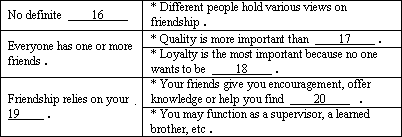
About friendship
Section B
We often say, “A friend in need is a friend indeed.” But what is the exact meaning of friendship? No one can really offer a definite concept, because different people hold various views on friendship.
Everyone has his own friendship and some have a lot of friends.But in fact, quantity is not so important as quality.Loyalty is the most important for friendship.No one wants to make friends with those who will betray them.
No matter whether you are married or not, no matter where you live and work, your friends are your friends.It is not based on bloodline.It relies on your intention.To you, some friends are fun-loving, some give encouragement, some offer knowledge, and others help you to find your own identity.Before your friends, you may act as a supervisor, a learned brother, a lovely child, a gentleman or a playmate.In a word, friendship helps you to be a full person.So friendship can benefit.
Keys:
湖北省互联网违法和不良信息举报平台 | 网上有害信息举报专区 | 电信诈骗举报专区 | 涉历史虚无主义有害信息举报专区 | 涉企侵权举报专区
违法和不良信息举报电话:027-86699610 举报邮箱:58377363@163.com