
题目列表(包括答案和解析)
第二部分 非选择题(满分60分)
五、语法填空 (两大题,共分20分)
(一)单句语法填空 (在空格中填入一个适当的词或用所给词的适当形式填空。1分/题,共分10分)
56. The evidence suggests that more and more applications for unemployment
assistance ______ to the government since the economic recession started. (submit)
57. The accident happened on the day ______ I lost my pet.
58. The citizens considered ______ essential to be informed of the whole truth of the
event.
59. Great changes have taken place in that school. It is no longer ______ it was 20
years ago, when it was so poorly equipped.
60. Can you try and speed your things ______ because you are in an instant need and
we are running out of time.
61. Happy ______ they were, they felt there was something missing.
62. You’ll easily get burnt if ______ to sunlight in summer. (expose)
63. Mary found it a(n) _______ moment when she was presented an award for her
bravery. (forget)
64. The orange juice _______ out now by the volunteers will be delivered to the
nursery homes instantly. (squeeze)
65. I’ll make ______ for you to be met at the airport. (arrange)
Some of the first poems written in English were n 5 rhymes.Children learned these when they were very young.Nursery rhymes like the following one are still a common t 6 of children's poetry.They delight small children because they give strong r 7 and rhyme and have a lot of r 8 .This makes them easy to learn and to r 9 . By p 10 with the words in nursery rhymes,children learn about language.
1._________
2._________
3._________
4._________
5._________
6._________
7._________
8._________
9._________
10._________
读下面一段文字,根据首字母填空
There are various reasons why people write p 1 .Some poems tell a story or describe something in a way that will give the readers a strong i 2 .Others try to c 3 certain emotions.Poets use many different forms of poems toe 4 themselves.
Some of the first poems written in English were n 5 rhymes.Children learned these when they were very young.Nursery rhymes like the following one are still a common t 6 of children’s poetry.They delight small children because they give strong r 7 and rhyme and have a lot of r 8 .This makes them easy to learn and to r 9 .By p 10 with the words in nursery rhymes, children learn about language.
阅读理解
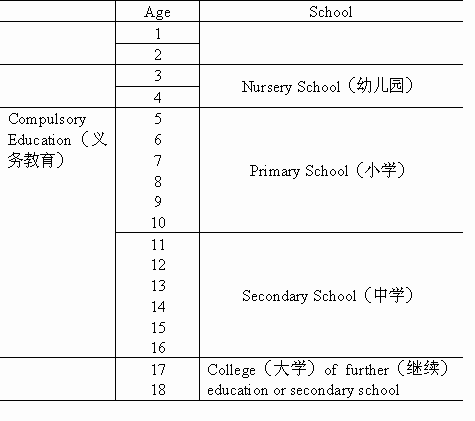
In England, many children go to nursery school from the age of about three, but these schools are not compulsory. Compulsory education begins at the age of five, when children go to primary school. Primary education takes six years, then pupils go to secondary school. After six years of secondary education, pupils take the General Certificate of Secondary Education (GCSE) examination. Most pupils take about eight subjects in this exam.
Compulsory education ends at sixteen. Some people choose to stay at secondary school for further two years and then take three or four subjects in this exam. Other people leave school at sixteen and go to college for further education.
Education in England has had many changes in the last ten years. Another new change took place in September 2000, in 6th forms where students will have to study four or five subjects at S-level for their first year and then choose 3 in their second year to study at A-level (S-level is not as difficult as A-level).
Higher education begins at eighteen and usually takes three or four years. Students go to universities, polytechnic(工艺)schools or colleges of higher education.
(1)The compulsory education in England needs _____ years.
[ ]
(2)Compulsory education means ________ .
[ ]
A. children can choose any school
B. every child must go to school
C. the school education
D. the education for the children
(3)Pupils will have to take GCSE exams _______ .
[ ]
A. when they go to primary school
B. during their secondary school years
C. after they finish schooling
D. before they go to secondary school
(4)If a student wants to stay at a secondary school for two more years for further study, he'll have to take a (n) ______ exam.
[ ]
(5)Some students in 6th forms can choose four to five subjects at ______ exam.
[ ]
湖北省互联网违法和不良信息举报平台 | 网上有害信息举报专区 | 电信诈骗举报专区 | 涉历史虚无主义有害信息举报专区 | 涉企侵权举报专区
违法和不良信息举报电话:027-86699610 举报邮箱:58377363@163.com