
题目列表(包括答案和解析)
阅读理解
You must have heard of Nobel Prize. But do you know where it comes from? The answer is: Alfred Nobel.
Alfred Nobel, the great Swedish inventor and industrialist(实业家), was born in Stockholm on October 21, 1833, but moved to Russia with his parents in 1842, where his father, Immanuel, made a strong position for himself in the engineering industry. Immanuel Nobel invented the landmine(地雷) and made a lot of money from government during the Crimean War(克里米亚战争), but went bankrupt(破产的) soon after. Then, the family returned to Sweden in 1859, where Alfred began his own study of explosives(炸药) in his father's lab. He had never been to school or university but had studied privately(私自的), and by the time he was twenty, he became a skillful chemist and excellent linguist(语言学家), speaking Swedish, Russian, German, French and English. He built up over 80 companies in 20 different countries. But seldom happy, he was always searching for a meaning to life, he never married. He spent much time and money working on how to end the wars, and thus peace between nations, until his death in Italy in 1896. His famous will, in which he left money to provide prizes for outstanding work in physics, chemistry, physiology(生理学), medicine, literature(文学) and peace, is a memorial to his interests and ideas. And so, the man is remembered and respected(尊敬) long after his death.
1.How old was Nobel when they moved to Russia?
[ ]
2.Who invented the landmine?
[ ]
3.Did Nobel learn all by himself before 20 years old?
[ ]
4.How many kinds of foreign languages could Nobel speak?
[ ]
5.________ isn't in Nobel prize.
[ ]
| |||||||||||||||||||||||||||||||||||||||||||||||||||||||||||||||||||||||||
| A.At 10:00 on Sunday in September. |
| B.At 22:00 on the first Saturday in October. |
| C.At 9:00 on Saturday in September. |
| D.On everey Saturday afternoon in September. |
| A.only Satyananda Yoga Center teaches yoga |
| B.there’s no better place to learn yoga than Satyananda Yoga Center |
| C.some yoga centers are not teaching yoga in the right way |
| D.you have to be a scientist before you take up yoga |
| A.In the class you will practise some positions. |
| B.You will feel very different after practising once. |
| C.You will feel new and fresh after practising yoga. |
| D.You will feel great if you keep on practising it for a few months. |
听力部分(25分)
一、根据你所听到的句子,从A、B、C三个选项中选出最恰当的答语。
1.A.I’m sorry.I won’t do that again.
B.I don’t think so.
C.I’m good at playing on the street.
2.A.That’s all right.
B.Maybe I can help you.
C.Thanks for helping me.
3.A.No, I didn’t.
B.Yes, I do.
C.No, I wasn’t.
4.A.Glad to hear that.
B.Don’t lose heart.Try to study hard.
C.You’re very lucky.
5.A.Monday, I think.
B.Oh, it’s half past seven.
C.October 22nd.
二、听对话,根据你所听到的对话和问题,从A、B、C三个选项中选出正确答案。
6.A.Take a walk
B.have a talk.
C.give a talk
7.A.Listening to English songs.
B.Reading magazines.
C.Joining an English club.
8.A.His mother.
B.His friends.
C.His father.
9.A.On the table.
B.Under the table.
C.In front of the table.
10.A.Mary’s mother.
B.Mary’s father.
C.Mary himself.
三、听两段对话,选择最佳答案,每段对话读两遍。
请听第一段对话,回答第11-12小题。
11.Why did the girl feel unhappy?
A.The teacher was angry with her.
B.She couldn’t find her school uniforms.
C.Her mother was angry with her.
12.Does the boy like the school uniform?
A.Yes, he does.
B.No, he doesn’t.
C.We don’t know.
请听第二段对话,回答第13-15小题。
13.What did the boy invite the girl to do?
A.To go on a picnic with him.
B.To watch a basketball match.
C.To go to a movie with him.
14.What will the girl do tomorrow?
A.She will go on a picnic.
B.She will stay at home and read books.
C.She will be busy doing housework.
15.What day is it today?
A.Friday.
B.Saturday.
C.Sunday
四、听短文。根据你所听到的短文内容,从A、B、C三个选项中选出正确答案,短文读两遍。
16.How old is Tom?
A.twenty
B.ten
C.five
17.Tom was a _________ boy.
A.clever
B.lazy
C.interesting
18.Tom’s father and mother were both _________.
A.teachers
B.doctors
C.dustmen
19.Tom said he wanted to be _________ when he grew up.
A.a doctor
B.a scientist
C.a dustman(清洁工)
20.Tom thought the dustman only worked one day a week because _________.
A.one of the dustmen had told him before
B.Tom had seen the dustmen only on Thursday at his house
C.Tom’s teacher told him
五、听下面一篇短文,根据短文内容把下面的表格补充完整,每空一词。短文读两遍。
Do children have to wear school uniforms?
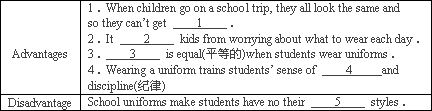
第一节 听下面的8段短对话。每段对话后有一个小题,从每小题A、B、C三个选项中选出一个最佳答案。听完每段对话后,你有10秒钟的时间来回答有关小题和阅读下一小题。每段对话只读一遍。
1.What is Jim doing?
A.He is reading.
B.He is sleeping.
C.He is drinking.
2.How will the man go to Beijing?
A.By plane
B.By train
C.By car
3.Where are the two speakers talking?
A.In a library
B.In a restaurant
C.In a shop
4.When does Bill's class begin?
A.8∶00.
B.8∶10.
C.8∶30.
5.What did Peter's mother want him to do?
A.To do homework.
B.To meet his grandma.
C.To clean the house.
6.How does Jim go to school when it is fine?
A.By bike.
B.By bus.
C.On foot.
7.Where did Fred go for vacation?
A.France.
B.Japan.
C.Britain.
8.What does the man want to be?
A.An actor.
B.A doctor.
C.A teacher.
第二节 听下面的5段对话或独白。每段对话或独白后有几个小题,从每小题A、B、C三个选项中,选出一个与你所听到的对话或独白内容相符的问题的答案。听每段对话和独白前,你都有10秒钟的时间阅读相关小题;听完后,每小题将给出5秒钟的作答时间。对话或独白读两遍。
听第一段材料,回答第9至第11小题。
9.Where does the man want to go?
A.Shanghai.
B.Beijing.
C.Hong Kong.
10.When will the man take the plane?
A.On November, 24th.
B.On October, 14th.
C.On December, 4th.
11.How many tickets does the man want?
A.Three.
B.Four.
C.Five.
听第二段材料,回答第12至第14小题。
12.How many classes for beginners are there in a week?
A.One.
B.Two.
C.Three.
13.What time does the evening class begin?
A.At 7∶30.
B.At 8∶30.
C.At 9∶30.
14.When will John probably have his piano lessons?
A.On Tuesday morning.
B.On Tuesday evening.
C.On Wednesday evening.
听第三段材料,回答第15至第17小题。
15.What's Mike going to do in London?
A.To do some shopping.
B.To see his uncle.
C.To visit some places.
16.Has Lily ever been to Beijing?
A.Yes, she has.
B.No, she hasn't.
C.We don't know.
17.Where will Lily visit?
A.The Great Wall.
B.Hong Kong.
C.Wuhan.
听第四段材料,回答第18至第20小题。
18.How often does the man run?
A.Once a week.
B.Once a day.
C.Once a month.
19.What does the man do first after he gets up?
A.He takes a shower.
B.He has breakfast.
C.He goes to school.
20.What's the man's favorite subject?
A.English.
B.Math.
C.PE.
听第五段材料,回答第21至25小题。
21.What was the husband like?
A.He was small and thin.
B.He was large and fat.
C.He was tall and strong.
22.How often did the man get his pay?
A.Once a month.
B.Once a week.
C.Once a day.
23.What was the wife doing when her husband hurried into the living room?
A.She was listening to the radio and eating apples.
B.She was watching TV and waiting for her husband.
C.She was listening to the radio and cleaning the room.
24.How did he get the ten thousand dollars?
A.He saved the money little by little.
B.He bought the lottery tickets.
C.He found the money on his way home.
25.What did his wife feel when she heard the news at first?
A.She was happy.
B.She was angry.
C.She was sad.
湖北省互联网违法和不良信息举报平台 | 网上有害信息举报专区 | 电信诈骗举报专区 | 涉历史虚无主义有害信息举报专区 | 涉企侵权举报专区
违法和不良信息举报电话:027-86699610 举报邮箱:58377363@163.com