写作
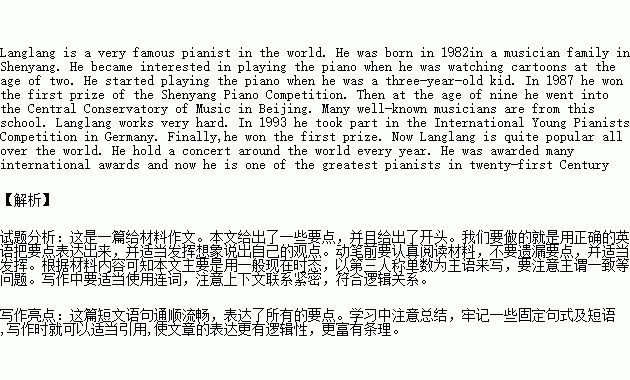
请你根据下面所给信息,写一篇介绍著名钢琴家 (pianist)郎朗的英语文章。
出生日期 | 1982年6月14日 |
出生地点 | 辽宁沈阳 |
家庭背景 | 出生于一个音乐家庭 |
成长经历 | ◆两岁时,看动画片时对钢琴产生了兴趣 ◆三岁时,正式开始学习钢琴 ◆五岁时,参加沈阳少年儿童钢琴比赛(Shenyang Children Piano Contest),获第一名; ◆九岁时,去北京学习钢琴。 |
主要成就 | ◆每年在世界各地举办音乐会; ◆被授予很多国际大奖,是21世纪最伟大的钢琴家之一。 |
要求:
1、条理清楚,语句通顺;
2、90词左右,开头已给出,不计入总词数。
Lang Lang is a famous Chinese pianist.
 名校课堂系列答案
科目:初中英语 来源:2015-2016学年湖北孝感孝南肖港镇肖港初中初一3月考英语卷(解析版) 题型:阅读理解
This is Scott. He has an interesting job. He works at a radio station. His radio show is from twelve o’clock at night to six o’clock in the morning. He sings well. He usually gets up at seven thirty at night. He brushes his teeth and takes a shower at ten past eight. Then he eats breakfast at nine. That’s a funny time for breakfast! After that , he usually exercise at about ten twenty. He goes to work by car at eleven o’clock. It takes ten minutes to get the radio station. So he is never late for work.
1.Where does Scott work?
A. train station B. bus station
C. radio station D. police station
2.Scott often ________ to the radio station.
A. takes the subway B. by bus
C. takes the car D. by subway
3.His radio show is _______________.
A. from8:00 to 12:00 in the morning.
B. from 12:00 at night to 6:00 in the morning.
C. from 13:15 to 18:25 in the afternoon
D. from 12:00 at noon to 6:oo in the afternoon
4.It takes Scott __________ minutes to get to the radio station.
A.50 B.10 C.15 D.20
5.He takes a shower at______________.
A. half past nine B. a quarter past eight.
C. eight ten D. ten to eight
查看答案和解析>>
科目:初中英语 来源:2015-2016学年广东广州番禺六校教育教学联合体初二3月考英语试卷(解析版) 题型:单项填空
_____ a cold Sunday evening, a thief broke into her house and stole a lot of money.
A. On B. In C. At D. for
查看答案和解析>>
科目:初中英语 来源:2016届云南腾冲县第五中学九年级上期第一次月考英语试卷(解析版) 题型:单项填空
When you meet a new word, you may ______ the new word in a dictionary.
A. look over B. look for
C. look up D. look after
查看答案和解析>>
科目:初中英语 来源:2016届云南腾冲县第五中学九年级上期第一次月考英语试卷(解析版) 题型:单项填空
Can you do your work with _____ money and _____ people?
A. less; few B. less; fewer C. little; less D. few; less
查看答案和解析>>
科目:初中英语 来源:2016届江苏扬州江都邵樊片九年级上期12月月考英语试卷(解析版) 题型:阅读理解
Does this ever happen to you? Someone introduces you to a friend, you hear his or her name, and then two minutes later, you forget it. Or you go to the same restaurant every day and the owner always says “Hello” to you but you can never remember her name. If this happens, you are typical— actually most people have the problem remembering names.
Here are some ways that can help people remember names.
◎ Repeat the person’s name loud at least three times while you talk together. For example, instead of saying “Nice to meet you.” say “Nice to meet you, Jack.” Instead of saying “Where do you live?” you can say “Where do you live, Jack?”
◎ Introduce the person by name to someone else right away.
◎ Write the name down as soon as possible.
There are other ways which may seem a little strange. However, try them.
◎ Think of a story using the person’s name. For example, think to yourself, “Jack has a nice jacket.” Imagine Jack in a nice jacket.
◎ Think of a rhyme(押韵)for the person's name. For example, think to yourself, “Jack would look nice in black.” Imagine Jack wearing black clothes.
All these ways have one thing in common. You must pay attention to the people you meet. You can’t just meet someone, nod your head, say hello, and walk away. Remembering names takes work and practice.
1.The word “typical” probably means “______”.
A. funny B. common C. strange D. careless
2.Which of the following may seem unusual to help remember a name?
A. Repeating the name.
B. Writing the name down.
C. Making up a story with it.
D. Introducing the person to others.
3.If you want to remember names easily, you must ______.
A. look after the people you meet
B. pay attention to the people you meet
C. nod your head to the people you meet
D. talk politely to the people you meet
4.The passage probably comes from ___________.
A. A science magazine. B. A boy’s diary
C. A story book. D. A community survey.
查看答案和解析>>
科目:初中英语 来源:2016届江苏扬州江都邵樊片九年级上期12月月考英语试卷(解析版) 题型:单项填空
It’s always bad news that the war between two countries _________.
A. comes out B. puts out
C. works out D. breaks out
查看答案和解析>>
科目:初中英语 来源:2015-2016学年浙江临海市七年级上期末考试英语试卷(解析版) 题型:其他题
任务型阅读,阅读下面的对话,将五门科目的字母序号填入1-10的空格中,完成课程表。
Susan: I’m really busy this term.
Linda: How many classes do you have every day?
Susan: Six.
Linda: Do you have English lessons every day?
Susan: Sure. We have five English classes in a week.
Linda: Do you have an art lesson?
Susan: Yes, it’s on Wednesday.
Linda: When do you have P.E.?
Susan: On Tuesday and Thursday.
Linda: What’s your favorite day?
Susan: My favorite day is Friday, because I have music and handwork(手工).
But I don’t like Thursday.
Linda: Why don’t you like it?
Susan: Because I have two science lessons. Science is too difficult for me.
A. English B. Science C. Art D. P.E. E. Music | |||||
Item | Monday | Tuesday | Wednesday | Thursday | Friday |
1 | 1. | Math | Chinese | Science | Chinese |
2 | Math | English | Science | Math | History |
3 | Chinese | History | English | Chinese | English |
4 | Geography | Chinese | 2. | English | Math |
Lunch Time | |||||
5 | Science | Geography | Math | 3. | 4. |
6 | History | 5. | Computer | P.E. | Handwork |
查看答案和解析>>
科目:初中英语 来源:2015-2016学年江苏靖江市八年级上期末考试英语试卷(解析版) 题型:其他题
阅读短文,根据短文内容回答问题。
The kangaroo is the world’s largest living marsupial (有袋动物).It was first found on the island of southwestern Australia.The animal was given its name by a famous English tourist in the 18th century.
The kangaroo may be 7 feet(2.1m) tall when standing upright and the male can weigh as heavy as 200 pounds(90kg).The female (雌性) is smaller and lighter than the male.The kangaroo’s head is small, but its ears are large, and its fore feet are really small.The animal has strong back legs and long tail.
The kangaroo usually covers from 5 to 10 feet(1.5 to 3m) with each jump.The female is usually faster than the male.The mother kangaroo has a pouch (育儿袋) in its abdomen (腹部).The baby kangaroo grows up in the mother’s pouch slowly.
The kangaroo lives on grass and other plants.It is always moving from one place to another, lying down to sleep on the ground during the night.It likes to enjoy the warm sunshine.When it’s in danger, it can use its back legs and strong tail to protect itself.Answer the following questions with No more than 6 words.
1.Who gave the kangaroo its name in the 18th century?
答:____________________________________________________________________________
2.Which kind of kangaroo looks smaller and lighter, the male kangaroo or the female kangaroo?
答:____________________________________________________________________________
3.Where does the baby kangaroo grow up?
答:____________________________________________________________________________
4.What does the kangaroo eat?
答:____________________________________________________________________________
5.What does the kangaroo use to protect itself in danger?
答:____________________________________________________________________________
查看答案和解析>>
湖北省互联网违法和不良信息举报平台 | 网上有害信息举报专区 | 电信诈骗举报专区 | 涉历史虚无主义有害信息举报专区 | 涉企侵权举报专区
违法和不良信息举报电话:027-86699610 举报邮箱:58377363@163.com