
【题目】英语课上,老师要求同桌同学相互修改作文。假设以下书信为你同桌所写,请你对其进行修改。文中共有10处错误,每句中最多有两处。错误涉及一个单词的增加、删除或修改。
增加:在缺词处加一个漏词符号(∧),并在此符号下面写出该加的词。
删除:把多余的词用斜线(\)划掉。
修改:在错的词下划一横线,并在该词下面写出修改后的词。
注意: 1、每处错误及其修改均仅限一词;
2、只允许修改10处,多者(从第11处起)不计分。
During the Renaissance, painters tried to paint people and nature as they real were. Rich people paid famous artists to paint pictures of them, their houses and possessions as well as their activities and achievements. One of the most important discovery during this period was how to draw things with perspective. This technique was first used by Masaccio in 1428. When people first saw his paintings, they convinced that they were looking through a hole in a wall at a real scene. If the rules of perspective have not been discovered, no one would have been able to paint such the realistic pictures. By coincidence, oil paints were also developed at this time, that made the colours used in paintings look rich and deeper. Without the new paints and the new technique, we will not be able to see the great masterpieces for which this period is famous.
【答案】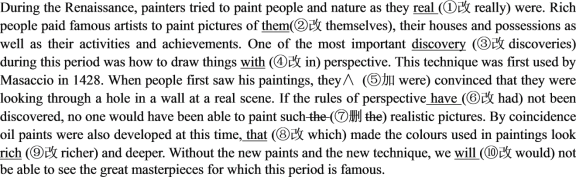
【解析】
这是一篇记叙文。文章讲述了文艺复兴时期绘画艺术的发展以及这种发展对现在的影响。
1.考查副词。句意:在文艺复兴时期,画家们试图把人和自然真实地描绘出来。分析句子,此处应将形容词real改为副词really以修饰动词paint。故将real改为really。
2.考查反身代词。句意:富人付钱给著名的艺术家,让他们为自己、他们的房子、财产以及他们的活动和成就画像。分析句意,此处应该表示,为他们自己画像。故应用反身代词。故将them改为themselves。
3.考查名词的复数。句意:这一时期最重要的发现之一是如何用透视法绘画。One of译为:其中之一。和one of 连用的名词应该用复数。故将discovery 改为discoveries。
4.考查固定短语。in perspective译为“用透视法”。故将with改为in。
5. 考查固定短语。句意:当人们第一次看到他的画时,他们相信他们是透过墙上的一个洞在看一个真实的场景。be convinced that相信,确信,信服。是固定表达。又因为文章整体时态是过去时。故在convinced 前加were。
6.考查虚拟语气。句意:如果没有发现透视法,就没有人能画出如此逼真的画。这是一个非真实条件句。根据非真实条件句虚拟的要求:若表达和过去相反,主句应该用would / should / could / might +have done而从句应该用had done(过去完成时)表示。故将have改为had。
7.考查冠词。realistic pictures中的pictures已经加了“s”了,且这边表示泛指。不需要在前加the。故将the去掉。
8.考查非限制性定语从句。句意:巧合的是,油彩也是在这个时候发展起来的,这使得绘画中使用的颜色看起来更加丰富和深沉。分析句子,逗号后面的从句为非限制性定语从句。而that不能引导非限制性定从。故将that改为which。
9.考查形容词的比较级。分析句子,and deeper后面的deep用了形容词的比较级。根据and前后级别一致,故rich也应用比较级。故将rich改为richer。
10.考查含蓄条件句的虚拟。句意:没有新的颜料和新的技术,我们就不能看到这一时期著名的杰作。分析句子,without译为“如果没有”后面的句子常用含蓄条件句的虚拟。根据句意,此处应表达和现在相反的虚拟,故应该用would / should / could / might +do 表示虚拟。故将will改为would。

科目:高中英语 来源: 题型:
【题目】 阅读下列短文,从每题所给的四个选项(A、B、C和D)中,选出最佳选项,并在答题卡上将该项涂黑。
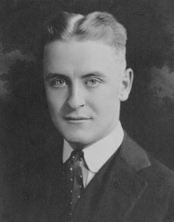
F . Scott Fitzgerald, born on September 24,1896, an American novelist, w as once a student of St.Paul Academy, the Newman School and attended Princeton. University for a short while. In 1917 he joined the army and was posted in Alabama, where he met his future wife Zelda Sayre. Then he had to make some money to impress her.
His life with her was full of great happiness, as he wrote in his diary :“ My own happiness in the past often approached such joy that I could share it even with the person dearest to me but had to walk it away in quiet streets and take down parts of it in my diary.”
This side of paradise, his first novel, was published in 1920. encouraged by its success, Fitzgerald began to devote more time to his writing. Then he continued with the novel the Beautiful and Damned (1922), a collection of short stories Thales of the Jazz Age (1922), and a play The Vegetable (1923). But his greatest success was The Great Gatsby, published in 1925,which quick brought him praise from the literary world. Yet it failed to give him the needed financial security. Then, in 1926, he published another collection lf short stories All the Sad Young Men.
However, Fitzgerald’s problems with his wife Zelda affected his writing. During the 1920s he tried to reorder his life, but failed. By 1930, his wife had her first breakdown and went to a Swiss clinic. During this period he completed novels Tender Is the Night in 1934 and The love of the last Tycoon in 1940. while his wife was in hospital in the United States, he got totally addicted to alcohol. Sheila Graham, his dear friend, helped him fight his alcoholism.
56. How many novels written by Fitzgerald are mentioned in the passage ?
A. 5 B. 6 C. 7 D. 8
57. Which of the following is the correct order to describe Fitzgerald’s life according to the passage?
a. He became addicted to drinking.
b. He studied at St.Paul Academy.
c. He published his first novel This Side of Paradise.
d. The Great Gatsby won high praise.
e. He failed to reorder his life.
f. He joined the army and met Zelda.
A.f-c-e-a-b-d B. b-e-a-f-c-d C. f-d-e-c-b-a D. b-f-c-d-e-a
58. We can infer from the passage that Fitzgerald .
A. had made some money when he met Zelda in Alabama.
B. was well educated and well off before he served in the army
C. would have completed more works if his wife hadn’t broken down
D. helped his friend get rid of drinking while his wife was in hospital
59. The passage is probably followed by a concluding paragraph about .
A. Zelda’s personal life
B. Zelda’s illness and treatment
C. Fitzgerald’s friendship with Graham
D. Fitzgerald’s contributions to the literary world
查看答案和解析>>
科目:高中英语 来源: 题型:
【题目】基础知识考查

【1】I __________ for being late.
【2】Many experts __________rewarding your child for good behaviour.
【3】Getting a visa isn't as simple as you might _________.
【4】Government troops were forced to ________ .
【5】I did not __________ that he had done anything wrong.
查看答案和解析>>
科目:高中英语 来源: 题型:
【题目】We should know that we can only reach the top if we are ready to ____ and learn from failure.
A.deal with B.depend on C.carry on D.go with
查看答案和解析>>
科目:高中英语 来源: 题型:
【题目】阅读每个小题,从方框内选择正确的短语,将其适当形式填入空白处。

【1】I _______________ a few words of Greek when I was there last year.
【2】The idea that robots _____________ any labor tasks is broadly true in theory.
【3】The boy who fell into the river wouldn’t have died if the young man ____________ .
【4】Research is now being undertaken ____________ an explanation for the phenomenon.
【5】Opportunities and success tend _____________ those people who are always prepared.
【6】Please put these lecture notes in order and don't leave them______________ next time.
【7】Many women of normal weight feel unable ___________the super-thin models in fancy clothes in various fashion magazines.
【8】As I was listening to the radio, a song ____________ such fond memories of my childhood, when I was raised by my grandparents in the countryside.
【9】We __________ to paint our new apartment quite early in the morning, in hope of finishing painting all rooms in one day. But we ended up finishing 2 at late night.
【10】According to a press conference held in Beijing on Wednesday, Chinese scientists announced that they ________ in developing a Coronavirus vaccine, and that they would conduct animal trials to test the feasibility and safety of it at the end of May.
查看答案和解析>>
科目:高中英语 来源: 题型:
【题目】__________ the bad weather we enjoyed our holiday very much.
A. As a result of B. In spite of
C. Because of D. According to
查看答案和解析>>
科目:高中英语 来源: 题型:
【题目】
Attitudes toward new technologies often fall along generational lines. That is, generally, younger people tend to 【1】 older people on the front end of a technological shift.
It is not always the case, though. When you look at attitudes toward driverless cars, there doesn't seem to be a clear 【2】 divide. The public overall is split on whether they'd like to use a driverless car. In a study last year, of all people surveyed, 48 percent said they wanted to ride in one, while 50 percent did not.
The fact that attitudes toward self-driving cars appear to be so 【3】 across generations suggests how transformative the shift to driverless cars could be. Not everyone wants a driverless car now-and no one can get one vet-but among those who are open to them, every age group is 【4】 engaged.
Actually, this isn't surprising. Whereas older generations are sometimes reluctant to adopt new technologies, driverless cars 【5】 real value to these age groups, especially to those with 【6】 mobility or difficulty driving on their own.
This is especially interesting when you consider that younger people are generally more interested in travel-related 【7】 than older ones.
When it comes to driverless cars, differences in attitude are more 【8】 based on factors not related to age. College graduates, for example, are particularly interested in driverless cars compared with those who have less education:59 percent of college graduates said they would like to use a driverless car compared with 38 percent of those with a high-school diploma or less.
Where a person lives 【9】 too. More people who lived in cities and suburbs said they wanted to try driverless cars than those who lived in rural areas.
While there's reason to believe that interest in self-driving cars is going up across the board, a person's age will have little to do with how self-driving cars can become 【10】. Once driverless cars are actually available for sale, the early adopters will be the people who can afford to buy them.
查看答案和解析>>
科目:高中英语 来源: 题型:
【题目】The man was charged ____________ the crime of betraying his country and sentenced ________ ten years in prison.
A. for; to B. with; for
C. of; for D. with; to
查看答案和解析>>
科目:高中英语 来源: 题型:
【题目】_____ all my money on the car, I can’t afford a holiday with my friend this summer.
A. Spending B. Spend
C. To spend D. Having spent
查看答案和解析>>
湖北省互联网违法和不良信息举报平台 | 网上有害信息举报专区 | 电信诈骗举报专区 | 涉历史虚无主义有害信息举报专区 | 涉企侵权举报专区
违法和不良信息举报电话:027-86699610 举报邮箱:58377363@163.com