
| A.our values and lifestyles are in no field of human activity |
| B.the clothes that we choose to wear have something to do with our values and lifestyles |
| C.our values and lifestyles are from the sign language |
| D.the clothes we choose to wear depend on a set of information and immediate impression |
| A.men cared very much for clothes |
| B.women were concerned greatly about what they wore while men didn’t |
| C.both men and women paid great attention to their clothes |
| D.neither men nor women showed interest in clothes |
| A.they are concerned about the impression their clothes make on their superiors |
| B.they know very clearly that people will judge them on the basis of their clothing |
| C.they want to impress and influence others |
| D.they don’t want to be laughed at |
| A.Men thought the value of clothing in daily life was very important. |
| B.Men didn’t pay attention to the importance of the value of clothing in daily life. |
| C.Men thought little of the importance of the value of clothing in daily life. |
| D.Men were concerned little about the value of clothing in daily life. |
| A.now men pay more attention to their clothes than women do |
| B.women always like beautiful dresses |
| C.people have paid more and more attention to the importance of dress |
| D.American culture is changing greatly |

 阅读快车系列答案
科目:高中英语 来源:不详 题型:阅读理解
| A.Women were braver than men in World War Ⅱ. |
| B.Women and men made equal contributions in World War Ⅱ. |
| C.Women played a significant role in World War Ⅱ. |
| D.Women’s death rate was high in World War Ⅱ. |
| A.Tatiana Baramzina. |
| B.Anne Frank. |
| C.Margaret Ringenberg. |
| D.Hannah Szenes. |
| A.Tatiana Baramzina and Anne Frank. |
| B.Hannah Szenes and Tatiana Baramzina. |
| C.Anne Frank and Margaret Ringenberg. |
| D.Margaret Ringenberg and Hannah Szenes. |
| A.Tatiana Baramzina was once a flight instructor |
| B.Margaret Ringenberg was the best at writing about the war experiences |
| C.Anne Frank and her family were arrested by Germans in 1944 |
| D.Hannah Szenes was arrested by Germans because of her diary |
查看答案和解析>>
科目:高中英语 来源:不详 题型:阅读理解
| A.Do not bad mouth me. |
| B.Stop mouthing off. |
| C.Do not put words in my mouth. |
| D.I really put my foot in my mouth this time. |
| A.he is badlyoff | B.he is hardworking |
| C.he has lots of money | D.he has enough to eat |
| A.I have run a long way |
| B.I have talked too much |
| C.I have learned a lot |
| D.I have been a mouthy person |
| A.Expressions about the word “mouth”. |
| B.Functions of the organ “mouth”. |
| C.Opinions about “mouthy people”. |
| D.Meanings of the word “mouth”. |
查看答案和解析>>
科目:高中英语 来源:不详 题型:阅读理解
| A.the theatres would be overcrowded |
| B.it would be a waste of money |
| C.pensioners wouldn’t get free tickets |
| D.the government wouldn’t be able to afford it |
| A.benefit the television industry |
| B.focus on producing better plays |
| C.help increase the sales of tickets |
| D.involve all the young people in England |
| A.Ninety-five theatres have received funding. |
| B.Everyone will get at least one free ticket. |
| C.It may not benefit all the young people. |
| D.Free tickets are offered once every day. |
| A.many plays are not for young people |
| B.many young people don’t like theatre |
| C.people know little about the plan |
| D.children used to receive good arts education |
| A.controversial | B.inspiring | C.exciting | D.unreasonable |
查看答案和解析>>
科目:高中英语 来源:不详 题型:阅读理解
| A.sometimes the third Saturday in October |
| B.hardly celebrated in Detroit |
| C.of equal importance in every part of the USA |
| D.getting increasingly popular in the USA |
| A.the young and disabled |
| B.friends and relatives |
| C.orphans and shutins |
| D.the sick and aged |
| A.Detroit | B.Cleveland |
| C.Buffalo | D.Washington |
| A.we care | B.we admire |
| C.in need of help | D.in trouble |
查看答案和解析>>
科目:高中英语 来源:不详 题型:阅读理解
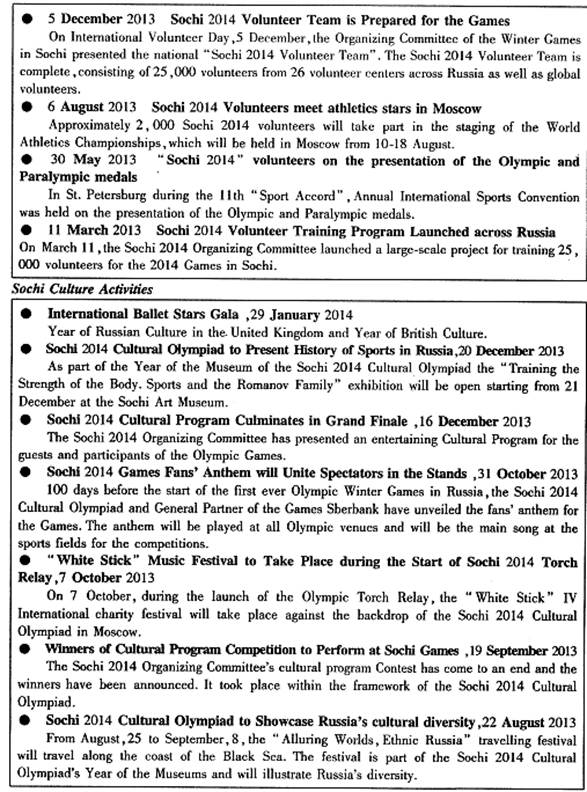
| A.30 May 2013 | B.11 March 2013 | C.16 December 2013 | D.19 September 2013 |
| A.Sochi | B.St. Petersburg |
| C.the United Kingdom | D.Moscow |
| A.The 25 ,000 volunteers were from Russia. |
| B.Winners of Cultural Program Competition weren't known until 19 September 2013. |
| C.From August,25 to September,8,you were able to enjoy Winter Games in Sochi. |
| D.Few of the cultural activities were intended for creating atmosphere of Sochi Winter Games. |
| A.importance | B.place | C.date | D.name |
查看答案和解析>>
科目:高中英语 来源:不详 题型:阅读理解
| A.covered | B.surrounded |
| C.separated | D.guarded |
| A.Because it changes its policy and begins to open up. |
| B.Because it uses “GNH” to measure its achievement. |
| C.Because it stresses both material and spiritual development. |
| D.Because it has the second fastest growing GDP in the world. |
| A.The election in Bhutan is far from satisfactory. |
| B.Globalization has influenced Bhutan’s religion. |
| C.Jigme’s educational background will cause distrust. |
| D.People in Bhutan will continue living a happy life. |

查看答案和解析>>
科目:高中英语 来源:不详 题型:阅读理解
| A.too many French moved to Britain |
| B.French brought animals with them |
| C.the king and his officials spoke French |
| D.the king allowed French to be spoken |
| A.Chose | B.Kept | C.Introduced | D.Give up |
| A.Because English and French share similar pronunciations. |
| B.Because English grammar and French grammar are similar. |
| C.Because a large number of English words have French origins. |
| D.Because English has great influences on the French language. |
| A.no words have the same pronunciation |
| B.all words have the same pronunciation |
| C.English nouns have a male or female gender |
| D.French nouns have different adjective forms |
| A.Language is closely related to history and culture. |
| B.French and English words have nothing in common. |
| C.Language is controlled by the upper classes of society. |
| D.English combines French and the Native Anglo-Saxon. |
查看答案和解析>>
科目:高中英语 来源:不详 题型:阅读理解
| A.The amount of wealth | B.The amount of money |
| C.The social status | D.The way of getting money |
| A.Officials and employees. | B.Peasants and farmers. |
| C.Doctors and teachers. | D.Tradesmen and landlords. |
| A.They were still the upper class people. |
| B.They were owners of large factories. |
| C.They were intelligent industrialists. |
| D.They were skilled workers who made their fortune. |
| A.They saved a lot of money for their children to receive higher education. |
| B.They tried to find marriage partners from the children of the upper class. |
| C.They made greater fortunes by their wits. |
| D.They worked even harder to acquire social training. |
| A.increased income and decreased taxation |
| B.taxation, social services and educational opportunities |
| C.education, the increase of income and industrial development |
| D.the decrease of the upper class population |
查看答案和解析>>
湖北省互联网违法和不良信息举报平台 | 网上有害信息举报专区 | 电信诈骗举报专区 | 涉历史虚无主义有害信息举报专区 | 涉企侵权举报专区
违法和不良信息举报电话:027-86699610 举报邮箱:58377363@163.com